

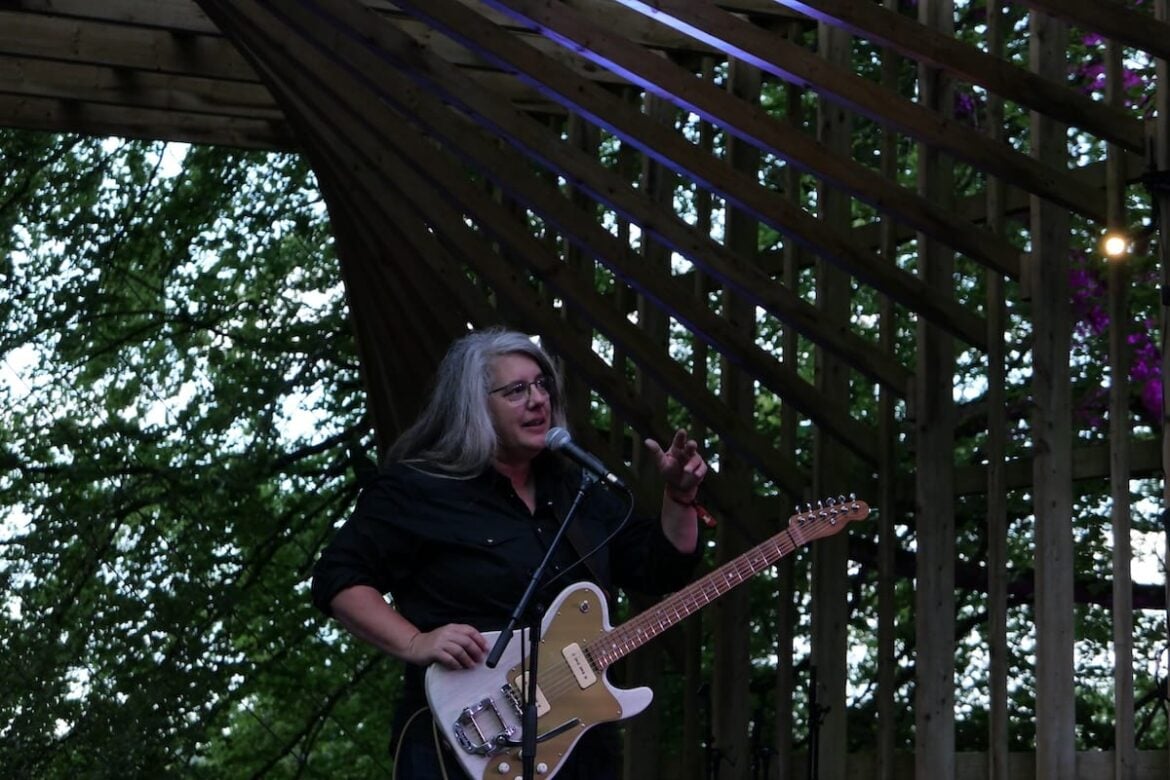
I am ushered in to meet Marisa Anderson in the artists’ compound behind End Of The Road’s Garden Stage, looking intense and very much like an artist getting ready to perform on the Talking Heads stage in less than an hour. It can make an interviewer feel a little like an unwelcome intruder, rocking up armed with a bunch of questions in what should be a private, thought-gathering moment, but as soon as I am introduced as from KLOF Magazine, the body language is welcoming. “Oh, KLOF have been doing a really good job of covering the new record”, she informs me (reviewed here). “I am really grateful for that. I like the magazine; I wish I could get it in the States as a paper copy or something. You all over here are doing such a good job, I mean KLOF and Songlines are so good, we don’t really have that in the US.” That, by any interviewer’s measure, has to be called pretty encouraging feedback; the following conversation was up against the ticking clock of impending stage time, but I was equally gratified by the attention and effort Marisa gave to these answers:
Is this your first End Of The Road? What do you look for in a festival as a performer and a punter?
Yes, it’s my first; I’ve never played this one before. I’m only ever at a festival if I am playing it or visiting someone I know who’s playing. Sometimes a friend will be like, “Hey, I’m over there, I’ll get you a pass.” I like music, but I’m like, if I hear one thing I can cruise with that for days, you know? Festivals are overwhelming to me.
Do you bring a different approach for a festival than when you’re playing a standard gig?
Yeah, sure, because if I’m playing a standard gig, I know that those people bought tickets specifically to see me; there’s a context I can assume, and there’s a reason that we are both there, whereas at a festival, people are coming by, trying to catch up; they’re coming by because they are curious, so it’s a little bit of a different approach, yes.
Before you put together your ‘Anthology Of Unamerican Folk Music’, you had the opportunity to explore Harry Smith’s private record collection. I’m curious to know how that came about.
Yes, Harry Smith’s final record collection is stored at the Bob Dylan Centre in Tulsa, Oklahoma. I was playing a gig in Tulsa, and I was invited to check out the Bob Dylan Centre, and a friend told me he had heard Harry’s personal records were there. So, the director of the museum, who was showing me around, was like, “well what do you think?” I said, “I heard you have Harry Smith’s records?” He was kind enough to let me look at them for fifteen minutes, and then I just started pushing on a series of doors that were slightly ajar until they were all open, and I got a residency and was able to download them. Yeah, I just kind of talked my way in, I suppose.
And this is a different collection from the famous one that formed the original ‘Anthology Of American Folk Music’?
Yes, it’s 100% different because all of these records are his final collection; he died in the nineties. The records that he used to make the ‘Anthology Of American Folk Music,’ which came out in 1952, were pre-war 78s; those were long gone from his life. He was notoriously a person who did not keep a lot of belongings. Most of these records are from the seventies and eighties; they are mostly LPs, they are not 78s or collectables in that sense.
Was there a theme to what he was collecting, or was it just a random selection of interesting things?
Not so random, but, as you could expect, there was American blues, jazz, country, gospel; there was a big stack of native American records and then there were records from all over the world, these ethnographic kind of field recordings, anthologies and compilations and that’s what I was interested in.
Other than music from places the US has been in conflict with since 1970, what were you looking for in the pieces that you selected to play?
I was looking for, first, if they were possible (laughs), if I could pull it off. There were a lot of dead ends, a lot of pieces where I got halfway down the road and felt right, this isn’t for now. So I was looking to see if it was possible; I was looking for variety, and I wanted distribution across countries and regions. I was looking for variety among the original instruments played on the source recordings; some were based on vocal pieces, some on whistles, some on strings. I wanted variety in that.
Were there things that you found made you push against your own musical instincts?
Oh yes, in every single piece. That was kind of the point too, you know?
So, were there spaces that you left for improvisation?
I chose not to leave that space; I chose to stay pretty close to the source material because I wanted to learn from the material rather than impose myself on it.
I asked because I noticed there was some jazz in your background; I mean, how much of a jazzer were you?
For about six years I was in a jazz band called the Evolutionary Jass Band; it was jazz in the sense of like, Albert Ayler, you know? Some of it was free, some of it was sort of free. I know my way around some chord progressions and stuff, but I don’t think or play from a jazz-influenced place. My technique is a classical technique, and my roots are in folk music, and I apply the freedom of jazz to both of those musics.
When did you commit your life to music? Would you say there was a defining moment when you knew this was what you were going to do?
I don’t know; I’ve been playing music since I was seven years old, so I was never not playing music.
And you spent a decade travelling; does that experience feed into your strength today?
Oh yeah, I mean, whoever we were in our twenties influences who we are today, right? If you went to university or worked a job, hitchhiked around the world or whatever, that’s the information that you have to work with moving forward. As well as the choices that you did not make- the choices not to go to university, not to get whatever kind of job, not to do a lot of the things that people my age did choose to do so that influenced me as well: what you do and what you don’t do. I used to work a factory job overnight to get enough money to keep travelling, so every couple of months I had to find a factory to work in for a week or two. Standing up on a factory line for twelve hours on an overnight shift teaches you quickly what you don’t want to do with your life.
Given the discontent with the current US administration, do you see much potency in folk music today as protest music, as it was sixty or so years ago? Do you hear much protest folk around?
Protest folk? I’m not sure that is a phrase I would particularly use because that doesn’t fall into my definition of folk music, which is maybe a little more specific.
So, would you say that you cannot bring activism into wordless music?
Oh, I would never say that. You absolutely can bring activism into wordless music, and I feel like I do that, but there’s something about the phrase ‘protest folk’ that sounds like a record bin! Going through the things at the record store, that is not a label that resonates for me.
I ask because there are particularly difficult times in the US. Is there a reaction to that in the folk movement?
I hope there’s a reaction to that in all movements amongst all people; I think it’s everybody’s responsibility to do and say what they can in this machine. On the other hand, there is also a pretty large body of work that talks about folk culture and the rise of nationalism as being linked, so that’s another reason why I can’t just jump into the phrase.
When you are in the studio, in your creative space, is there an elusive sound that you are still striving for?
That’s a good question, and probably the answer is yes, but I won’t know it until I make it.
With your recording process, you do a lot (not always) of your own engineering; what does that give you that outsourcing it to another person would not?
Well, privacy in the process. A lot of pieces are recorded and composed at the same time, so it’s kind of this back and forth, and back and forth and back and forth with the recording, and that’s a really personal process. So, there’s that, and there’s the economics of it of course, when the clock is ticking on the studio you are paying for by the hour, by the day, it defines the process in a way that is sometimes helpful and other times not helpful. I go back and forth, particularly when I want to do something that is really good, but it’s acoustic; I’ll pay someone to do that because it’s super hard to engineer on your own. But with electric stuff, if I can make a good sound from my amp and throw some good microphones on it, it’s just a guitar; it’s not rocket science.
And when you work in pairs, such as with Jim White or William Tyler, what are you looking for in a collaborator?
First of all, can it be fun? Am I going to learn something? (Ponders if there is anything else). No, I think they’re the main ones; I like both of those things.
Is there a musical ancestor, I mean possibly someone like Harry Smith, who you feel you and your work are in conversation with?
That’s a good question too. (A long pause for thought). You are going to have to get back to me on that one.
Well, I can give you a moment…
No, I would need a lot longer than that. I like that question (laughs)
OK, well, where do we find you today in terms of future plans? Is there anything you are currently working on that you would like to share?
Yes, well… I feel like there is a lot coming up, but what can I share? I just did my first ever art piece. It was a collaboration with an artist called Patricia Vazquez Gomez in Portland, and we did an installation that’s part of a show called Converge 45 Triennial. We did this art piece that’s going to be up until December that uses her work with the Mayan language. She works with the Mayan community and does a lot of things around language, so we built these pieces together that work as a tonal language, so you can make music with it. I worked with her to create four immersive audio pieces that are installed in a listening environment. I’m really happy about that and excited to be able to do more work like that. The opening just happened, which is why I’m excited to talk about it. There are a couple of other things happening but it’s too early to talk about them yet.
What is currently inspiring you in music?
I’m just always inspired by playing guitar; any time that I can play, that’s it.
How about your earliest influences?
My earliest influences are like church music, Doc Watson, Bach…that’s the stuff that I was raised on.
And finally, is there anyone here at End Of The Road you would like to see perform?
Yes, I’m excited about ØXN; that was the one on the list that I was like, “Oh yes.”