
Earlier this month, Darren Hayman released I’m Your Team via Audio Antihero. In his album review, Thomas Blake notes: “He has the enviable talent of writing extremely clever songs which always come from the heart, and he’s been doing it consistently and prolifically for thirty years.” He concludes: “I’m Your Team sees him at his most undiluted and emotionally stark, delivering some of the best songs of his career.”
Hayman’s creative passions don’t stop at music. He attended Maidstone College of Art in 1989 and earned a degree in illustration. While his passion for art has never abated, he began painting in earnest in 2015, creating watercolour postcards for friends and later selling them via his Darren Hayman Art website: https://darrenhaymanart.com. In his bio, he shares how, during the 2021 lockdown, “I decided to make a concerted effort to become a painter of light. It was the first time I made a conscious effort to dig deeper and become a much better painter.”
The ever-busy Audio Antihero recently started working with Darren to fill the digital gaps in his incredible back catalogue (visit Darren’s Bandcamp here: https://darrenhayman.bandcamp.com/). They thought it would be interesting to present these two worlds together. They weren’t wrong; Darren’s article is full of interesting detail and observations, and it offers fascinating insight into two worlds: one where people are ever-present, and one where they are absent.
Enjoy
When I was young, I wanted to be a comic artist, so I went to art college. When I got to art college, I realised that comic artists didn’t really go to art college. I saw Billy Bragg, and it was the first time I’d heard someone singing in my accent. I bought a guitar off of my friend Graham the next day. Maybe I’d be a musician instead.
Art college both enlightened and confused me. My fellow students wanted to be proper artists, so I pretended I wanted to as well. Everyone seemed to know more than me about art and music. I got lent records by the Velvet Underground, Cardiacs, and Crass and found it natural to start writing songs myself.
I’m a late developer and a slow learner. I wrote bad songs for at least five years and was one of the least inspiring artists amongst my friends when we graduated. I also knew I wasn’t really able to do anything else.
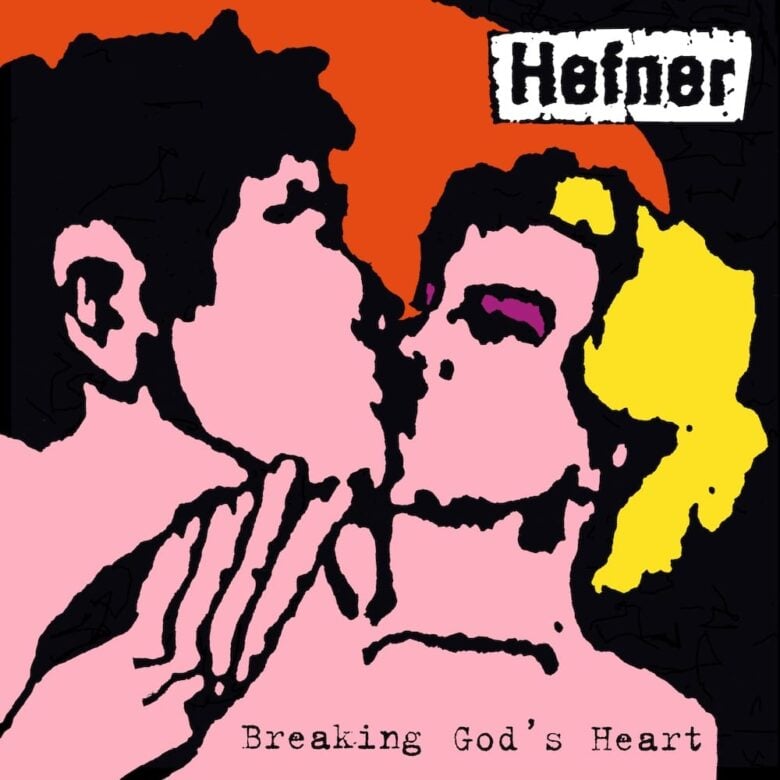
I got this idea stuck in my head that good musicians were young and successful artists were old, and decided to prioritise my band, Hefner. Hefner got signed, made four albums, were played on the radio and toured the world. I still wasn’t sure I was that good at writing songs, but I was getting better. Hefner had cover art designed by me, which proved popular with fans. I would steal and manipulate clip art and comics into pop art images. It had no relation to my earlier painting style, but I was very keen that there was a visual identity to my band. It mattered to me that the records belonged together.
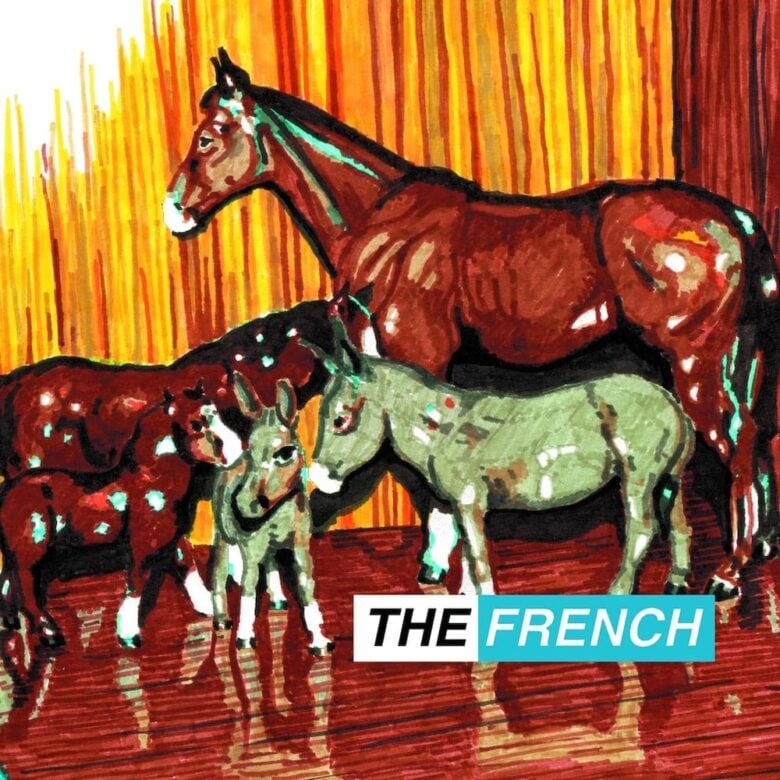
After Hefner, my next band, The French, and subsequent solo records had a much more analogue approach, and I started to become interested in the art mediums of my childhood, like felt-tip pens and coloured pencils.
When I was studying art, one tutor in particular had a huge influence on me, an influence I didn’t properly acknowledge until much later in life. He had a series of lessons that imposed rules and restrictions on us; one week he had us tie bags of flour to our arms to make our arms tired as we painted at our easels. The idea being, perhaps, to make us paint less and look more. Another week he made us move one easel to the right every five minutes so that by the end of the lesson we had 20 pictures produced collaboratively by all the students.
During my solo career, my records became more and more conceptual in terms of lyrics and content, but I also relied on rules and restrictions in order to find more interesting music.
‘Local Information’ used only monophonic electronic instruments, and the only thing to be recorded by a microphone was the voice.
‘Essex Arms’ had the opposite restriction in that everything had to be recorded on acoustic instruments via microphones.
‘Home Time’ was recorded entirely on an eight-track.
I had found out about Brian Eno and his Oblique Strategies cards, a set of cards with rules to be distributed to musicians to provide inspiration in the studio. I enjoyed discovering this, and it made me feel more confident in using similar ideas.
For the past fifteen years, painting has steadily returned to my life. To the extent that it now makes up more than half my income, and I might sometimes describe myself as an artist before a musician. My plan of being a young musician and an old artist might be coming true.
Music has a more manic and urgent priority in my mind than art. With music, I think there’s a possibility I could be really great at it and make something really important to some people. With drawing and painting, I can sit more comfortably with my abilities, and the process itself does something good for me. Drawing makes my heart rate slower, whilst music makes it go faster.
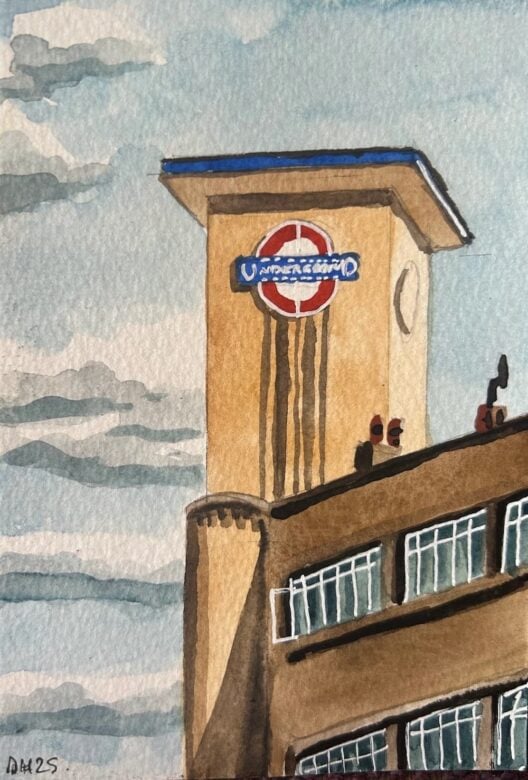
Lately I’ve been considering how I could become better at drawing and painting without losing the calming effects it has on me. A few years ago I stopped using the line and started painting light and how it falls on things. Objects in real life don’t have a pen outline; we detect the edge of things by a change in light or colour. Up until this point, I had been essentially colouring in drawings, an influence from comic art.
In my lyrics, despite the many themes I place upon my albums, I am almost always singing about people – what they say and think when they’re lonely or in love. My songs focus on fear, longing and ennui. I like language, and I’m trying to find the words we use to describe ourselves that don’t often appear in music.
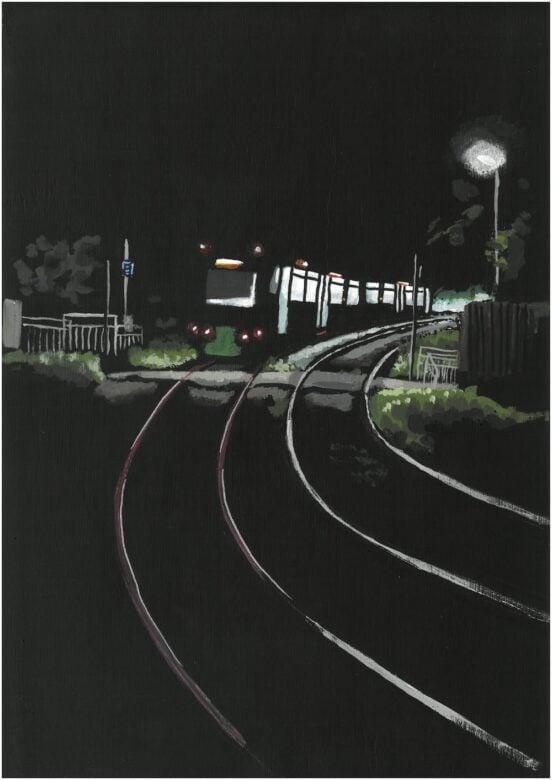
In my paintings, people don’t feature at all. Even when I paint London scenes, I take all the people out so that everything looks deserted. It is, perhaps, painting another kind of loneliness, or maybe some people’s idea of a utopia. I also think to paint human beings well, to make them convincing, is a lifetime’s work for an artist and beyond me. I don’t wish to be a realist painter, but I want my images to at least convince, and I don’t believe I could convince you of a human being with my paintbrush.
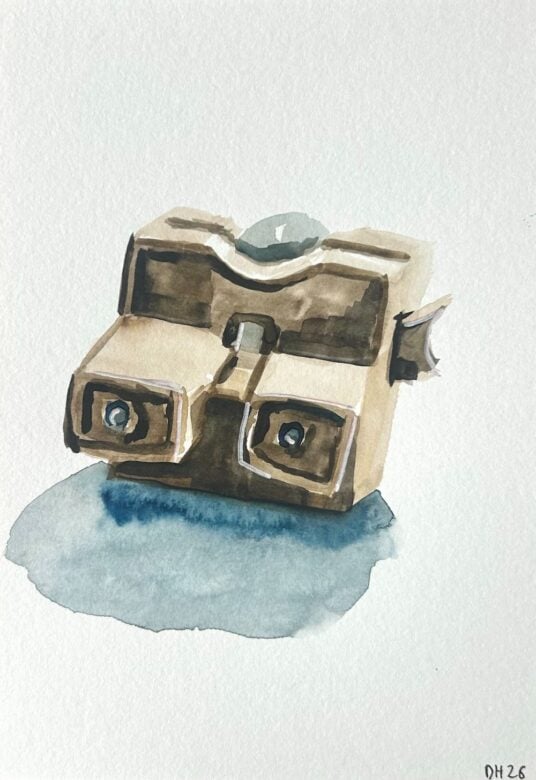
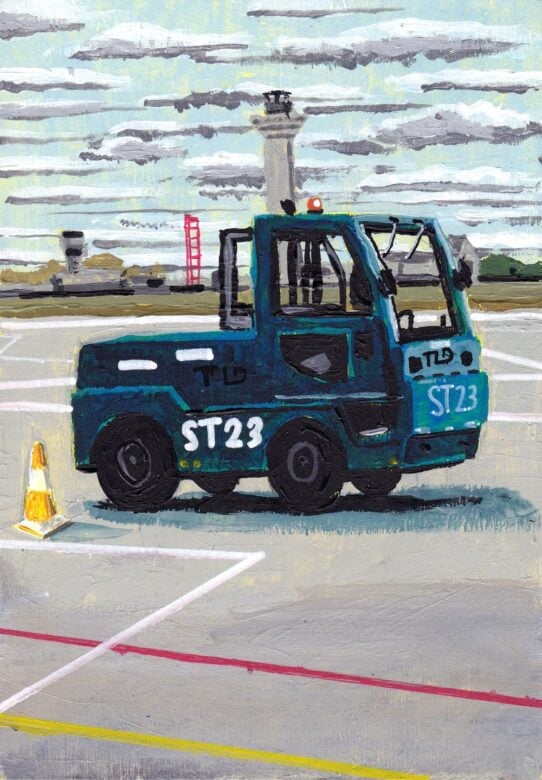
I often paint trains, stations, airport vehicles, small toys and familiar objects. There’s something comfortingly childish about my subject matter; they are solid, dependable things in a shifting, uncertain world. In fact, ‘solid’ is a good word for how I’d like my art to develop, not ‘better’ or more ‘real’, but more solid and safe.
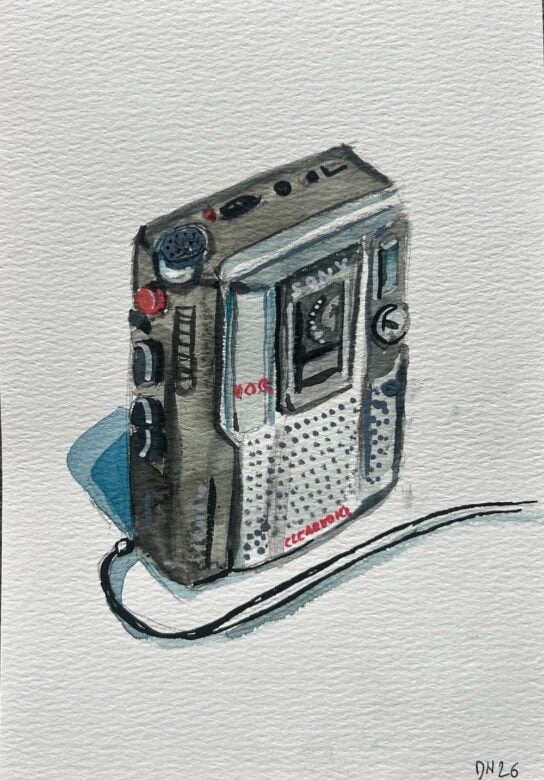
My songs are strong on narrative and are rarely elliptical or metaphoric. I like to be clear. I think there are stories in my paintings too, even if it’s only ‘What is this object? Who loves it? Why is it here?’ During the lockdown, I became interested in the lights inside houses. They represented safety and solitude, and I thought I’d found a way to paint more of a human story into my unpopulated world.
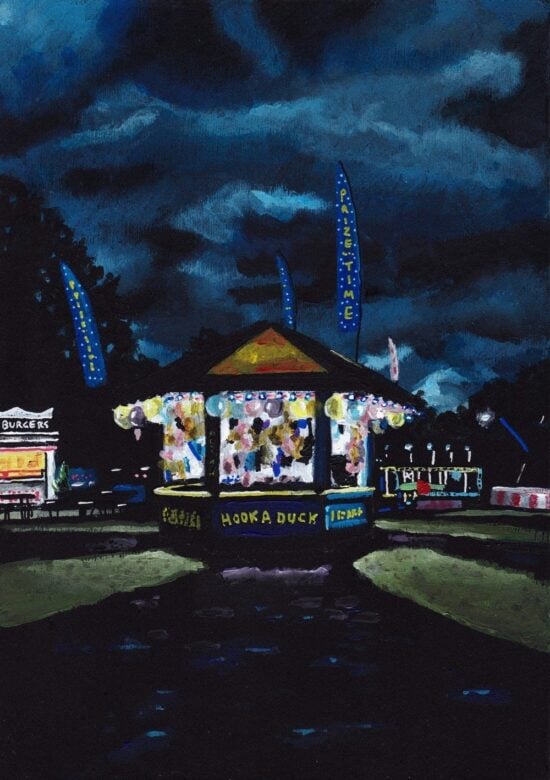
My nightscapes became some of my most successful and popular works and seemed a way to make my songs and artworks relate more closely to each other. I think also these paintings fed back into my songwriting, making me more sure of a certain mood or stillness in my work.
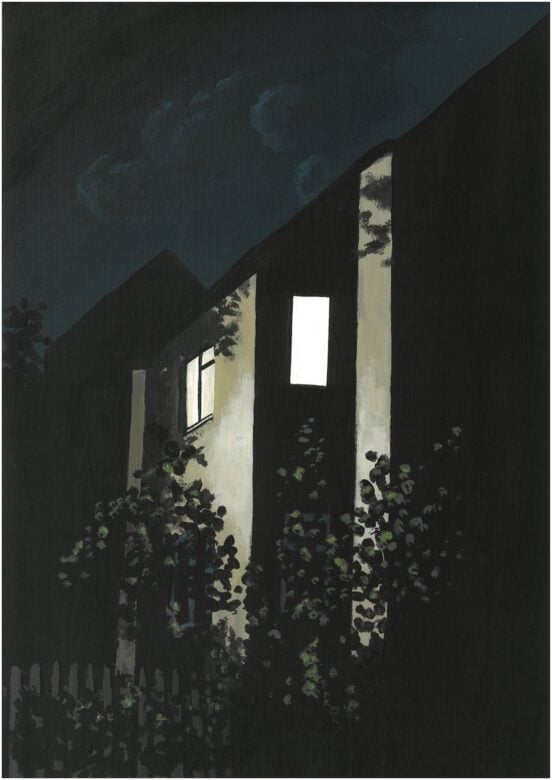
That mood is never more apparent than on the new record, ‘I’m Your Team,’ where once again, I employed a set of rules. I was only allowed to use three instruments: a DX7 synthesiser, a TR707 drum machine and a bass guitar. The DX7 and TR707 are pretty broadly considered to be obsolete by anyone who still knows what they are. It’s a mirror to my night paintings in that it’s about loneliness and a possible comfort inside that loneliness.
Hopefully it will teach me something that I can take back to my paintings, and the two worlds can continue reflecting on each other, one with people and one with none at all.
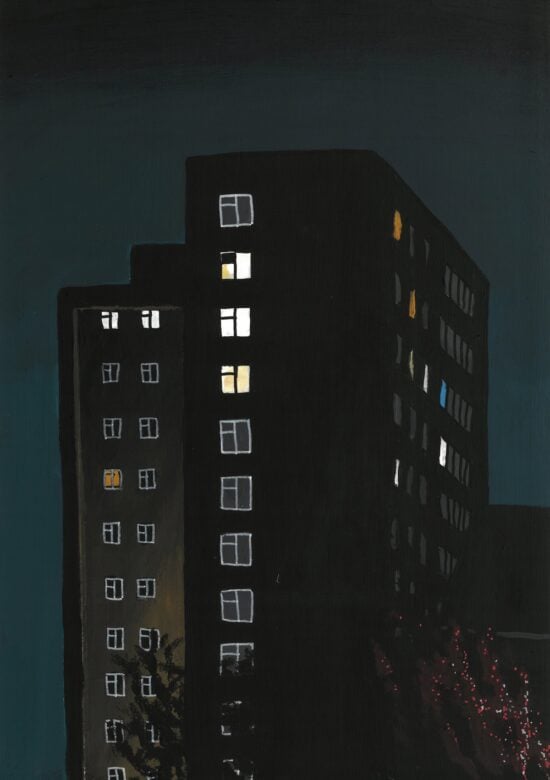
‘I’m Your Team’ is out now.
Darren will be leading a month’s worth of weekly Thursday painting workshops for all ability levels at Soho Poly in central London between November 12th and December 3rd.
Links
Darren’s Art: https://darrenhaymanart.com/
Bandcamp: https://darrenhayman.bandcamp.com/
https://linktr.ee/darrenhaymancatalogue