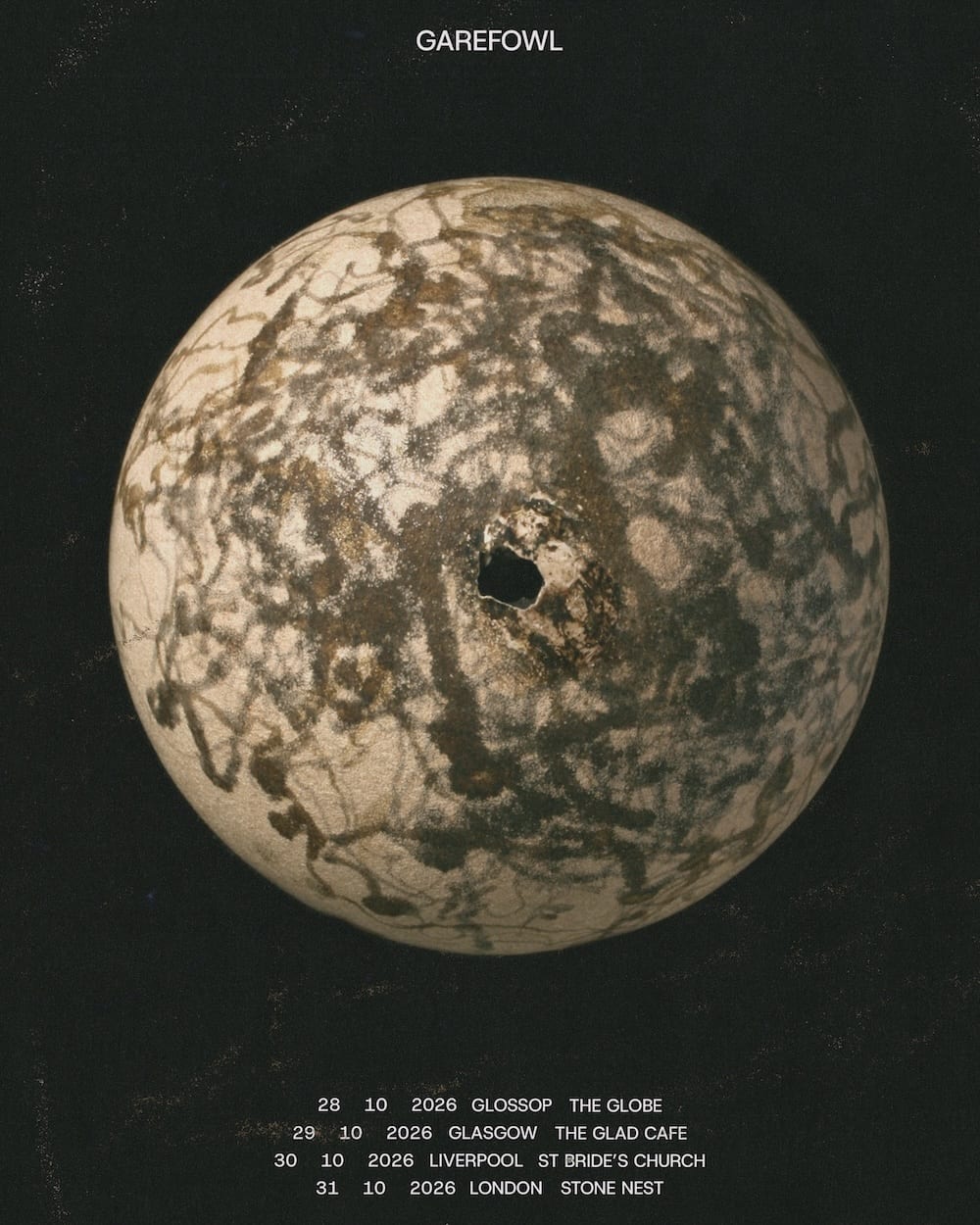
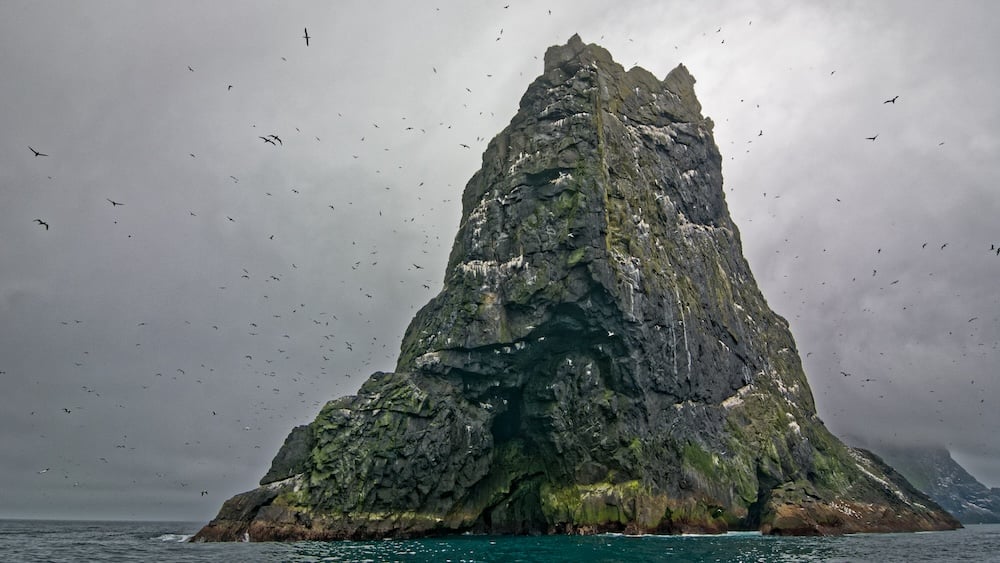
Garefowl is a musical project originally conceived by Ewan Macdonald and his father, Murdo, relatives of Lachlan MacKinnon, one of the men who killed the great auk on Stac an Armin in 1840. They state that the project is a reflection on this family history, but as you will see and hear, it is so much more than this. For those of us unfortunate enough not to have visited St Kilda (an archipelago off the northwest coast of Scotland) and witnessed the towering Stac an Armin, the highest sea stack in the British Isles, and the numerous nesting seabirds that colonise it, their latest album, Things That Vanish, manages to compress time and distance into an album revealing hidden depths and reminding us of the fragility of many of our planet’s species.
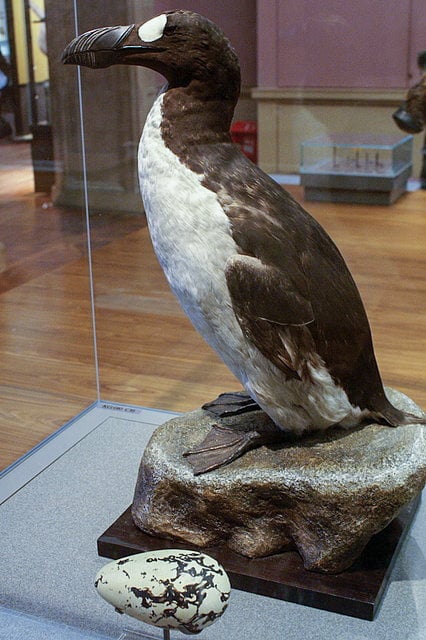
The Great Auk (Pinguinus impennis), or Garefowl, was a flightless bird that belonged to the auk family (Alcidae), closely related to modern razorbills, puffins, and guillemots native to the North Atlantic. Humans hunted them to extinction in the mid-1800s.
As mentioned recently when previewing one of the album’s singles, Garefowl’s debut album, Cliffs (2020), was created remotely during lockdown, with synths augmenting strings and traditional instruments. We reviewed it here — Johnny Whalley called it music that “effortlessly evokes the sights and sounds of the remote, rocky, seabird havens that make up the St Kilda archipelago.” We also featured them in our Folk Show, Episode 82, and ranked the album among our Top 100 Folk Albums of 2020.
While their latest album, Things That Vanish, overcame the restrictions imposed on their first, it also has tangible links to Hirta (the largest and main island of the St Kilda archipelago), breathing right through it. Unlike their debut, this album has no synths; instead, some of the sounds you hear are actual sampled and processed field and hydrophone recordings collected on St Kilda, with the drones created by Richard O’Flynn and Joe Gardner using X-ray diffraction: Rock or bone samples are analysed using X-ray diffraction (XRD), which creates a spectrum with peaks corresponding to the sample’s crystalline structure. The peaks in each spectrum were used to create a set of sine waves unique to each sample, following a method developed by Bill Sethares at the University of Wisconsin, and these sine waves are blended together to form the drones. At various points in time, Hirta is literally present in this album.
They also brought on an international group of musicians combining strings and electronics. Garefowl members are: Nathan Bontrager (viola da gamba/harmonium/banjo), Stuart Graham (bouzouki/harmonica/harmonium), Chris Jones (concertina/mandolin), Ewan Macdonald (fiddle/smallpipe drone), Richard O’Flynn (island sounds/percussion/XRD drones), Jess Whelligan (cello).
This is quite unlike any other album you are likely to hear this year, which makes this Track-by-Track even more special. Below, Garefowl offer an insight into some of the most beautiful creatures that occupy St Kilda today: nearly a million breeding seabirds. It is the largest colony in the North Atlantic. As they say: It is not too late to learn the lessons of the past.
From the album notes: The Last Garefowl
1840, midsummer. Four men were clambering over the rocks of Stac an Armin, a shark’s-tooth of stone rising from the waters off St Kilda, when they met with a very strange creature.
It was a heavy, cumbersome thing. Nearly three feet tall when it lifted its chest from the ground. Its back was black and its breast was white, and it had a thick, dark bill etched with silver. Short wings protruded from its shoulders—more like flippers—for it did not fly but swam, shooting through the sea as if the water were thin as air.
‘Gearrabhal’, said one man: garefowl, or great auk. It was so much larger than the birds around it, and so strange. “Prophet-like that lone one stood,” another remembered, much later. When they found it, it was sleeping.
It was not the only one of its kind, but it was one of the last. Since the 16th century, the great auk had been under attack. British sailors happening upon vast colonies of the birds off the coast of Newfoundland had seized on it as source of sustenance, killing the birds in a carnival of obscene excess.
They roasted birds over fires built of the bodies of their brethren—for their flesh was rich in oil and burned like kerosene. They would herd hundreds of the creatures down a gangplank into a ship to their doom. They would pluck the birds alive, for their feathers—increasingly rare—were gaining in value. There were no more great auks in Newfoundland, and ever fewer elsewhere.
Once, they had been common on St Kilda, though they had dwindled away. Two decades earlier, a rare visitor was caught and detained on a twine for three days. But that was a long time ago now.
Not wanting to miss their chance, the men grasped it, heaving the surprised bird back to a stone bothy where they slept at night while, in the day, they gathered eggs and young birds for salting—food to keep the islanders alive through the ‘black months’ of winter.
For three days they worked. On the fourth day, a great storm got up. Wind battered at the bothy like a banshee desperate to get in. Waves lashed at the stack. On the cliffs outside, birds clung to rocky ledges. Behind the hut, the captive gearrabhal shrieked and wailed.
Hours of this. An awful sound. The men began to see it differently. No longer of a fat, beatific bird, but a malevolent power: “a maelstrom-conjuring witch” summoning aid. Terrified, they stoned it to death.
It was the last garefowl ever seen on St Kilda.
Today, the abandoned isles of St Kilda host nearly a million breeding seabirds. It is the largest colony in the North Atlantic. But, as the story of the garefowl shows us, even vast populations are vulnerable to collapse. After a century of growth, St Kilda’s great skuas, fulmars, kittiwakes, guillemots and razorbills are in sharp decline. It is not too late to learn the lessons of the past.
Track by Track by Garefowl: Things That Vanish
1. Buthaigir/Puffin
We recorded the album at night, stepping outside during breaks to take in the late-night soundscape of Hirta: a quietly rolling swell of wind, waves, seabirds, sheep, and the otherworldly thrum of the snipe. While we were recording this tune, a ewe poked her head through the door in search of her lamb.
2. Làmhaidh/Guillemot (Tha Giullan Agam Fhìn/I Have a Lad Myself)
A St Kildan tune found in the Patrick McDonald Collection (1784). The crowded colonies of guillemots that line the cliffs are living communities that have evolved over decades: after winters spent on the open seas, guillemots return home to the same ledge on the same cliff year after year, laying their single egg within two inches of the previous year’s. Living in near-constant physical contact with their neighbours, the birds are constantly keeping tabs on who is best at bringing home the fish: guillemots who don’t measure up soon find themselves newly single.
3. Aisealag/Storm Petrel
An aura of the uncanny surrounds these elusive harbingers of stormy weather, believed variously to be the pelagic souls of drowned sailors or the cursed spirits of cruel captains, condemned to fly the seas forever for their sins. Seafarers nailed horseshoes to their masts in an effort to keep them at bay.
4. Sgarbh/Cormorant
The ominous silhouette of the cormorant drying its feathers – unlike most seabirds, they are not waterproof – lends this bird an air of primaeval darkness. In Gaelic myth, the boibhre or boobrie is a malevolent being that can assume the form of a water horse (each-uisge) or water bull (tarbh-uisge), but is most comfortable as a giant cormorant, the size of “seventeen of the biggest eagles”, with immense claws. The boibhre preys on calves, sheep, and otters, retreating into deep sea-lochs to devour their flesh.
5. Sgrabaille/Shearwater
The concept of the Umwelt describes the unique sensory reality that a species inhabits. The Umwelt of each species is shaped by what its senses can identify and the things it finds meaningful: some elements of the objective physical world are sensed in raw, immediate clarity, while others are left forever beyond the horizon of perception. Where humans perceive only faceless ocean, shearwaters navigate from their Hebridean burrows to the coasts of South America and back each year by following subtle changes in the smell of the brine.
6. Ruideag/Kittiwake
Unlike other members of the gull family, these graceful birds spend most of their lives on the seas, and only visit land to lay their eggs on narrow cliff ledges. Though they flourished in living memory, warming seas and depleted fish stocks are now forcing them to fly further to find enough food for their chicks. The extra energy this expends has eroded their margin of survival, and the numbers nesting on St Kilda have fallen by 84% since 1999.
7. Sùlaire/Gannet
Our boat out to St Kilda was joined by gannets flying low to the swell, skimming the wave crests and gliding into the troughs, the foamy tips momentarily above them. When they find fish, they soar to heights of up to 30m before slamming vertically into the water at 60mph to catch their prey. Their Gaelic name references their piercing blue eyes, which fade to black if they are fortunate enough to survive avian flu.
8. Fàsgadair/Bonxie
This bird’s burly, brooding appearance and kleptoparasitical habits – “bonxie” derives from the Norse for “dumpy”, while “fàsgadair” means “squeezer” or “extortioner” – conceal its grace and beauty. As Martin Martin wrote in 1703, “the Bird Faskidar… pursues lesser Fowls, and forces them in their flight to let fall the Food which they have got, and by its nimbleness catches it, before it touch the Ground”.
9. Fulmair/Fulmar
Carried on the gales, fulmars can soar hundreds of miles in a single fishing trip on a few scarce wingbeats; in still air, they can be reluctant to even take flight. After the final night of recording, we climbed to the cliffs for a view of the dawn sea. There we were met by hundreds of gliding fulmars, some skimming arcs across the cliff face, some hanging high and motionless until they yielded to a gust.
Things That Vanish is available digitally and on LP now via AD 93.
GAREFOWL LIVE
28 October – GLOSSOP, UK, The Globe
29 October – GLASGOW, UK, Glad Cafe
30 October – LIVERPOOL, UK, St Brides Church
31 October – LONDON, UK, Stones Nest