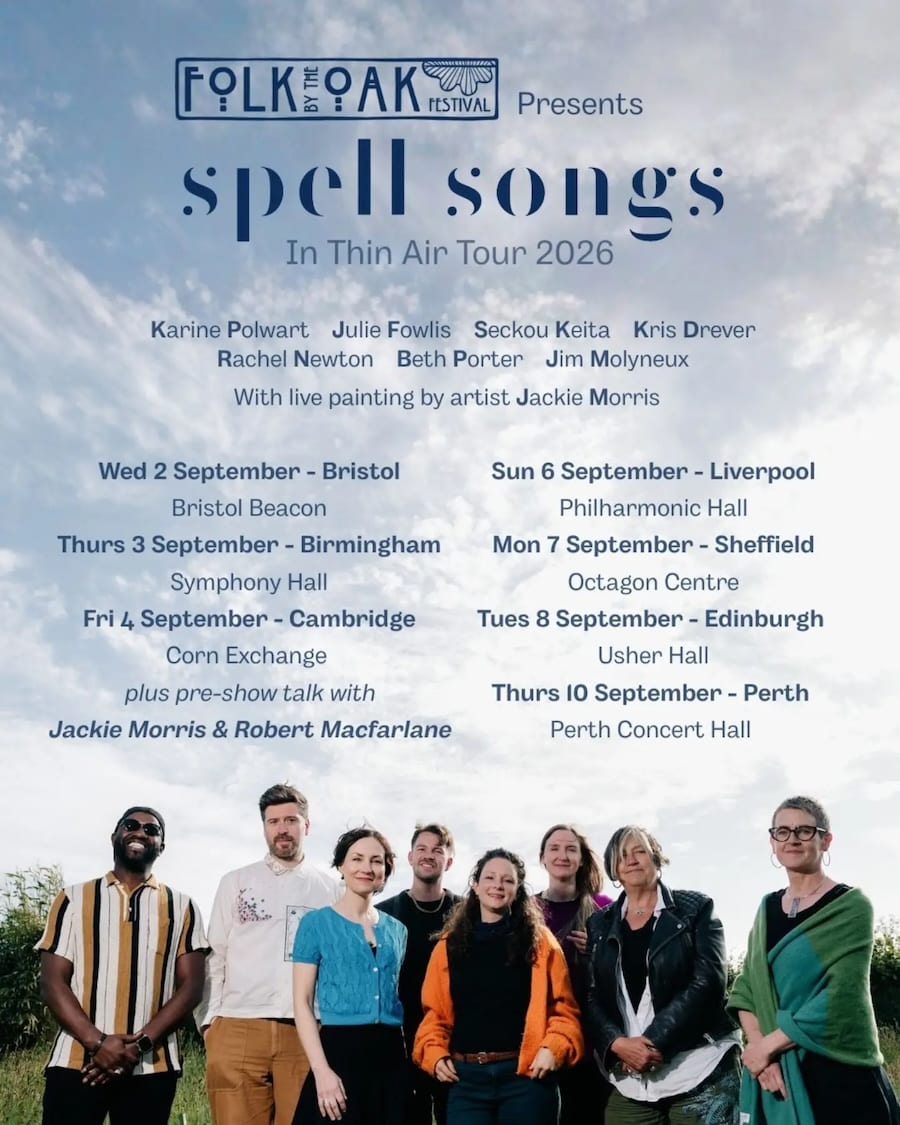
Sometimes a project has so much potential, so much more to give beyond its original iteration, that it seems to take on a life of its own. This is certainly the case with Spell Songs, which can trace its roots back to 2015, when the nature writer Robert Macfarlane published Landmarks, a study (or rather a celebration) of language and landscape. It was in Landmarks that Macfarlane first posited the idea of a word-horde, a lexicon of landscape-words at risk of being forgotten – and worryingly culled from children’s dictionaries – as people become increasingly estranged from nature. In 2017, Macfarlane collaborated with the illustrator Jackie Morris to create The Lost Words: A Spell Book, a stunningly produced selection of some of our most wonderful and endangered words, intended to encourage readers young and old to reconnect with the outside world through literature and art. It functioned as a direct appeal to an oral tradition which, while apparently dormant, can still be called up if the right kind of practical magic is applied.

Through the oral tradition, Macfarlane’s word-spells are directly linked to a certain kind of folk music, so it’s not surprising that a group of talented musicians coalesced around the idea of an album inspired by The Lost Words. The collective that works under the Spell Songs name formed in 2018 as a result of a commission by the Folk by the Oak Festival and released their first album to critical acclaim the following year. It was followed in 2021 by Spell Songs II: Let the Light In (which reached number one on the UK Indie Breakers Chart) and then in 2023 by a live album, Gifts of Light.
It speaks both to the importance of the project and to the wide range of creative possibilities it fosters that the ensemble’s third studio album, In Thin Air, sounds just as vital and accomplished as its predecessors. Like those other albums, In Thin Air has a specific angle. In this case, it is a creative reaction to Macfarlane and Morris’s latest collaboration, The Book of Birds: A Field Guide to Wonder and Loss. Here the ecological concern is the dramatic decline in bird populations in Britain and around the world. The fifteen songs here deal with different aspects of avian life, from nest-building to migration, in such a way that the album builds up a noticeable narrative thrust.
If this sounds like an ambitious endeavour, it’s worth reminding ourselves of the musicians’ identities. The seven-strong collective features Kris Drever (guitars and bass), Julie Fowlis (whistles), Seckou Keita (kora, percussion), Jim Molyneux (piano, keyboards, synths, drums, percussion), Rachel Newton (electroharp, viola), Karine Polwart (tenor guitar), Beth Porter (cello, ukulele). All seven members contribute vocals, and all are involved at some level with the writing and composition. As some of the most gifted artists in the world of folk and roots music, they wear their ambition with admirable lightness, creating songs that flutter and rise like their subjects. The title track, which opens the album, grows out of field recordings of birdsong which seem to mesh with quietly intoned words, soft keys and hushed strings. It creates a kind of canvas – almost blank in the way that any canvas can only be almost blank – on which the rest of the album can be painted.
It is the sound of implication and of airiness, and onto it the group paint their detailed but feather-light pictures. Polwart’s lyrics on Make Your Heart a Cradle exemplify this: ‘Pray to the feathered ether/Pray for the not yet born,’ she sings, and ‘Dream of flying/Dream of rest.’ It seems about as close as we’ll ever get to experiencing the exhilarating and delicate life of a bird. Swathes of strings trade places with gentle music-box notes, calling to mind the comfort of a nest and the fragility of its contents. The brief, kinetic Njan (Nest) provides a sharp contrast: Keita, who hails from Senegal, brings in African-inspired rhythms, while his lyrics touch on the parallels between birds and humans (particularly the need to create safe spaces). Completing a kind of miniature suite of ‘nest’ songs, Nest Builder is a short instrumental led by a pretty, introspective guitar line.
On A Life Begun, Newton delivers a beautiful lead vocal over a barely-there piano motif, reimagining and restructuring Macfarlane’s words to align with her own personal struggles with pregnancy-associated osteoporosis. Again and again, this album cleverly conflates the lives of birds with human experience, and this is one of the most moving examples. There are also moments when the music becomes one with its subject in a more visceral or naturalistic way. An Calman (The Dove) sees Fowlis interpreting an old Gaelic-language song that contains a mimetic version of a dove’s call. It serves as a reminder of how closely birds are linked with human song and human life, through culture and shared memory.
Another Polwart-penned song, Bells Fall Still (which she composed along with Drever), is a modern quatrain ballad. It uses powerful bird imagery to explore themes of human displacement, conflict, and resistance in Palestine, and shows how our treatment of the natural world reflects our treatment of ourselves. It is at around this point that you realise that In Thin Air is, amongst other things, a potent document of protest.
Tàladh nan Eun (Lullaby of the Birds) is a stunning combination of disparate elements: Fowlis develops a Gaelic lullaby into a fully realised song, while Keita weaves in a Mandinka proverb on a similar theme: the bittersweet moment when birds and children leave the nest for the first time. A miniature instrumental, Feathers (inspired by a Jackie Morris poem) combines Keita’s kora with traditional British folk instrumentation to a sweetly hypnotic effect, and Fallen Feathers is built around Polwart’s sinuous electric guitar riff, a dreamy arrangement and a poetic lyric from Fowlis. Halfway through, an unexpected drum break kicks in, and the song drifts into territory adjacent to folktronica and dream pop.
On the Molyneux-led Ride the World’s Winds, the group create a satisfyingly contemporary folk-pop sound, and the arrangement gives ample space for the impressionistic lyrics – many of which are taken directly from Macfarlane and Morris – to find a new kind of life. Flight is the thing that we still find most mysterious and most alluring about birds, and setting these words to music seems to give them their own kind of flight. This becomes even more evident in the song Flight, a spirited and playful tune that revels in close collaboration. Once again Keita’s kora stands out, and the shared vocals are nothing short of uplifting.
Similarly uplifting is Migration, with its airy uprush of combined instruments and a simple but heart-stirring lyric. The idea of migration is explored in further detail on Drever’s Senegal, a character study of a certain type of person, always restless and always on the move; it is also a loving portrait of a seabird, the bonxie (or great skua), while its music is a comment on the closeness of apparently distant lands and cultures. The bonxie doesn’t care much for national borders, and perhaps that’s an attitude we could learn from. In Thin Air’s final song, Porter’s We Only Save the Ones We Love, is a tender and minimal piece for voice and ukulele that acts as a quietly passionate warning about extinction and loss. Here, Porter neatly encapsulates one of the album’s most pertinent themes: that birdlife can act as a kind of barometer, letting us gauge human behaviour and showing us how we are going wrong and perhaps how we can start to make things better. Crucially, though, In Thin Air never loses sight of the fact that birds are worthy subjects on their own terms. It is an album in constant fluttering movement, one that soars and sings.
In Thin Air (September 4th, 2026) Hudson Records
Available on Digital/CD/Vinyl, including Deluxe CD Box & Limited Edition Deluxe CD Box (details here)
Pre-Order/Save: https://hudsonrecords.ffm.to/inthinair