

Mali Obomsawin has announced Automatic, her second solo album, out October 16th via Out Of Your Head Records. The eight-track album arrives alongside its frenetic title track, which pairs Obomsawin’s voice with archival recordings of her great-grand relative, Malian.
Obomsawin has been a constant presence on these pages since we premiered Odana back in 2022, ahead of her breakout debut Sweet Tooth. That album — a horn-driven suite for Indigenous resistance from the Brooklyn-based multi-instrumentalist, singer, composer, and citizen of the Abenaki First Nation’s Odanak community in Quebec — landed year-end lists at KLOF, as well as The Guardian, NPR, and JazzTimes.
What followed Sweet Tooth was gruelling — relentless touring, sudden visibility, the particular awkwardness of being a genre-defying musician inside an institutional music industry. Obomsawin has described the period as “a disorienting and emotional journey.” Automatic came out of it.
During the rollout of her debut, Odanak received hundreds of hours of mid-twentieth-century ethnological recordings of the Abenaki language, previously held exclusively at Dartmouth College, Obomsawin’s alma mater. She had drawn on some of these recordings for Sweet Tooth, but the unprecedented scale of access transformed her process entirely. “Behind Automatic is a deep awareness about institutions’ predatory relationship with Native material,” Obomsawin says. “I wanted to make a record that institutions couldn’t own.”
To get there, she worked closely with turntablist Andrew Broder to process and preserve the untidy reality of those source materials — decades-old, crackling reel-to-reel recordings of her ancestors’ voices. “The turntable is an instrument that explores time and temporality and is able to give a form of agency to the ancestors in the recordings,” she explains.
The use of archival material runs deep in Obomsawin’s practice. In our review of Sweet Tooth, David Morrison drew a parallel with another artist working in this territory:
By mining Mali’s heritage in such a way, with the inclusion of archive recordings, a creative comparison can be drawn with the extraordinary Jeremy Dutcher, whose independently issued sole album to date, Wolastoqiyik Lintuwakonawa – another of those head-spinning, standalone records – was the worthy recipient of the 2018 Polaris Music Prize. An operatically trained tenor, classical pianist, activist, and musicologist from New Brunswick’s Tobique First Nation, Dutcher melds his incredible voice and original contemporary classical melodies to scratchy, deeply moving transcriptions of traditional Wolastoq songs originally captured on wax cylinders in the first decade of the last century.
That Mali is walking a parallel path comes as no surprise when learning that their parents met in a Vermont courtroom when fighting for tribal sovereignty. As well as being a professional musician, Thomas Obomsawin was an advocate for Indigenous rights, and Mali’s mother, Daisy Goodman, was a nurse practitioner working within the social justice system of New York City. They have seemingly proven to be inspirational role models for this vital artist, and in their father’s case by more than guiding their political thinking: Mali bought a double bass in order to jam with their dad and siblings, going on to formally study and master the instrument, ultimately leading to this compelling debut.
Since Sweet Tooth, Obomsawin has been prolific and unpredictable. Her 2024 collaboration with Jake Blount, Symbiont (Smithsonian Folkways), fused pioneering Black folk music and Afrofuturism with free jazz experimentalism. Danny Neill, reviewing it for KLOF, described it as “a daring album in which the apparently incompatible make for perfect bedfellows.” She also scored Julian Brave NoiseCat and Emily Kassie’s Academy Award-nominated documentary Sugarcane, about the discovery of unmarked graves at Canadian residential schools, and was involved in ENCODED: Change the Story, Change the Future, an unsanctioned exhibition of seventeen Native artists staged at the Metropolitan Museum of Art.
Collaborators on Automatic include cornetist Taylor Ho Bynum — who co-produced Sweet Tooth — brothers Zack and Adam O’Farrill, and guitarist Magdalena Abrego, Obomsawin’s collaborator in Deerlady. The album examines maximalism, war, and Indigenous identity through the voices of the Odanak people themselves. Its cover art places Obomsawin among objects tied to her personal and cultural history — her upright bass, traditional ash basket splints — alongside symbols of conflict: grenades, a rifle, Marxist literature, the Mohawk Warrior Society flag.
Rather than treat her ancestors’ voices as ethnological material for outside consumption, Automatic reclaims traditional Abenaki language and music traditions as living improvisational composition, refusing to let institutions commodify what belongs to her people.
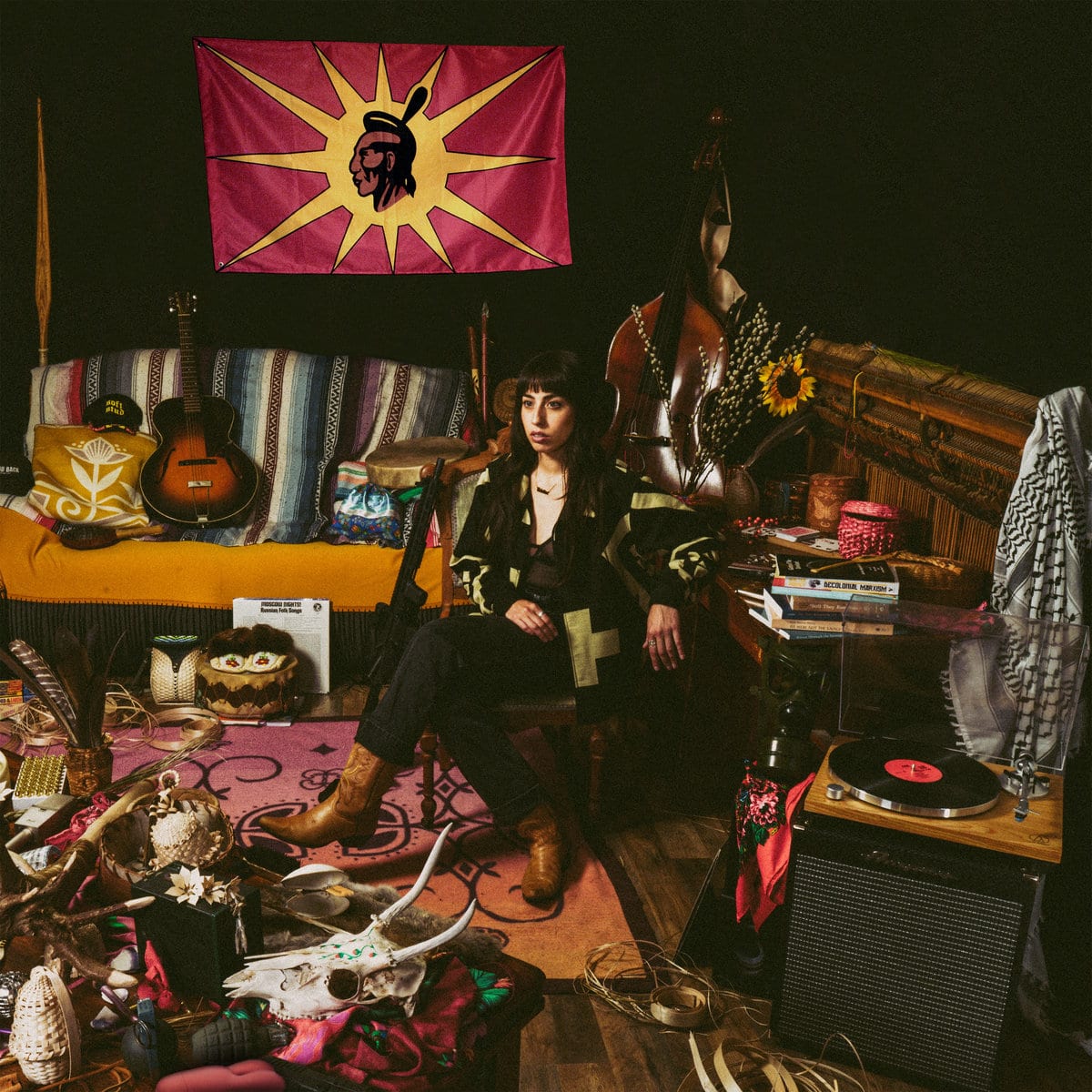
Automatic tracklist:
- Nawa
- Automatic
- Triage
- O’temin
- Moi, quand j’y suis
- Malian
- Kojua II
- Venez
Automatic (October 16th, 2026) Out Of Your Head
Shows
August 21 @ James Oliver Gallery – Philadelphia, PA
October 28 @ La Sotterenea – Montreal, QC
October 30 @ Meridian Arts Centre – Toronto, ON