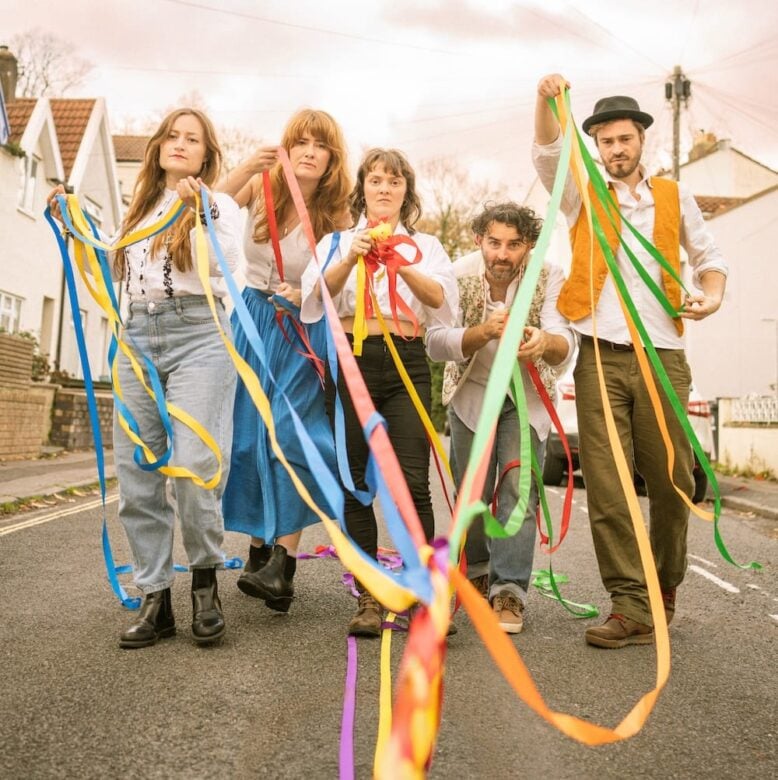
Lady Maisery are a supergroup in their own right. A trio made up of Hazel Askew (vocals, melodeon, concertina, harp, bells), Hannah James (vocals, piano accordion, clogs, foot percussion) and Rowan Rheingans (vocals, fiddle, banjo), they have mastered a genuinely forward-thinking and often groundbreaking approach to traditional music. Their vision incorporates not only folk song but musique concrete, secular requiems, musical theatre and whatever else takes their fancy, and they are almost single-handedly responsible for keeping the singing style known as ‘diddling’ alive. In the fifteen years since their formation, they have released four albums as a trio, each more expansive and accomplished than the last, and have picked up many a rave review along the way (read our review of their 2022 album ‘tender’ – one of their strongest collection of songs).
So what happens when you take one of folk music’s most successful and acclaimed groups and augment them with one of folk music’s most successful and acclaimed duos? Well, part of the answer lies in 2019’s Awake Arise: A Winter Album, on which Lady Maisery were joined by Jimmy Aldridge & Sid Goldsmith, a pair of singers and multi-instrumentalists who have released a handful of exemplary albums, including Many a Thousand (2018), which proved they could be astute and politically fiery or gentle and confessional. For all concerned, Awake Arise was one of the most ambitious projects they had worked on, and one of the most rewarding. Its follow-up, Wakefire: A Summer Album, manages to trump it in terms of both ambition and reward.
Where its predecessor packed a hefty seventeen tracks, Wakefire is a full-scale double album with twenty-seven songs. It’s worth saying right off the bat that it doesn’t feel in any way cumbersome or overblown, and there are a couple of reasons for this. Firstly, with five creative voices in the mix, each member can present the best of their material. And secondly, both Lady Maisery and Adridge & Goldsmith hold attention to detail in high esteem. And because the theme – summer – is so large and so open to interpretation, everyone is free to come at it from a different angle, which means things never get stale.
Wakefire is presented as a largely chronological account of summer. It begins with Summer’s In, Hannah James’ rewrite of Anne Briggs rousing paean to new beginnings and new experience, and ends as the autumn arrives, with a series of songs about harvest, about endings, and about departure. In between, a spoken narrative – the story of an awakening, a life growing and changing – threads everything together. There are familiar songs and new ones. Sid Goldsmith’s version of The Cuckoo (also known as Cuckoo, Cuckoo, What Do You Do) uses the well-known Benjamin Britten setting as a starting point but strips it down to a minimal musical backing, allowing the vocal harmonies to shine through.
Askew’s traditional Following the Old Oss/ Padstow May Song and Rheingans’ own May Day show two very different sides of the May holiday: the first is a joyful celebration, while the latter – introduced by a newsreel – tells the story of the Trafalgar Square May Day riots. Rheingans uses the old socialist anthem Which Side Are You On as the basis for a politically charged yet highly literate folk-rock protest song. A version of Staines Morris, a traditional May Day song, becomes uncanny and haunting, with a hint of warning or of forbidden lore about it. James sings it with bewitching innocence, like an upside-down nursery rhyme. Askew’s May Morning Dew, by contrast, is a stately, drone-backed lament – a lament, perhaps, for the passing of time itself, for the ageing world.
But for every serious statement, there is a moment of lightness: Goldsmith’s lead vocal on the Leon Rosselson song The Ant and the Grasshopper is a sprightly, springy delight. A loving cover of Ivor Cutler’s I’m Going in a Field (a song that should probably have some special hall of fame all to itself) hums and buzzes with (literal) field recordings of wildlife.
The self-penned songs are equally well-judged. Hazel Askew’s River Came Back finds a heady, arcadian magic in an urban river. Jimmy Aldridge’s Aftermath arrives on a striking segment of banjo minimalism, before a symbolically potent tale of environmental defiance emerges: the story of a nesting goshawk and the scourge of deforestation. The album’s environmental concerns continue with a cover of banjo virtuoso Béla Fleck’s What’cha Gonna Do, a rallying cry against climate change, performed with real passion: it becomes a piece of gospel-tinged protest-folk.
The album’s spoken sections have a tangible rhythm of their own, especially when accompanied by field recordings or distant song. The multilayered voices of Midsummer Divinations tread a tense line between prettiness and strangeness, while on Yellow Sun, Hannah James tells the story of a European car journey and a wildfire: in little over a minute and a half, she manages to convey a sharp sense of beauty and destruction, in a piece that is both descriptive and quietly political.
None of those involved have ever been afraid to venture out of their geographic and linguistic comfort zones, and there are two songs in Swedish here: the brief, mournful Limu, and the more forceful Mikaelidagen (Michaelmas), both with Goldsmith on lead vocals. The latter builds into a driving, rhythmic showcase for the group’s vocal harmonies. Ligō is a celebration of the Latvian midsummer, sung unaccompanied and with great gusto, not to mention an impressive control of harmony. Closer to home but no less powerful is a rendition of Sweet Lemeney, a song from the Copper Family repertoire. Sung by Aldridge, it is suffused with plangent melancholy.
The mood alters slightly as the album draws towards its close, and towards an inevitable autumn. There is a beautiful, bittersweet sense of nostalgia on Rowan Rheingan’s Longest Hot Summer. Askew and James both contribute spoken sections that echo this nostalgia but also look to the future. The Askew-led Harvest Song is an old Wiltshire folk song from Alfred Williams’ Folk Songs of the Upper Thames (a version was also sung by The Watersons), and it provides a spirited – not to mention beer-soaked – send-off to the season. Rheingans’ closer, Good As Gone, is a sweet, emotionally rich and melodically complex song augmented by deft banjo, which shows just how skilful a songwriter she is.
Such is the musical and emotional depth of Wakefire, it would take more than a single review to elucidate all its many and varied strengths. Indeed, this is the kind of album you’ll be finding new routes into and hearing new facets of for years to come. And for all its sweeping vision, it’s the small details that really make this Wakefire stand out: the narrative links between songs, the unexpected harmonic flourishes and discordant passages, the continuity between the ancient and the modern, constructed so precisely that you can’t see the joins. The best advice is to sit down with this album. Take your time, because it deserves your time. A twenty-seven track double album might sound like something of a throwback in today’s climate of instant gratification, but Lady Maisery, Sid Goldsmith and Jimmy Aldridge make it seem like a revolutionary act, and a hugely gratifying one at that.
Wakefire: A Summer Album (May 1st, 2026) LM Records
Bandcamp (Dgital + Deluxe Extended CD & Illustrated Lyric Book): https://ladymaisery.bandcamp.com/album/wakefire-a-summer-album-extended-length
Website: https://wakefire-awakearise.com/
Tour Dates
12 June – Playhouse, ALNWICK
13 June – City Varieties, LEEDS
16 June – Firth Hall, SHEFFIELD
17 June – Cecil Sharp House, LONDON
18 June – Symphony Hall, BIRMINGHAM
19 June – Stapleford Granary, CAMBRIDGE
20 June – Dome Theatre Studio, BRIGHTON
21 June – Komedia, BATH
Ticket Links: https://wakefire-awakearise.com/tour-dates