
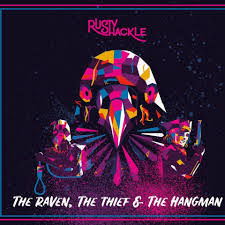
 Rusty Shackle – The Raven, The Thief & The Hangman
Get Folked Records – 8 March 2019
Their fourth album, the first with new drummer George Barrell, sees the Monmouthshire five-piece taking a radical departure from previous releases, both in that the material is predominantly traditional and an approach is largely more restrained than rumbustious.
The band spent the last two years researching folk music, from libraries, manuscripts and interviews, gathering material and then writing new music for the songs, the result, as the title suggests (although it was originally to be called Passion, Death & Joy), leaning to the dark side of life.
They kick off with Hanging Johnny, a halyard shanty about a hangman (generic rather than specific), though, the ‘away boys away’ refrain aside, you’d be hard pressed to recognise the arrangement here as such, icy pizzicato guitar notes leading into a moody, driving rhythm of circling rumbling drums and electric guitar coloured by fiddle.
One of the more uptempo tracks is told from the other side of the noose with an aggressive fiddle pulsing treatment of the folk staple Sam Hall that departs dramatically from the familiar melody to take on a Seth Lakeman-like aura.
The only self-penned number comes with Newport Rising, throbbing bass line and march beat carrying along a song commemorating the last large-scale armed rebellion in Great Britain , when on 4 November 1839, led by John Frost, Chartist sympathisers marched on Newport (birthplace of the band’s singer Liam Collins), the leaders subsequently sentenced to deportation.
By way of departure, they cross the Atlantic for Long John, strummed bluesy resonator guitar and hellhound fiddle bolstering a traditional African-American work song which, mixing religious and secular imagery and with a typical verse and chant refrain structure, talks of escape from slavery and the chain gang.
The Holy Ground is well-trodden folk territory, but the band brings a new approach to what is usually a rousing stomp and shout, slowing things down to a plaintive ballad feel and initially accompanied by just acoustic guitar and muted bass drum before the fiddle arrives in the final stretch.
Neither self-penned nor traditional (though sounding it), the doomy piano-backed and raspingly hushed sung Coorie Doon is a cover of Scottish singer Matt McGinn’s Miner’s Lullaby, the soothing lyrics belying the anger about working conditions down the mines.
A particularly obscure find, adapted from an Icelandic poem, The Raven’s Song, a chirpy, calypso-ish number featuring pipes, handclaps and banjo, partly sung from the bird’s perspective, bemoaning the difficulty of trying to find food during winter when everything’s covered in ice, and which could easily be seen as a reminder not ignore the winter hardships of the homeless.
The penultimate track is the much-covered blues St James Infirmary, here given a muscular Lakemanesque bass riff, drum clatter and fiddle arrangement with added banjo for good measure and they close on another persistent riff, hovering, strobe-like bass and echoing reverb guitar driving the moody and murkily menacing Time Of Death, a19th century murder ballad better known as Poor Ellen Smith which recounts the true story of how, in 1894 in Winston-Salem, North Carolina, Smith was murdered by her ex-lover, Peter DeGraff, who was subsequently hanged, the semi-spoken passage and wailing backing underscoring the noirish ambience.
Stepping outside of a well-established comfort zone and challenging fan expectations is a bold but risky move for any artist, but they pull it off with horizons-widening success.