
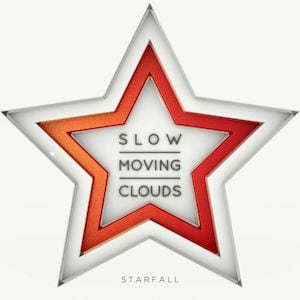
 Slow Moving Clouds – Starfall
Self Released – 21 September 2018
The music of Dublin-based trio Slow Moving Clouds is – especially at first – difficult to get a handle on. Though in the nicest possible way, it’s attention-grabbing, yet subsequently requires a degree of concentration that doesn’t necessarily go with the territory of instant-impact. Perhaps the closest comparisons I could offer might be Spiro, or fusion traditionalists The Gloaming, but only in the sense that their music might be termed quasi-improvisatory folk minimalism. Closer scrutiny of Slow Moving Clouds’ actual complement and sound might invoke a less rustic variant of Third Ear Band perhaps, i.e. minus the latter’s prominent woodwind contingent. Any casual acquaintance might initially invite a charge of ambient, but caution is advised before making this judgement too hastily, for the creations of Slow Moving Clouds are definitely not background music. Slow Moving Clouds’ members draw inspiration from Irish and Nordic traditions; in this way, Starfall can be viewed as a natural follow-up to the trio’s debut album Os, which appeared a couple of years ago.
The band lineup is, you could say, slightly unorthodox, even in these “anything goes” times. The common factor between all three musicians is an open-mindedness that goes hand in hand with a respect and understanding of both each other’s respective traditional musics and contemporary experimentalism. Danny Diamond is an Irish fiddle player who’s particularly receptive to new ways of presenting the tradition, and Kevin Murphy is a pioneering Irish cellist and bass player with a background in experimental acoustic music, while Aki is a Finnish nyckelharpa player. Their combined instrumental palette is further expanded by marxophone and mbira, while according to the sleeve notes, both Danny and Kevin contribute occasional vocals.
The trio’s special instrumental blend is rich and dark-toned, intense and atmospheric, and when performing the more stately-paced material the group name is certainly felt and heard to be appropriate, whereby the music is imbued with a drifting panoramic quality. But that statement should not be taken to imply an aimless lack of momentum, for in contrast to the music on Os that on Starfall has an altogether more developed sense of forward motion that stems from the constantly shifting motifs and note patterns from which each piece is constituted. Similarly, although each of the disc’s nine tracks embodies a different aura or character of soundscape, this can also vary within the course of the tracks themselves, as can the deceptive meandering between traditional-sounding and original-sounding modes.
Starfall’s four central tracks are all credited as “trad. arr. Slow Moving Clouds”, and this should probably best be taken in the sense of deconstructing and reworking traditional melodies. I concede that this doesn’t necessarily imply a particularly traditional sound, but certainly Ash Plant and Downfall Of Paris, in particular, seem to take dance-like structures to a kind of minimalist conclusion where their intrinsic lushness of texture sacrifices any implied sparseness of musical argument (which, I admit, may well sound like a contradiction in terms). Ash Plant has something of the feel of an antique early-music, largely due to the exotic timbre of the nyckelharpa. First Breath kicks off with tick-tocking pizzicato metronome rhythms before the feathery, zither marxophone enters the fray and ushers in a wordless vocal peroration: a key example of the trio’s ability to travel far and create much in a short space of time. Under The City alternates floaty, claustrophobic vocals with motoric string rhythms.
The animated Trin is drone-based, with the air of a Scandinavian hoedown that’s gotten slightly out of control, whereas Droghedy sounds altogether more reflective and is possibly where the album comes closest to ambient, as does the gently swaying initial half of Muunnos before the relaxing invention yields to a vital and more frenetic eastern-European-sounding dance section. Drops starts out like the finale of a Schubert string quartet before developing into a song-like melody con variazioni. Seven-minute combi-finale Swansong/Starfall feels (perhaps against expectations) is not the strongest track: the first part’s a slice of minimal quasi-sunshine-pop (late-period Beach Boys without the harmonies) built around a cooing vocal melody repeating what sounds like the phrases “midnight sunshine”, “suntan” and “swansong” until they rather outstay their welcome, whereas the second part arguably has slightly more in the way of musical interest and a sawing low-register string figure that gives an impression of epic before the vocals return for a curiously inconclusive finish.
Notwithstanding the ostensible ephemerality of the album’s finale, there’s still something very compelling and subtly intriguing about the music of Slow Moving Clouds, which delivers qualities that don’t automatically stem from any overt on-the-surface generated dramatic impact. It certainly warrants impartial investigation.