
Our latest Off the Shelf guest is Emily Portman. Emily released her fourth album, Dominon of Spells, on May 1st via Hudson Records (order it here – includes Ltd Vinyl & Book + CD options). It was also one of our Featured Albums of the Month, and, in his review, Thomas Blake notes that, from the off, she is in full creative control, weaving a tapestry of complex lyrical themes and intricate musical arrangements. He later concludes:
Of all the singers and songwriters in British folk music, few have the ability to encapsulate what it means to be human in the way that Portman does. Dominion of Spells is a real and vital piece of work, something to be cherished.
For those who are new to our Off the Shelf series, we basically ask an artist to select ten objects from their home and talk about them. These tend to hold a meaning for their daily life, their musical practice, or the overlap between the two. I have to say, Emily has pulled out all the stops on this one, but that should come as no surprise to those who have followed and enjoyed her creations. The choice of objects, and the stories behind them are pure magic and often fascinating.
Before this, watch Emily performing Fox’s Song live, alongside with Louis Campbell (guitar, voice) and Lucy Revis (cello, voice). The session was filmed at Deborah Maire Nelson’s shop Moonko in Sheffield.
Off the Shelf with Emily Portman
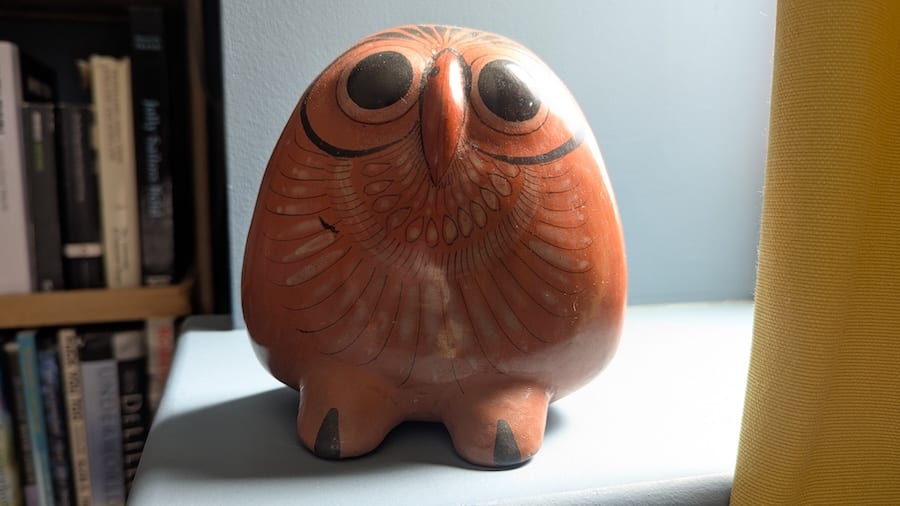
Grandpa’s Owl
When my grandpa John died, I found myself the new guardian of this pottery owl. Grandpa lived and worked abroad until he retired, moving every three years or so, which gave my mother and her siblings a colourful, if untethered childhood. This folk art owl comes from Mexico, where he, my granny and mum lived when she was a young girl in the 1960s and 70s. My mum calls it one of their ‘sacred objects’. The owl was always unpacked and displayed, wherever they lived – a signifier of home, wherever they were. I remember it looking down at me from the shelf at their home in the Lake District, and then in Devon, when they moved to help with my granny’s ill health.
The owl now sits on my living room windowsill, watching over me benevolently whenever I’m at the piano, writing songs. When I wrote ‘Owl Light’, I remember nodding at the owl as I sang about ‘the white old woman of the night’, a folk name for an owl that connects to the Welsh tale of Blodeuwedd from the Mabinogion. (More on her later.) Perhaps it’s no accident that the owl has flown into a few new songs – this little owl must have found its way into my subconscious.
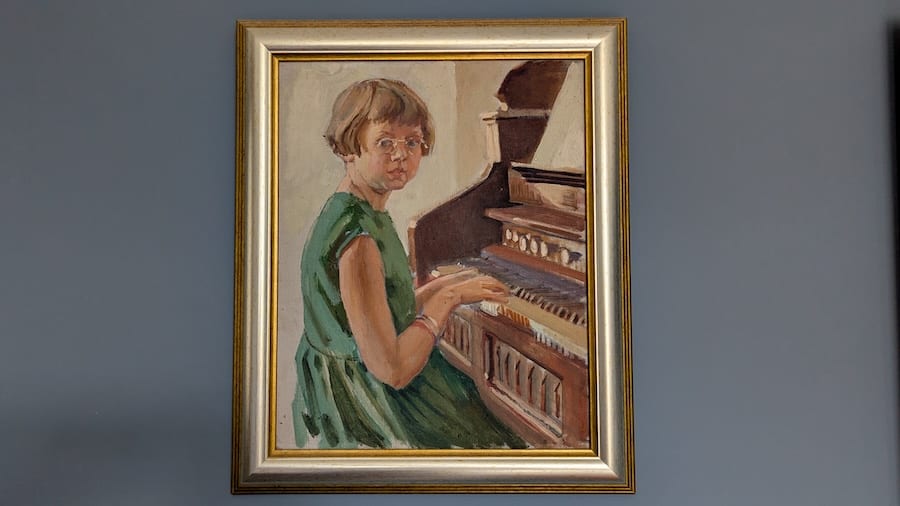
A Painting of my Granny
This painting of my grandmother, Brigit, as a child hangs on my living room wall. I love her direct gaze, which hints at the woman she’d become: sharp-eyed and sharp-witted, trainer of wild horses, wearer of gold trouser suits. Apparently, when she went into labour with my mum, Brigit turned to her husband John and said, “honey, pour me an Old Fashioned.” John knew better than to refuse a woman in labour her favourite cocktail!
The painter was Dora Altounyan (née Collingwood), my granny’s mother: daughter of painters from the Lake District, married to an Armenian doctor who ran a hospital in Aleppo, Syria, where they lived. My grandmother was the youngest of her siblings, home-schooled by her mother. She played violin, and (if the painting is correct) organ. I love Dora’s impressionist style, and the few paintings I have of hers are among my most treasured possessions.
Granny encouraged me in my artistic endeavours, taught me about politics, and was the reigning queen of Racing Demons, our family’s favourite card game. She spoke six languages, cooked wonderful dishes with ‘rubber cheese’ and olives, and had a commanding presence that defied her tiny stature. In her face and thin fingers, I see not only her, but my own mother, myself and my daughter. The last time I saw her, she said “be good, but not too good,” and cracked a glittering smile; a moment I’ll not forget.
I live in a different world to Brigit, but I aspire to have even half her energy, assurance and curiosity. This painting reminds me of my elders, and the colourful, creative family I’m part of.
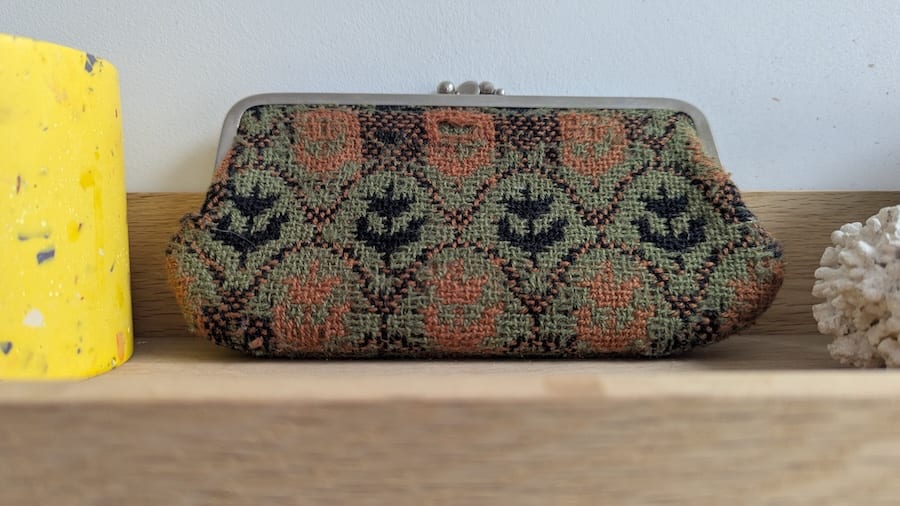
Welsh Tapestry Purse
This purse belonged to my dad’s mother, Annie-Mary, who we all called Nan. When she passed away, it was the keepsake of hers I took home, along with some hand-made lace. Nan looked after things, and the purse is still in great condition despite its age. For a while I used it as my main purse, but my tendency to stuff it with receipts has meant I now keep it as an occasional one for preservation’s sake.
Nan grew up in Rotherham, close to where I live now in Sheffield. Her mother ran a bakery, and Nan inherited her culinary skills, famous for her trifle, and the ‘pudding trolley’ at Christmas, wheeled out just when we thought we could eat no more!
I wonder if Nan brought this purse when they briefly lived in Wales. Her father disapproved of her love match – my grandfather Den – because he was working class, from a mining and steel-working family. Which is ironic, given Nan’s father was working-class himself, and seemed to have forgotten his own roots. He refused to walk Nan down the aisle, and was violent towards Den, once throwing an axe at him in their bakery in Belper, where they’d moved to. Apparently the mark is still there in the wall, where it was embedded. So Nan, Den and Nan’s mother escaped in secret, in the night, to Wales, where they lived for a while, trying to disentangle themselves from a very difficult man.
Nan was not only a remarkable cook and welcoming host, but she actually kept the purse strings, becoming the main breadwinner of the family. She worked first in the family bakery, then as a secretary, and later as a teacher. So perhaps this purse has particular significance as a symbol of Nan’s remarkable independence and resilience, like her mother before her.
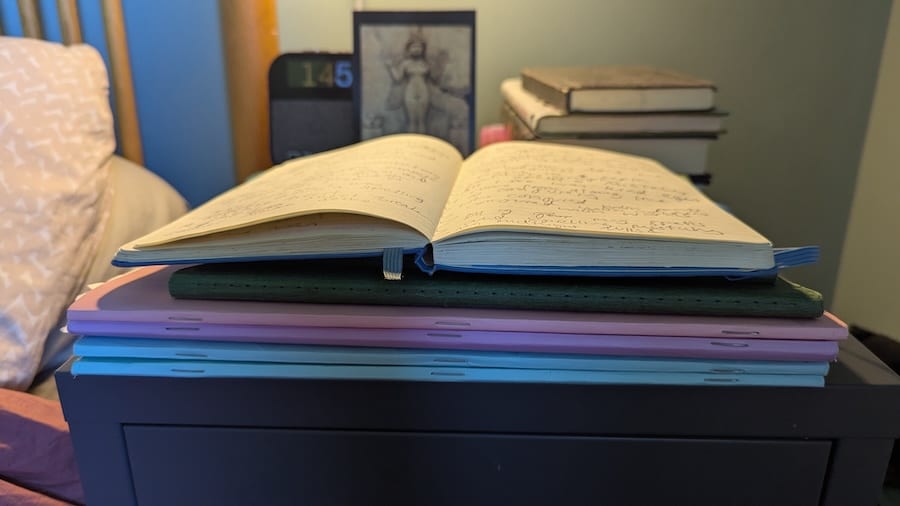
Notebooks
I’ve always been a sporadic diary writer, and I feel happiest when I remember to nurture the habit. During lockdown, my dear friend and bandmate Lucy Farrell started an informal group to meet online and work through The Artist’s Way by Julia Cameron together, a twelve-step course in a book, designed to unlock creativity. At the time I hadn’t written regularly for years. I loved rekindling the habit of morning pages, after years in a songwriting desert, consumed with motherhood and combining touring life with raising young kids.
If I hadn’t started morning pages – three pages every morning (in theory!) – I doubt I’d have written Dominion of Spells. Life gets busy, and often journaling can fall by the wayside. But when I do it, it puts me in touch with how I’m feeling and propels me into creative action. Most of the time this stream-of-consciousness form of writing does the job of clearing out the things that are stopping me from creating. Sometimes negative self-talk splurges onto the pages, but once it’s visible, I can turn it round. I notice what’s been stopping me from making space for creative work – and how much happier I am when I tear myself away from my to-do lists to prioritise it.
This is my most recent notebook stash, which lives in my bedside table cupboard. I hope no one ever reads them. They are full of drivel, with only the occasional flash of inspiration, but they’re a symbol of the small, everyday habits that go into making the finished creative work – if it’s ever finished. And that reminds me, I think it’s time to start the habit up again!
Chest of Letters
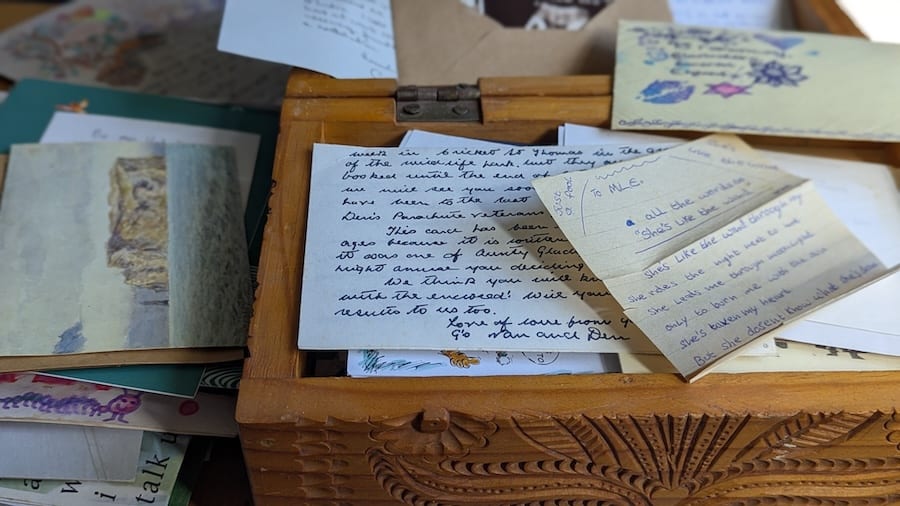
I miss letter-writing and haven’t got the heart to throw away these old letters, notes and cards which I keep in an old wooden treasure chest my mum gave me, filled to bursting. In here are letters from my life-long friend Joy, who I met as a baby, on a stage, auspiciously! We would send each other cassette tapes, recording onto one side while chattering away, making each other radio shows. The tapes are long gone, but the letters talk about the bands we listened to, detailing our young lives, margins filled with rubber stamps and doodles. There are hand-drawn cards, handwritten notes from friends and relations, the odd love letter – interspersed with more recent additions: ultrasound scans, and cards made by my children.
Whilst looking through, I realised I was missing two particularly precious letters from my paternal grandparents, who wrote to me on my 16th birthday, telling me about their memories of turning sixteen. Early in the war, as I remember it, Den (Dennis Portman, my grandfather) was peeling potatoes at a camp for soldiers, and Nan (Annie Mary) was taught to drive by the family’s lodger, an American soldier. Those letters remind me of my own privilege, never to have lived a life defined by war. It had reverberations across my grandparents’ lives, and shortly before he died, Den opened up about his underage enlistment and his brush with death at the Battle of Arnhem.
Each letter in this chest is a little time capsule, a token of care. As I grow older, I realise how many are from relatives who have since passed away, making it all the more special to read details of their lives. I still hope those two letters turn up soon; somehow these treasures have become more precious with age and hindsight.
Owl Mask
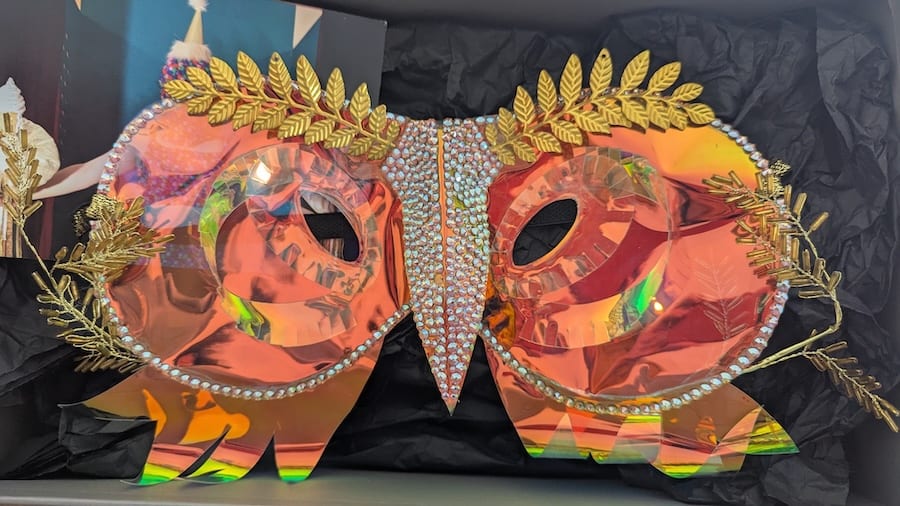
This mask was kindly made by the artist Lucy Wright for me to wear on my album photoshoot for Dominion of Spells. I have long admired Lucy’s work and ethos. Like me, Lucy has a deep interest in folklore and traditions, and she highlights female-led practices and reclaims traditionally male folk customs through a feminist lens. My writing often centres women’s voices and stories from folktales and ballads, and as I was writing Dominion of Spells, I had an inkling that Lucy would know where I was coming from.
The mask represents Blodeuwedd, a character from the Welsh folktale collection The Mabinogion. The tale follows a woman conjured from flowers to be a wife, who is transformed into an owl as punishment when her unhappy marriage falls apart and she attempts to murder her husband. When I wrote ‘Flowerface’, I imagined that her punishment might in fact become her liberation. Perhaps Blodeuwedd finds a freedom in her owl form that wasn’t afforded to her as an unhappy wife, valued only for her beauty. I wrote to Lucy with a little notion that she might be able to craft me a mask for my album photos, something I could wear to embody Blodeuwedd and to signify her transformation. Metamorphosis is an enduring preoccupation of mine, one that’s threaded its way through most of my songs – but this was the first time I’d embodied one of my characters visually.
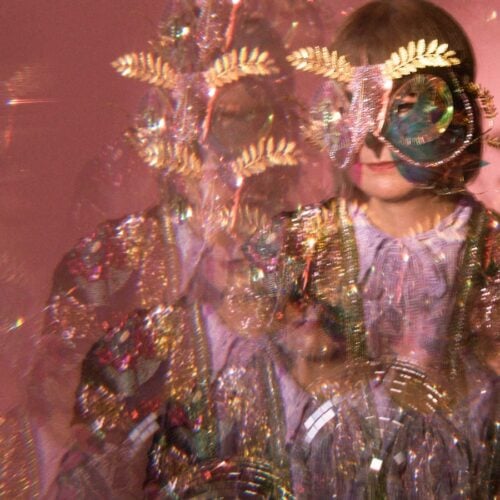
It was liberating to wear it for the photoshoot! Masks are magical, transformative things, allowing us to become something or someone quite different from our everyday selves. Eventually I’d like to display it somewhere in the house, or might even pluck up the courage to wear it on stage. I hope it has many more sparkly outings to come, but for now, it awaits its next adventure in a shoebox under my bed. It’s a little reminder to me of the generosity and kinship that runs through the folk community. Thanks, Lucy, for indulging the whim of a stranger on the internet – and for making something so beautiful out of my bizarre request!
I may now be a 40-something mother of two, but this album reminds me that once I roamed the kitchen garden, Victoria plums climbing the red brick walls, raspberry canes above my head, gorging on the ripe fruit like Eve before the fall.
Photograph Album
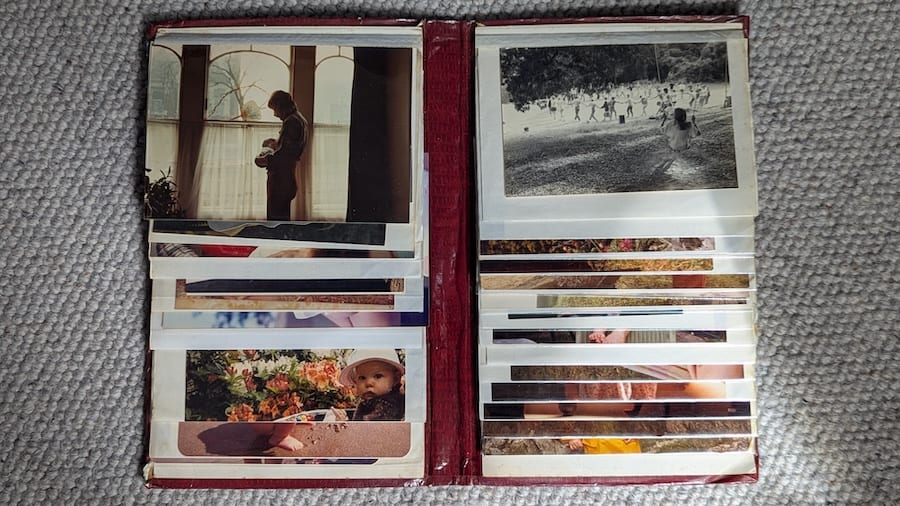
I love a good photo album, and have a big box of them under my bed from my childhood, which come out once in a blue moon, much to the intrigue of my kids. My oldest photo album has that musty ancient-book smell, and some of the pictures now seem like they’re from another era – I guess the 1980s was a long time ago now.
Early snaps show my very young parents, who were in their early twenties when they had me. There’s my dad, moustached and tanned-legged, on his bike in London, with me, a solemn blond-haired cherub, in a baby seat on the back. My camera-shy mother did her best to avoid the lens, but an early photo shows her with a shaved head, carrying me – two baldies together, looking curiously similar! Skip forward to my little sister’s birth: that night a photo reminds me that I wore my yellow raincoat and matching waterproof hat, ready for the next adventure. This came in the form of a house move to Monkton Wyld Court, a community where several families lived together in a rambling country house, in search of a freer, utopian way of living. There are pictures of a pack of children in the grounds, racing across the big terraced lawns, which tumbled down into a huge maze of rhododendrons – the best playground. It brings back vivid memories: the luxury of freedom, a whole kingdom to roam with little friends by my side. Out of the haze come memories of listening to my dad play by ear in the piano room, and circle dancing to folk tunes in a field. Then my parents split, and we all moved on to Glastonbury, a tough transition. The state school seemed Draconian after Monkton Wyld’s idyllic Steiner kindergarten, where we once found a magical gingerbread house hidden in the rhododendrons, and carded sheep’s wool into strands. I may now be a 40-something mother of two, but this album reminds me that once I roamed the kitchen garden, Victoria plums climbing the red brick walls, raspberry canes above my head, gorging on the ripe fruit like Eve before the fall.
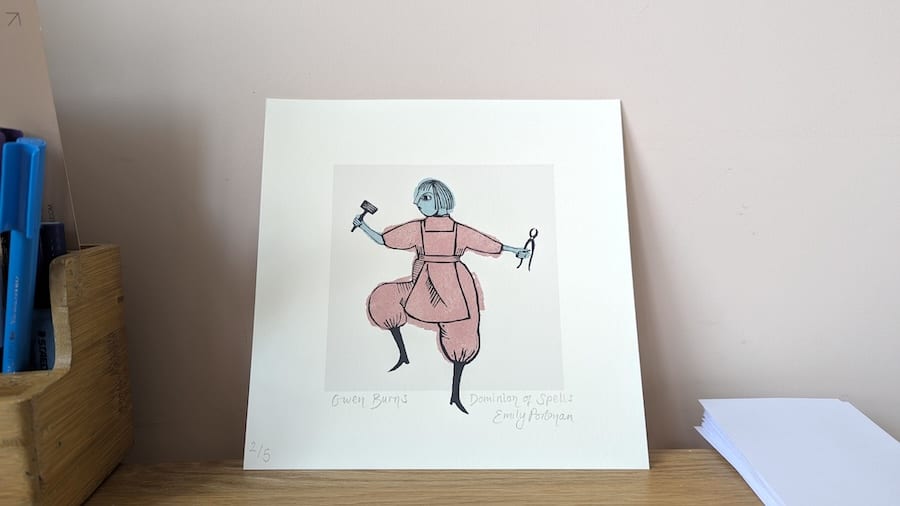
Illustration by Gwen Burns
This print by artist Gwen Burns features one of her illustrations for the Dominion of Spells album book. We got a limited run printed for my Kickstarter backers, and I’ve taken the liberty of keeping my favourite – currently propped up on my desk, awaiting a frame.
I sent Gwen the unmixed songs, with little descriptions of the stories behind them, and she sent a collection of wonders back. This woman belongs to ‘Three Magic Notes’, inspired by the Finnish epic the Kalevala. She leaps off the page in her work overalls – a songwriter with her tools, ready to do some creative forging.
The Kalevala follows the ageing singer Väinämöinen, who journeys into the buried body of the giant Vipunen to recover three magic words he needs to finish building his boat. Braving the giant’s knife-lined throat, he becomes a blacksmith, lighting a fire in Vipunen’s belly until the giant wakes and sings the magic words to him.
I was struck by how well this story works as a metaphor for the creative process: entering the cave, or turning inward, to search for and unearth little pieces of magic. I love that the quest is won not through brute strength, but through the discovery of a song by an older singer. I began to reimagine Väinämöinen as a middle-aged woman — who may or may not be based on a real character! This picture really embodies the album’s heart: a heroine in midlife, rediscovering meaning through creativity and storytelling; a little talisman, or taliswoman, ready to enter the cave, become a blacksmith, light a fire, and search for those three magic words.
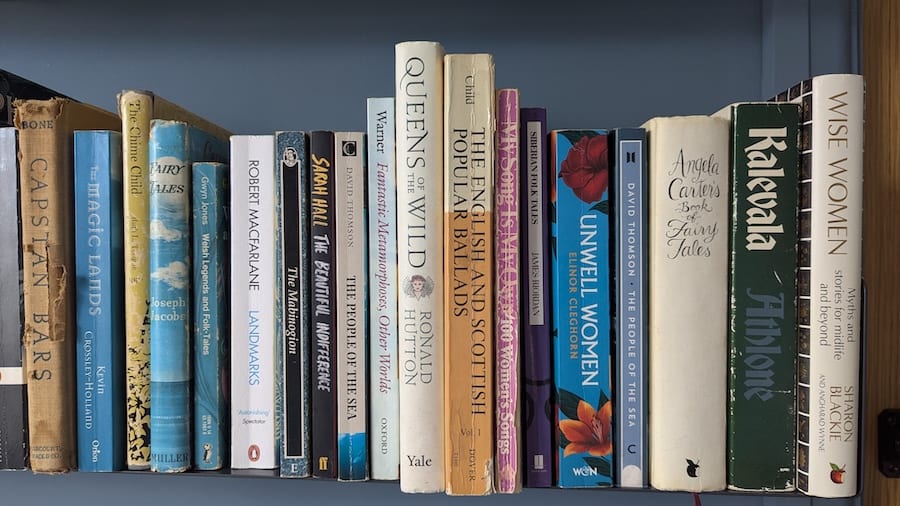
A Slice of Book Shelf
I don’t have a lot of trinkets, and the main things that take up space in our house are books. I find them very hard to let go of and could have easily written exclusively about books for this feature. When we moved from Liverpool to Sheffield a couple of years ago, we downsized, so I still have boxes of them in the attic, waiting for the day we have more shelf space. For now, here’s a slice of my shelf containing the books important enough to be liberated from the attic!
I have a lot of old folk song books, including some left to me by folk singer Lou Killen, my teacher and, later, my friend. I treasure those especially. It was Lou who left me The English & Scottish Popular Ballads, by F.J. Child, which I return to often, most recently to learn ‘Thomas the Rhymer’ for a project with The Furrow Collective. It’s a ballad about the queen of the fairies, a powerful character who has crept into my own songs lately. Ronald Hutton has written about her in his book Queens of the Wild: Pagan Goddesses in Christian Europe. My Song is My Own deserves a special mention: the first book of folk songs from women’s perspectives, co-authored by singer, songwriter and all-round legend, Sandra Kerr, who I was lucky to have as a mentor and teacher.
I collect books of folktales, and they often inspire my writing. Angela Carter has long been a literary hero of mine, and I’m often drawn back to the rich seam of her fairytale collections. Robert Macfarlane’s Landmarks sent me down a rabbit hole into the Kalevala. Sharon Blackie’s Wise Women is a beautiful collection of stories about midlife that inspired a new song of mine, and one I know I’ll keep returning to. And Unwell Women, by Dr Eleanor Cleghorn, gave me a fascinating phrase, a piece of buried history – and, as it turned out, my latest album title. A 17th-century physician once described women’s disorders of the mind as rendering them “under the dominion of spells,” caused by the “unnatural states of the uterus.” I started thinking about that phrase, and what it might mean to reclaim it – to imagine a version of that “dominion” that could mean freedom and magic rather than affliction. These books have earned their liberation from the attic – each one, in some way, feeding into the clutch of new songs that have become Dominion of Spells.
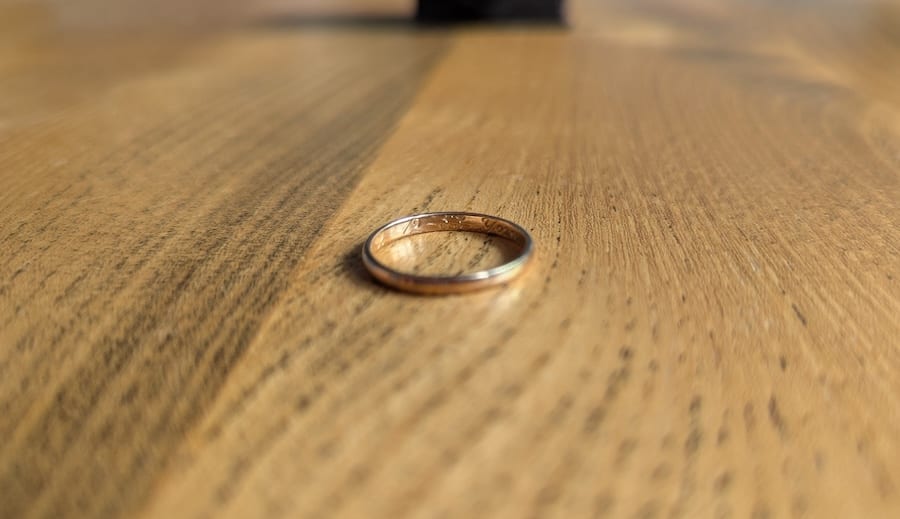
Wedding Ring Unearthed
I am the keeper of this gold ring, made from rose gold melted down from gold coins bought in the souks of Aleppo, to become my granny’s wedding ring. It makes me think of the story grandpa told me of his proposal: rational as he was, he’d been swept up in a whirlwind romance, and only weeks after they met, found himself on one knee in the ruins of an ancient temple. Granny would have worn it when they spent their wedding night sleeping out on a roof terrace, under the stars in the city of Aleppo. I’m keeping the ring now for my daughter, who will inherit it one day. It happens to fit my ring finger perfectly, but I’m too scared to wear it in case I lose it – particularly because it’s already been lost once.
One day, my granny came in from her garden in the Lake District to find her wedding ring had fallen off. No amount of searching brought it back. It stayed lost for over twenty years – long after my grandparents had moved away, and after granny herself had passed away. Then one day my grandpa received a letter. The current owners of the Lake District house had been digging in their vegetable patch when they saw something glinting in the soil. It was a ring, cut cleanly in half by their spade. Engraved on it were the words ‘Brigit 2-12-53 Yorath’, and they put two and two together, knowing Brigit to be my grandmother’s name. The date, of course, was their wedding day, and Yorath is my grandpa’s middle name.
Grandpa had the ring repaired, then made me its custodian. Who knows what new chapter is in store for this ring when I pass it onto my daughter – whether it becomes a wedding band again, or simply a treasure. But I love that this plain band holds a bigger story about love, longevity, and a lifetime of memories: Aleppo gold, buried in the Lake District soil, and unearthed so that its story can continue.
Dominion of Spells (May 1st, 2026) Hudson Records
Available on digital, CD, LP. There is also a Book-CD – The Book includes a CD and download of the new album along with lyrics, illustrations and the folk tales which inspired and informed Dominion of Spells.
Order: https://hudsonrecords.ffm.to/dominionofspells
Musicians on Dominion of Spells
Emily Portman—voice, piano, Wurlitzer, keys, banjo, ukulele, concertina
Louis Campbell—guitars
Lucy Revis—cello
Lucy Farrell—voice, saw
Mary Hampton—voice
Martin Simpson—acoustic/slide guitars
Helen Bell—viola & violin
Neil McSweeney—electric bass
Ben Nicholls—double bass
Sam Sweeney—violin
Will Schrimshaw—drums