
2026 marks 125 years since the launch of the Discovery, and 125 years since my distant cousin Sir Ernest Shackleton set sail aboard her with Captain Robert Falcon Scott. To mark this anniversary year, I released From the Floorboards. An album born of sea, exploration, and a remarkable instrument.
Ours is not the closest branch of the family tree; my side descends from Shackleton’s great-uncle. Yet the pull of the story has always been there. Not simply the epic narratives of endurance, but the quieter threads: the songs sung in cramped cabins, the friendships forged in hardship, the humanity behind the legend.
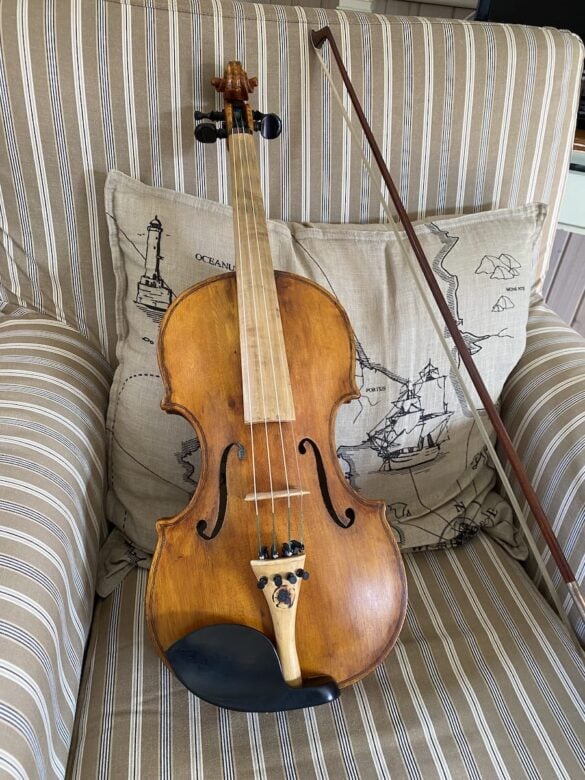
At the heart of this record is the Shackleton Violin, crafted by conservationist and luthier Steve Burnett from the floorboards of Shackleton’s former Edinburgh home. Built as a time capsule and as a voice “from and for the sea,” it carries history quite literally in its grain. Alongside it are two companion instruments carved from the same piece of driftwood: The Il Mare Violin and The Orca Viola. Together, forming a small family of voices with a shared origin. The driftwood itself was collected by Steve on the East Lothian coast, adding another layer of maritime story to their making.
I first contacted Steve in 2022 after reading about the Shackleton Violin. I was struck by how closely his vision for the instrument aligned with my own songwriting, which has long leaned toward environmental themes. When he described the violin as a voice “from and for the sea,” I knew I had to meet both him and the fiddle.
We arranged to meet at his workshop during a day off while I was on tour with The Shackleton Trio. Drawing the bow across the Shackleton Violin for the first time, I felt something shift. Its tone is broad and woody, yet bright and full of punch. There is an authority to it – fitting, perhaps, given that it is built from the floorboards of Shackleton’s former home. Seeing Steve’s workshop and witnessing the care and conviction behind his craft made the instrument feel even more alive.
After returning home, I tentatively asked whether he might consider loaning it to me for a week so I could travel to Scotland and write with it. He generously agreed. A few months later, I drove north to collect the violin and take it to its temporary home: an isolated fisherman’s cottage near Crail, on the East Neuk of Fife.
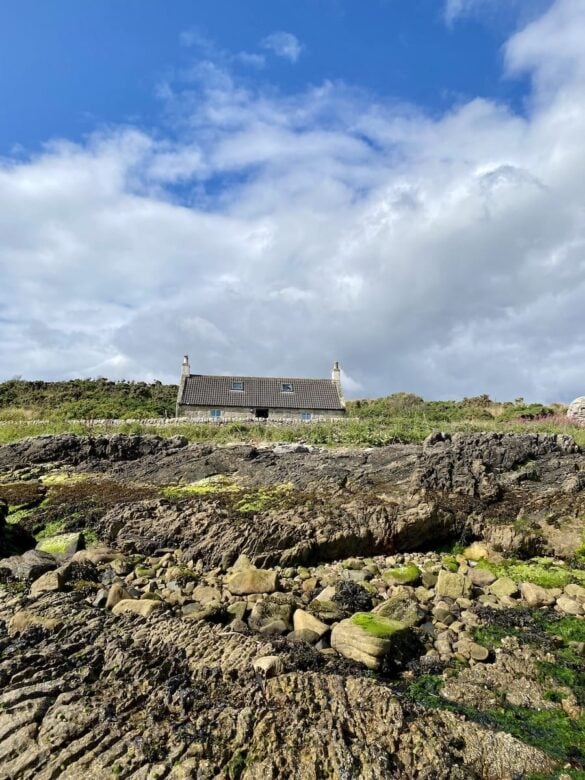
During that first residency, I wrote wrapped in a scarf outside the cottage, cup of tea in hand, watching tide-washed shores shift hour by hour. The Shackleton Violin shaped the music in ways my own violin never has. The title track, From the Floorboards, was the first tune I wrote on it. The instrument led; I followed. The strength, warmth and expressive possibility of that reclaimed wood became the seed from which the album grew.
East Neuk was written while waiting for the tide to fill a small bay before a brisk winter swim. Oystercatchers captures the jostling drama of birds clinging to a shrinking offshore rock at rising tide – black, white and red against brine and surf. Down to the Rockpool celebrates the miniature universes of anemones, crabs and darting fish and the quiet theatre of tidal pools that has fascinated me since childhood.
The Seahorse was inspired by Katherine Rundell’s book The Golden Mole and her assertion that each seahorse contains enough wonder to knock humanity off its feet, if only we would pay attention. The song is my attempt to do just that: to marvel at fragility, grace and hidden complexity.
Other tracks turn more overtly toward environmental reflection. Band of Mothers responds to the 2016 stranding of sperm whales along England’s east coast. These deep-water giants fatally disoriented in shallow seas. It is a lament for creatures whose intelligence and bonds we are only beginning to understand, and whose world is increasingly shaped by ours.
Happisburgh Tide was written for the rapidly eroding coastline of Norfolk, where homes and livelihoods are claimed year after year by the advancing sea. The ebb and flow of the tune mirrors the phases of the tide itself. Advance, retreat, inevitability.
While I was borrowing the violin, I was contacted by Iain Morrison, the grandson of the Chief Engineer aboard the relief vessel Morning, which brought aid to the Discovery when Scott, Shackleton and their crew became trapped in the ice. In 1902, Shackleton was deemed too ill to continue and returned to New Zealand aboard The Morning.
Iain told me that Shackleton and his grandfather became close friends, writing songs together on board with other members of the crew. Gerald Doorly, who could notate music, would transcribe melodies after lyric writers traced the imagined rise and fall of a tune in the air with a finger. I was deeply moved when Iain shared these songs with me.
On board The Morning, Shackleton struck up a friendship with two fellow Scots, John Morrison, whom Shackleton nicknamed “MacHinery”, and George Davidson, “MacMush.” Shackleton’s song, Engineer and the Doctorman (originally titled Scotland Forever), intended as a humorous duet, celebrates the supposed supremacy of engineers and doctors, inspired by Morrison’s reading of H. G. Wells. Something in its playful lyricism feels strangely familiar to me, as though a creative thread has stretched quietly across generations.
Southward, written by Morrison with a melody shaped in partnership with Gerald Doorly, holds a fragile longing for home. Morrison would sketch the melodic contour; Doorly would notate it.
For The Ice King, penned by Morrison a week after The Morning departed south, I composed a new melody. The “Discoverers” faced the long Antarctic winter alone, waiting for the ship’s return.
What struck me most was their timelessness. Written aboard The Morning 125 years ago, the emotional heart of these songs: longing for home, pride in craft, friendship, humour in adversity – feels utterly unchanged.
Two of my own songs speak directly to Shackleton himself.
Sea Legs is a reflection across time, and a meditation on his restlessness. The sea was both burden and compass. However briefly he returned to land, the open water called him back. The final verse circles his last diary entry, written during the Quest expedition: “A wonderful evening. In the darkening twilight I saw a lone star hover: gem-like above the bay.” There is stillness there – a man who chased horizons, pausing.
Elephant Island traces the perilous 800-nautical-mile journey of the lifeboat James Caird after the Endurance was crushed. From the desolation of Elephant Island to the mountainous sanctuary of South Georgia, it was a 16-day voyage through freezing seas and towering waves. I recorded this track on board the RRS Discovery. Its companion piece, Safe Harbour, lifts into a steady modal jig.
Footprints in the Snow is a tribute to the dogs whose strength and spirit underpinned so many expeditions. In a world of ice and silence, their paw prints ran faithfully beside human ones.
In 2024, I returned to Scotland with Aaren Bennett to record aboard the Discovery itself, staying once again in the same fisherman’s cottage. There was something profoundly fitting about playing the Shackleton Violin on a historic research vessel – wood once trodden by Shackleton resonating above dark water. The instrument felt entirely at home there. During that trip, we also met Iain Morrison in person at Discovery Point. After years of exchanging emails, songs and photographs, it was a real pleasure to finally meet face to face beside the ship that had first connected our family stories.
The following year, we completed the album in East Anglia with Sam Kelly, who co-produced the record alongside Aaren and I. It felt wonderful to bring these songs and stories home, and tie everything together in my Native East Anglia with a fresh pair of ears.
What I would like people to take from this album is that the polar stories are not relics, but they are mirrors. They remind us of resilience, yes, but also of vulnerability. The ice that once trapped ships now melts at an alarming rate. The oceans that carried explorers now carry the consequences of our actions.
If this album invites listeners to traverse icy seas, tidal shores and hidden rockpools, to encounter whales, seahorses, oystercatchers and eroding cliffs – then I hope it also invites awe. Awe at what has been endured. Awe at what still lives, and what is possible. Awe, above all, at the fragile, extraordinary world that holds us all.
The album is out now, order via Bandcamp (Digital/Vinyl/CD): https://georgiashackleton.bandcamp.com/album/from-the-floorboards