
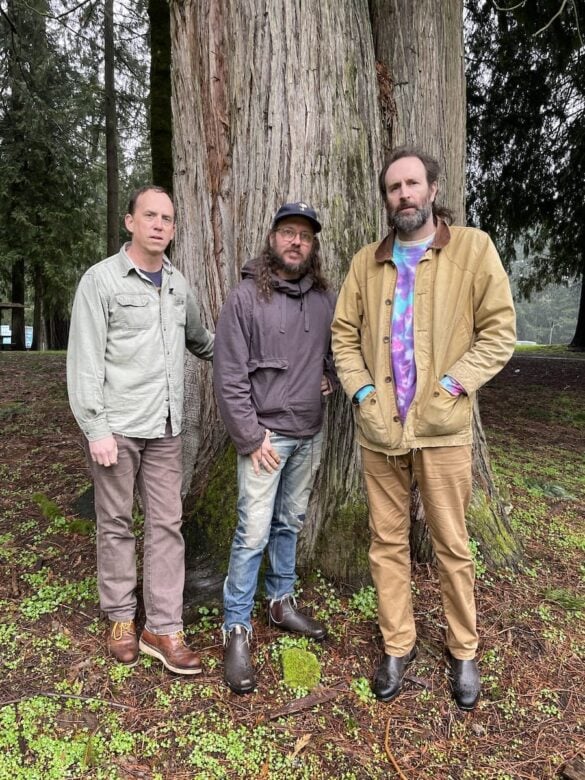
Barry Walker Jr. lays himself at the foot of the folk tradition with his Thrill Jockey debut album, Paleo Sol (reviewed here). Born from new age lullabies dedicated to his newborn daughter, Kalena, the album gradually lithified with the addition of close friends and musical influences, drummer Rob Smith (Animal, Surrender! Gray/Smith, Rhyton, Pigeons) and bassist Jason Willmon (Mouth Painter, Fruited Planes). Paleo Sol merges Walker’s atmospheric leanings with Smith and Willmon’s intuitive collaborations, creating a definitive ambient-country sound. “I view this as a collaboration between us three,” says Walker. “This would be a very different album without them.”
Walker has been playing music with Willmon for the last decade, making him a natural fit for Paleo Sol. Smith even further back. “He’s been introducing me to music, artistic ideas and philosophy for a long time,” says Walker of their nearly 20-year-long friendship. “He’s an incredible drummer. He’s got a heavy spirit.”
Like a paleosol, the album took shape slowly. “A lot of these melodies were born out of this idea of starlight, new creation and new life, as opposed to death, which was actually going on all around us,” says Walker. Composed during 2020 and 2021, Paleo Sol was marked by the birth of Walker’s first child, a global pandemic, the murder of George Floyd and nationwide protests. “It was a time of great calm and tranquility in our household, but the dark forces were banging on the door.”
Before moving to Oregon to pursue a PhD in geology, his understanding of the state extended little beyond the Portland Trail Blazers and the Oregon Trail computer game he played in his elementary school library. “In terms of the United States, Oregon was this mythologized place: the Old West,” he says. Nearly two decades later, he’s come to value the ways it has challenged him, both musically and culturally. “It’s a place where people are grappling with the terrible history of this land and of modern society. It’s important.”
Walker moved to Corvallis, Oregon, in 2006 to begin his doctoral studies at Oregon State University. “Looking back on it now, it seems crazy that I’d just uproot my life and move, but at the time, it was exciting,” he says. Already an established banjo player, he quickly became involved in the Corvallis music scene. “My friend Shane Hayden had moved to town and he had a pedal steel that he was selling for $300 but I couldn’t afford it, so somebody else bought it,” says Walker. “I’d been thinking about pedal steel for a while because I liked the sound, but it’s one of those things I didn’t think I could do until I found myself doing it.” Teased by the opportunity of owning one, Walker convinced the person who bought it to let him use the instrument. “It was probably the only pedal steel in Corvallis and this guy wasn’t playing it,” said Walker. “I kept it for about six months and worked out some basics. Essentially, I got hooked on it.”
A geologist and professor by day, Walker drew the title Paleo Sol from his years studying the ancient, oxidised soils that band across the Painted Hills of Central Oregon. “Paleosol literally means old soil,” he says, describing formations shaped over hundreds of thousands of years through slow processes of weathering and oxidation. “When you’re out in the desert, either hiking or coming around the road, you’re presented with these almost comically out of place, red and white striped hills. I’ve had the fortune of walking around those hills a lot.” But for Walker, Paleo Sol holds a double meaning. “In Spanish, sol means sun, so we can also think of it as an ancient sun leering at the world. The paleo sol is the past, the present and the future.”
That layered sense of time seeps into other tracks like Peridot, Call Me, Sentient Lithosphere and Aether Ore, interweaving Walker’s geological escapades with dreamy soundscapes. Of Son Don’t Brighten the Bear Creek Rhyolite, Walker says, “It’s something that I imagine one of my guitar heroes, Tony Rice, would say. You’d be sitting there thinking, ‘What on Earth does he mean?’ Maybe Tony doesn’t even know.”
Rhyolite, a common volcanic rock, appears throughout the Painted Hills in a localised unit known to geologists as the Bear Creek Rhyolite. Situated just outside Mitchell, Oregon, it’s a place Walker often brings students to, and, like many small towns, it carries its own folklore. “At the gas station, they used to have a live bear in a cage. His name was Henry,” says Walker. Locals swear that if a woman placed an apple in her teeth and approached the cage, Henry would take it from her. “Eventually they moved him onto some property, ironically right along the Bear Creek watershed, and as far as I know, he’s still out there,” says Walker. “That’s some Old West shit. It’s like walking 150 years back in time.”
Growing up outside of Nashville, Tennessee, the folk tradition has always been dear to Walker. “I’m basically a folky. I like country music and bluegrass. Those records are never far from my turntable and never far from my heart.” As a child, he sang Baptist hymns at church and later joined his college’s Episcopal choir. The moving harmonies reminded him of the barbershop quartet songs his grandfather used to sing. “They move you, move your soul and spur your spirit,” he says. “In terms of my melodic sensibilities, I have to lay myself at the foot of the folk-country tradition.” But while folk runs deep in Walker’s veins, he has never defined himself by the genre. “I love it, but I don’t want to play folk or country music all the time. I’m trying to exist creatively and artistically in a world that’s trying to absolutely chew us up.”
Walker also draws inspiration from Japanese new-age artists like Inoyama Land, World Standard, and Hiroshi Yoshimura, and enjoys “academic-unlistenable” music. “Some of my biggest inspirations have come not when I’m listening to music but when I’m listening to a person droning on a violin for 30 minutes straight,” says Walker. “It sandblasts the topography down to where there’s nothing. A good drone will clean my pipes out.”
For Walker, it’s a meditative experience akin to his time spent in the deserts of Central Oregon. “Inspiration comes when I’m walking around with no music, looking off in the distance and hearing the ground crunch underneath my boots or just sitting there and hearing nothing,” he says. “I’m inspired by mountains, old rocks, volcanoes, silence and cacophonous noise. These are the beds on which melodies start popping up in my head.”
At home in Portland, Oregon, his melodic sensibilities are in high demand. In addition to six solo albums under various monikers and collaborative projects (Mouth Painter and North Americans), Walker appears on dozens of records and live performances. He’s played with Portland mainstays like Marisa Anderson and the late Michael Hurley, and spent the last several years touring with Rose City Band, where he’s learned that “you don’t have to destroy the form every time.”
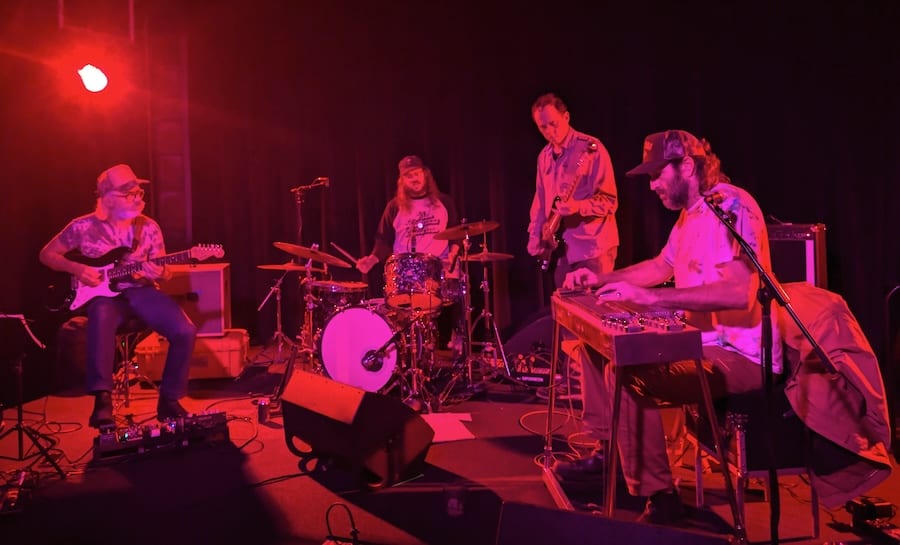
“I’ve been inspired to be a better player because the people in Rose City Band are so good,” says Walker. “They’re all probably better than I am in terms of their ability to execute what they want to do on their instrument night after night, whereas I have bursts of abated ecstasy that aren’t necessarily sustainable.” Walker is grateful for the exposure to new audiences and the support he feels from band leader Ripley Johnson. “I respect Ripley a lot. He’s a great friend and a great human.”
While Walker’s musical bursts may not be sustainable on tour, they fuel his creative process. “I don’t hit a pocket and just cruise. I’m always wanting to do something new,” says Walker, who already has another album in the works. Similar to the creative process behind Paleo Sol, Walker hopes to involve other musicians in these recordings. “Collaborating with people is great because you get to pass off your vision. You’re not sacrificing it, but opening it up.”
Paleo Sol isn’t laden with political lyrics, but Walker certainly isn’t turning a blind eye. “We’re living in a political and cultural horror show in the United States. Maybe not as horrible as it could be, but as horrible as it’s been in my lifetime on a wide scale,” he says. “We have to make music that makes people, at least temporarily, feel some beauty while at the same time grappling with how crazy the world is.” Walker’s music comes not from anger but from looking beyond what we can see. “I want people to look past the horizon and try to break the material veil that we’re all living in,” he says. “If I can make people feel a sense of wonder and creative awe, that’s all I want.”
Paleo Sol (January 3oth, 2026) Thrill Jockey