
West Virginia Snake Handler Revival “They Shall Take Up Serpents” offers a raw, unfiltered immersion into the sound and faith of the last snake-handling church in Appalachia. Captured 100% live and without overdubs by Grammy-winning producer Ian Brennan, whom we had the pleasure of chatting to in depth about the album and his other work below. The album documents a single, two-plus-hour Sunday service in the West Virginia mountains and marks the first-ever American music release by the Sublime Frequencies label.
The music is a visceral, chaotic blend of “hillbilly rock guitars”, “dueling flat-picked Telecasters”, and “trance-like rhythms” that drive the congregation into “eruptions of abandon and passion”. Brennan described the scene as “the most metal thing” he’d ever witnessed, rendering bands like Slayer “mere kids play”.
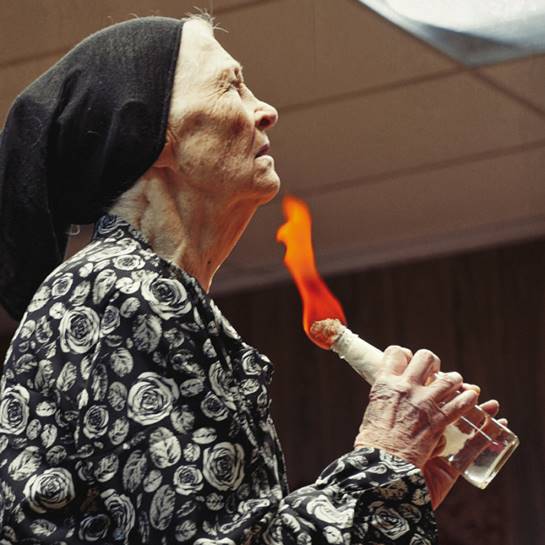
This intensity is not performance; it is a ritual of profound risk. During the recording, a chaplain was bitten by a snake. The moment is audible on the track “Don’t Worry It’s Just a Snakebite (What Has Happened to This Generation?)”. Blood pooled on the floor as the church’s PA system blew out from the screams. Other rituals witnessed included preachers huffing strychnine-soaked handkerchiefs and worshipers holding flames to their throats.
This faith is practised against a backdrop of genuine tragedy and regional hardship. Pastor Chris’s father and brother both died from timber rattlesnake bites, and the pastor himself nearly died from a previous bite that required his forearm to be “sliced open from wrist to bicep”. He nonetheless maintains, “Jesus is our anti-venom”. This devotion exists in a community gutted by the coal industry’s decline, now leading the US in drug-related deaths. The resulting album is a startling document of faith, ritual, and raw American music at its most “exotic” and primal.
Ian Brennan Interview
Ian Brennan is a GRAMMY-winning producer (Best World Music 2011) with three other GRAMMY-nominated records (Best World Music 2015, Best Traditional Folk-2006 and 2007). His ninth book, Missing Music: voices from where the dirt roads end was published in 2024.
He has produced over fifty international records since 2009 across five continents including the countries of Rwanda, Tanzania, South Sudan, Cambodia, Romania, Pakistan, Suriname, Azerbaijan, Bangladesh, Botswana, São Tomé, Comoros, and Djibouti.
Source: https://ianbrennan.com/
KLOF: You’ve recorded music in many remote locations, but you stated that “few places have felt more foreign or ‘exotic'” than this part of Appalachia. What specific elements of this service contributed to that powerful feeling of unfamiliarity?
Ian: The most unfamiliar is paradoxically often that which is seemingly similar. In those cases, there is a false sense of knowing, whereas places that are more distant are the ones that we’re often far more open and receptive to, since we have fewer preconceptions. But when we possess some knowledge of a place, the subtle nuances tend to get lost if we’re not careful to recognize and actively test the limits of our own understanding.
The press release details the moment when a chaplain was bitten by a snake, with blood splattering on the floor. As a producer crouched at the altar tending to your equipment, what was your personal and professional reaction to witnessing such a dangerous event unfold in real-time?
At that moment, I was attending to the equipment, so what I witnessed was the immediate aftermath, the blood and the raised voices. I’d promised myself I was going to stay far away from the snakes, but nonetheless, in the heat of the moment, I found myself somehow right in the midst of them since I was squatting on the floor at the foot of the altar.
You described the service as ” the most metal” you’d ever seen, rendering Slayer “mere kids play”. Can you elaborate on that?
The level of commitment that the pastors possess is visceral. They express themselves with their entire body, and thus, within minutes, were drenched in sweat. It immediately called to mind memories of illegal, warehouse punk shows growing up as a kid in the Bay Area in the early 1980s. There was the same sense that things were teetering on the edge of disaster.
This album was recorded 100% live without overdubs. What were the specific technical challenges in capturing the “trance-like rhythms” and “screaming vocals”, especially in such a chaotic and unpredictable environment?
I utilize as many microphones as possible to provide wide coverage and then hope that at least one mic represents the moment accurately, even if the others fail. These type of recordings tend to dictate what they will become, rather than being preordained or reverse engineered. You can try to prepare as much as possible, but once you’re in the thick of the moment, the only choice is to adapt to the reality of what’s happening and catch as catch can.
You mentioned this recording represents a “counterpoint” to your work on the Parchman Prison Prayer albums. Could you expand on what “divide” you were “attempting to listen across” and what you learned from documenting these two different sides of the American South?
America has never fully healed from the violence of its own inception. And violence by nature ricochets, becoming a self-perpetuating wound. In the end, when faced with differences, we ultimately are left with two choices— mutual obliteration or understanding. And we can only understand one another if we listen deeply. Through that process, what is almost unfailingly found is that in our hearts, the majority of us share the same hopes, fears, and desires.
The congregation claims that rock and roll was “stolen from them by Satan” and that they are the originators. After immersing yourself in their “hillbilly rock guitars”, do you see a legitimate, overlooked lineage in their claim?
The real story of America’s South is that it was non-binary. The melting pot— or more accurately, the pressure cooker— of that region generated cross-pollinations that run deeply across four centuries and are almost impossible to untangle. What’s clear is that from the very outset, the Transatlantic Slave trade overlords knew that they must work to deliberately divide all marginalized people so that they wouldn’t unite against the exploiters that benefited from such an evil system.
You noted that despite Pastor Chris joking about his singing, he is “a gifted vocalist with singular phrasing”. As a producer, what stood out to you about his improvisational preaching style and vocal delivery?
What I listen for is whether a voice sounds unlike any I’ve ever heard before, rather than whether it is “good” or if I personally like it. These are the fingerprint sounds that rise from within someone’s being rather than the consumeristic mimicry that copies existing models.
The music is described as sounding like it’s “emanating from the past and the future simultaneously”. What musical or spiritual qualities did you capture that create this timeless, “parallel universe” feeling?
When people bore down into the core of their being, technologies, eras, and generations evaporate. What’s left is the universal experience that mankind has shared, no matter what the era, no matter where the location.
The document highlights the immense social hardships in the area, including an 80% population drop and the nation’s highest rate of drug-related deaths. How do you feel these stark realities are channelled into the “eruptions of abandon and passion” you captured in the music?
When the material world fails you, what’s left is faith— that tomorrow or another life will deliver the needs that are currently denied. Music is the bridge between those two worlds.
You witnessed rituals beyond snake handling, including preachers huffing strychnine-soaked handkerchiefs and a worshiper holding a candle flame to her throat. How did witnessing these specific acts of faith inform your understanding of the music you were there to record?
Rituals help people connect to a sense of something larger than themselves. These acts formalize the process and act as passageways towards commitment.
You’ve built a career on recording music from marginalised and overlooked communities around the world. What first drove you to leave the traditional studio system and pursue these field recordings?
I’ve been driven by the massive mathematical inequalities in representation of languages, populations, and regions around the globe, coupled with the homogenization of so much of the content that mass media perpetuates.
Your books, particularly How Music Dies [or Lives] and Muse-Sick, are a sharp critique of the homogenization of the music industry. What do you believe is the single greatest “sickness” in how we consume and create music today?
In the 1970s, media corporations realized that selling a lifestyle was much easier and more profitable than supporting art. Then, since the advent of music videos, most popular “musicians” have become visual artists more than sonic ones. The songs themselves routinely become paint-by-the-numbers where singers are literally going through the motions and performing an identity, whereas the most timeless art is a calling and requires a lifetime commitment to discover and bare one’s soul.
When you enter a new community—whether it’s with the Malawi Mouse Boys or the Tanzania Albinism Collective—what is your process for building trust and ensuring the collaboration is respectful, not extractive?
Equality can only be achieved through balance and not by misguided guilt and over-compensation. Everyone should be treated with respect, and that includes each individual’s artistic efforts being evaluated just as robustly— and even as harshly— as would be done with any other artist from anywhere in the world. It’s not charitable to fawn, lie, and pretend that someone is better than they are. Instead, that actually does a disservice to any and all other efforts to elevate voices from regions and populations that are otherwise invisibilized.
These are money-losing, labors-of-love. My wife, Marilena Umuhoza Delli— who does all of the photos and videos for these projects— only releases music that we personally believe in 100%. An album shouldn’t exist simply because we were involved and wanted it to. The voices must— and I believe, do— stand on their own. Otherwise, they remain on the shelf.
You’ve described your production style as minimal, often recording on a single handheld stereo microphone. Why is capturing this raw, unpolished “intimacy” more important to you than studio fidelity?
I almost always record with eight tracks and with the best microphones that mobile, battery-operated setups allow. My goal is to present artists in the most advantageous light that I’m able. But in the end, the technical aspects are meaningless if the humanity is lacking. Some of the most striking recordings of all-time not only include mistakes and distortion, but become lesser if those elements are corrected or eliminated. It is at those breaking points and thresholds where the truth of the moment reveals itself, and honoring those unrepeatable events is so much more valuable than any aspirations towards perfection.
For your album The Oldest Voice in the World, you recorded centenarians in Azerbaijan. What did you learn from that experience about the relationship between memory, music, and a long life?
Every person has music in them. That ability doesn’t have to be trained, but rather it simply needs to not be squashed by standardization. There are few things sadder to me than when a person says, “I cannot sing,” for almost without exception that is a lie. The truth is that they’ve been made to fear expressing themselves creatively, and that is a form of abuse that regrettably is wrested upon almost all children in industrialized nations.
You often speak about “musical tourism” and the flaws of the “world music” label. How do you navigate that line yourself, ensuring your work amplifies voices rather than simply curating them for a Western audience?
My focus is on individuals and not tradition. Tradition itself is born from unique individuals around whom communities are built. That initial spark is the most precious, and the trappings that follow become more and more codified until those rules deny the freedom and abandon that what inspired them required.
I don’t endeavor to cater to any audience other than active music lovers with wide-ranging tastes and open ears. The goal is to find the point of transcendence where competition ceases and works are connected by the same through line: that they involuntarily make you feel something. For me, Ornette Coleman, Nick Drake, Fugazi, Chavela Vargas, Bill Monroe, and the Wu-Yang Clan, all trafficked in the same milieu: truth. Ours are punk rock, DIY recordings. I am interested in folk music regardless of whether it resembles the genre of Folk— music of the people, that values texture over virtuosity.
After recording over 50 albums from three continents, what musical tradition or “unheard” voice are you most passionate about documenting next?
There are over 8-billion people on the planet. The most valuable stories and voices often are ignored or remain hidden within the quietest and most meek people.
I just finished another record with the homeless in the Bay Area, and this time deliberately stayed within a three-square-block area that I “know” well. In reality, those streets that I’ve walked hundreds of times before were completely foreign to me in so many ways until I stopped and listened closely to the most marginalized inhabitants. There are few things more humbling than hearing the dignity and insights that emanate from within the most downtrodden, if only their worth is considered and recognized.
West Virginia Snake Handler Revival “They Shall Take Up Serpents” is out now on Sublime Frequencies (Digital/Vinyl).
Bandcamp | Sublime Frequencies | Honest Jon Records (UK)
Find out more about Ian Brennan here: https://ianbrennan.com/