
Originally from the Scottish Highlands, Grace Stewart-Skinner is a professional musician who began playing the clàrsach at the age of 8. We recently reviewed her debut album Auchies Spikkin’ Auchie, an album I described as “one of the most engaging and evocative albums I’ve heard this year.” For this reason, I reached out to Grace to see if she’d be happy to talk about the creation of the album, and she obliged.
As described in our review, Avoch (Auch), is a historic fishing village on the Black Isle in the Scottish Highlands, and has its unique dialect of Scots, “Avochie,” described by Grace as a blend of Scots and Gaelic elements, with a vocabulary strongly tied to the sea. With the shift towards commercial fishing, the dialect has been fading, a fact that spurred Grace to create this album. Grace says, “The language will be gone within a generation. Auchies Spikkin’ Auchie is integral in conserving language and celebrating culture.”
KLOF: The entire project was sparked by rediscovering a video of your grandfather, or “Boba,” reciting his poetry. Can you describe the moment you found that recording and the feeling that made you decide to turn this personal discovery into a full album?
Grace: The video of Boba was taken (I think) in 2015, and it was very much on a whim – a family friend had gotten a new camera and wanted to test it, and it just so happened that Boba was at home in that very moment. It wasn’t meant to be anything special and just got circulated around family, then kind of forgotten about. I was 15 at the time and think I was actually at school on that day, so was vaguely aware this had happened but hadn’t seen it and certainly had no thoughts of making an album with it!
Fast forward nine years and I was lying on me bed in my Glasgow flat listening to a podcast, and someone mentioned putting music to some poetry her grandfather had written. This tickled the memory that this video of Boba existed, and I decided to track it down. As I’m sure you’d expect, it was quite an emotional moment when I first watched the shaking camcorder recording. I was very close with my Boba as a child and hadn’t heard his voice in many years. I had to listen to it about five times before getting past the initial rush of emotion, and my mind wandered to thinking about the ethnological importance of this recording. My academic background in Scottish linguistic ethonology slightly took over at this point, and I really started realising how special my Boba’s language was and is. I did a wee bit of digging and discovered that there were hardly any recordings of Avochie in the archives, which led me to wanting to make more of my own. But I was very aware that so many things go into the archives and then are only seen or heard by people who seek them out. I wanted to do something that could be shared far and wide, while making ethnological recordings more mainstream accessible.
I will admit, the original plan was to visit Avoch, make my recordings and compose one solo clarsach tune to complement my findings. Just, I had SO much great material I had captured, so one tune wasn’t going to cut it…and then somehow I had written a full album for a four-piece band…oops!
You describe your original music as a “frame” for the field recordings. Could you walk us through your creative process? Did you compose the music first and fit the voices in, or did the cadence and stories of the speakers directly inspire the melodies and arrangements?
From the start, I knew that I wanted the voices to be the focus of the album, like a picture, with the music responding to the emotion of the words and drawing your ear to certain points, like a frame. Once I actually started composing, I realised that I actually maybe wanted the music to be more like another voice in the conversation, rather than just a soundtrack type of thing.
I had recorded about two hours of conversation between the Avochies, and in reality, only a fraction of this actually made it onto the album. The first step was to make the recordings more manageable, and I started by simply cutting them at every natural pause or change of topic in the conversation. This resulted in about 50 clips ranging from 30 seconds to many minutes long. I then roughly categorised these by topic. It was incredibly difficult to decide which clips to use, it was all great material, but I decided to focus on the true heart of Avoch – the fishing – and then just naturally some track ideas started coming. It took a lot of listening though, and shortening and lengthening of clips from the interviews.
The voices and their stories have always been the most important thing for me, so I was very much guided by the mood and topic of the dialogue when I came to writing the tunes. However, I am a Traditional music musician, and as I mentioned, I didn’t want my music to just float along in the background, so I did what comes most naturally to me and wrote distinct two-part tunes for each track (bar ‘Boats’, which was a collab). I got all my dialogue sorted, then played music from artists I like underneath to get an idea of the ‘vibe’ for each track. This helped me make decisions on tonality and tune type, for example, I wanted ‘Auchie’ to be poignant but not too sad, so I settled on a waltz in D major.
Once I had my tunes written, I then deconstructed them to fit under the dialogue. In this process, I was very aware that I didn’t want the musical arrangements to be too busy and risk detracting from the voices. I also wanted the album not to feel too same-y as it would have been very easy to just follow a Dialogue – Music structure for each track, like a call and response, so it was a conscious decision to mix this up over the album as a whole.
I decided on the structure of each track, in terms of where the dialogue and melodies would sit, and all the melodies before meeting with my band. But I wanted the musician arrangements to be very free, and I was especially keen to let each of my wonderful musicians’ own style and musical voice shine through. They absolutely rose to this spectacularly – I don’t have the brain for Nordic breakdowns or sick jazzy bass solos! I really love that, although this is a very personal project to me, my band totally leapt on board and added they’re own twists to my music.
Your father, one of the last Avochie fishermen, contributed a powerful poem about the changes in the village. What was it like to collaborate with him, and how has your family’s direct line to this heritage influenced your artistic identity?
I think it is fair to say that my dad does not see himself as a ‘creative’ person, and he was surprised, and quite chuffed, when I asked him to write the poem. My thought process was that it would be a nice touch to have three generations of Skinners represented in Auchies Spikkin’ Auchie, and Boba was also not your typical poet, so why not get dad to give it a go? It was a bit nerve-wracking though, because I really didn’t know what dad was going to do, and I think this may be the only poem he has ever written, but I had no need to be worried at all. My dad is not the most outwardly sentimental person, so it was very touching to get this rare insight into his feelings and connection to Avoch.
My approach was always to put the emphasis on the people and community I am representing on the album. I was extremely sensitive to how I was portraying individual characters and Avoch as a whole. This consideration was definitely exaggerated by my personal connections to the project, making me fully appreciate that these were not just disembodied voices up for grabs to be used as samples, but the voices and stories of real people who had lived very full lives. On a personal level, this project was like a merging of different aspects of my identity. My mother is a Gaelic singer and plays a big role in me being a musician today, while the Avochie side of my family is less involved in the Arts. My dad feels a deep regret that he is the last in our family lineage of Avochie fishermen and that he is carrying the remnants of our family’s heritage on his shoulders, as well as that of the Avoch community. I was never going to go to sea myself, so this project definitely turned into me doing my bit for our family trade, business and lifestyle. Fishing is very much more than just a job, it is a way of life. I was brought up on the tail end of this, and through this project, I really have solidified my ties and appreciation for the fishing culture.
As an ethnologist, you created an archive where none existed. What was the most surprising or moving story you heard during your recording sessions with the Avoch locals?
It was a really interesting experience conducting the interviews; it was my first time, and I wasn’t sure how much to say or not to say. My favourite parts are where the informants took the conversations in their own direction, and it flowed naturally between them; from this came the best stories and fragments of dialogue. Most of the really poignant and moving parts were said in passing, and there were a few which I didn’t even really realise the significance of during the interview, and it was only when I was going through the recordings that it struck me and I fully appreciated what had been said.
One of these moments happened with the track ‘Mrs Moira Reid o’ George Street’. Moira tells a wee story about Granny P, and at the time of recording, I don’t think I really followed the story, but when I played a very early version of the track to my dad, he stopped and said, ‘Do you realise what she is talking about?’. Dad explained to me that during the war, denfensive railings had been put up along the shore front, and in front of Granny P’s house. Granny P had six sons, all of whom were constripted and ha died in battle. When the war had ended and they came to take down the railings, Granny P was indigent, she had already lost so much to the war, they would not take away her railings as well. So, in Moira’s words, “she chased ‘em awa’” and the railings are still there.
Moira tells the story as Granny P saying “you’ve ‘ad my six sons, yer no gettin’ ma raileens”. I think it is very easy to miss the point of this story, but it is incredibly moving.
The concept of “Dr Kessik”—the idea that the arrival of the herring cured all ills—is fascinating. Could you expand on that and how it reflects the deep connection between the village’s well-being and the sea?
Ah yes, Dr Kessik. This was something that was mentioned both in the interview with Moira, Lewie and Alasdair, and the one with my dad, so it was definitely worth including somewhere on the album.
Back in the day, the herring fishing boats would do different seasons in different places, often travelling all the way down to the English coast, as well as right up to the north of Scotland. It was said that when a fisherman was too old to make these long journeys, he had ‘retired’ from sea – or maybe just didn’t fancy spending weeks and weeks at sea anymore… However, the ‘Kessik’ herring refers specifically to the herring in the Inverness Firth, which lies directly on Avoch’s doorstep. So when it was the time of year for herring in the Inverness Firth, all these old boys would suddenly be fit to fish again!
The phrase ‘Dr Kessik’ is definitely a bit tongue in cheek, but it does highlight the need these men had to be at the fishing, right up until the point when they literally could not go anymore.
Being at the sea is just the way of life for Avochie fishermen. By the time my Boba retired from the fishing, there was no longer a fishery in Avoch, but he still had to be around boats and became the skipper of the Cromarty-Nigg ferry and the local dolphin boat. I am sure that if he had a chance to go out and fish the Kessiks in the firth, he most certainly would have!
You chose to include humorous and light-hearted moments, like the track “Whit’s ‘ad Lochie?”. Why was it important to capture not just the history, but also the personalities and humour of the speakers?
I know I am not the first person in Trad to take excerpts of interviews and incorporate them into music, and I actually reached out to some people who had done this in the early stages of planning this project to discuss their approach. I was really surprised to find that the musicians I spoke to had not really considered the people behind the voices they were using, and weren’t even bothered about finding out who they were. Perhaps because I had made the recordings myself, spent time with the informants, and was featuring members of my own family, I was hyper-aware of what my fellow musicians may not have given much thought to.
There was a point where ‘Whit’s ‘ad Lochie’ may not have made it onto the album because someone had told me that it was a pointless track, but that is exactly why I liked it. The album, as a whole, has the potential to be a bit heavy, with the overarching theme of a fading heritage and much of the dialogue tackling serious topics. I was also aware that it could be heavy on the ears for people who did not understand Scots, so this track felt like a nice way to be a bit of light relief, capture a bit of personality, and be easy to follow for the casual listener.
The liner notes mention the strong women of Avoch who would carry men on their backs to the boats. How did you approach composing the music for the track “Womun” to honour their strength and central role in the community?
I knew that I wanted the music to reflect the strength of the Avochie women, so the first thing I thought was to have a heavy down-beat to drive the melody. I started by wanting to write a Strathspey in a minor key, because I thought that would convey the strength but also have a bit of grittiness. After working on that for a while, I realised I was gravitating more towards a March. The more I thought about it, the more I realised that a March made more sense anyway, to convey this image of the women wading with the men on their backs. Then it turned out to be major, not minor!
During the arrangement process, my band really helped me bring out the grit and the rawness that I wanted in this track – specifically through the bass and drum parts. I am really pleased with how we arranged this track. It’s really one that I think we all get our teeth into when we play live. I think this track could be the one that resonates the most with the band, because although they don’t have the personal connection to the project that I have, we are a band of strong women who have bonded through doing this project.
This was a monumental undertaking for a debut album. What was the biggest challenge you faced in blending the roles of composer, performer, and cultural archivist?
I would say the biggest challenge was actually managing the project, liaising with all the people involved from start to finish. I had an end goal, but I didn’t know how many steps it would take to even get started. The whole process was a massive learning experience. In writing the Creative Scotland application, I was required to consider all the small stepping stones needed to make a project like this happen. I decided to split the project up into phases, which was really lovely, because I gave myself a month dedicated to composing the music and nothing else. It got more complicated when it came to arranging, because I quickly realised that we would need a lot more time than I had originally scheduled with the band to arrange the music fully. I think that process took longer because I was very keen to instil in the band my ethos and approach, making sure that they fully understood the dialogue and the heart of the project. Place and belonging are the cornerstones of the project, so it was important to me to stay in Avoch while composing and bring the band to Avoch at the start of our arrangement phase, in order to ensure that it didn’t deviate from where it all began.
It felt natural for me to compose music for myself to perform, because I have been doing that my whole professional career, but it was a different experience to compose for other musicians, and that was more nerve-wracking. I think it helped that I left the arrangements open. I am so used to just arranging for myself, it was a very different experience to hear my tunes played by other people and in their own ways.
Beyond preserving the Avochie dialect, what do you hope a modern listener, perhaps from outside Scotland, takes away from hearing these very specific stories and voices?
I hope it raises awareness of the intricate linguistic landscape of Scotland (and probably every other country!) There is no doubt that language in general nowadays is getting more and more homogenised, and such small, local dialects are suffering because of this. Avochie is just one example, but I think a similar narrative of decline can be applied to many other cases, so if this project sparks interest in other local dialects, that would be great. I also wanted to create an archive that was easily accessible and easily consumed, to show that ethnological research does not need to be purely academic. People are not museum exhibits.
These kinds of stories in the dialogue are quite common across fishing villages, so they resonate with a lot of people, not only from Avoch but from other fishing villages. They capture a way of life which is also changing fast and maybe slightly underappreciated outwith the villages.
Now that you have created this incredible sonic postcard of Avoch, do you have any similar plans for the future that maybe draw on ethnology and include other stories or fading dialects?
Well, my mum’s family is from Torridon, in the West Highlands, which has its own dialect of Gaelic, which is, sadly, also not commonly used anymore, so I have been toying with the idea of doing a similar project with that. In the very long term, I would love to create a dialectal/musical map of the Highlands. But, for right now, my sights are very much set on taking Auchies Spikkin Auchie on tour, which I need to organise and letting as many people know about the album as possible. So, I am delighted to be doing this interview and that people are interested in my wee project!
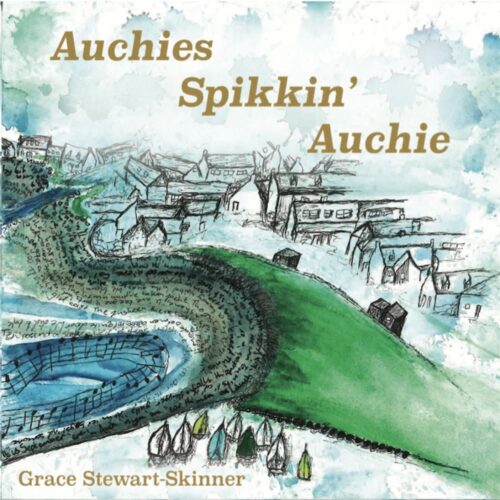
Order Auchies Spikkin’ Auchie via Bandcamp: https://gracestewart-skinner.bandcamp.com/album/auchies-spikkin-auchie
Keep an eye out for that tour; that will be something special.
Follow Grace on Facebook | Instagram
Website: https://gracestewartskinner.co.uk/auchies-spikkin-auchie