
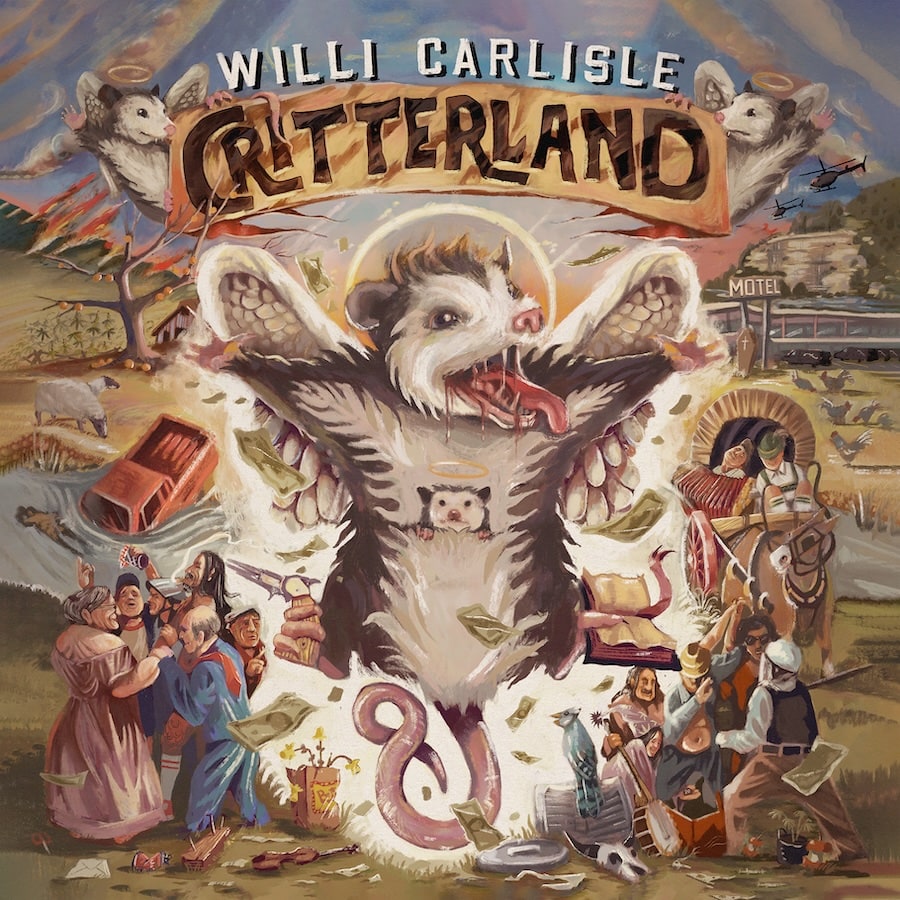
Critterland is Willi Carlisle‘s follow-up to 2022’s well-received Peculiar, Missouri. This third album, produced by Darrell Scott, is also his first for the prestigious Signature Sounds label, further cementing his reputation as a captivating spinner of yarns with songs populated by colourful characters that dig into the human condition.
As a writer, he’s been spoken of alongside Prine and Dylan, but his voice and delivery are far closer to Loudon Wainwright III, as are his sympathies for life’s misfits and outsiders, never quite comfortable in their own skin. Bluegrass banjo setting the pace, with producer Darrell Scott on guitar, dulcimer and pedal steel; it opens with the title track, dedicated to the isolated international anarchist hippie values community of Mountain View, Arkansas, which he almost joined during the pandemic (the song title derives from a game where you had to call our ‘critters’ if you saw one cross the road), speaks of nature in regarding doing the best we can in the world where we live as just part of the ecology, suggesting animals may have their act together more than humans (“The possum knows his mind more than I do”). Here the narrator (“I could’ve been a businessman, I was too hot-headed/Plus I never had the money, plus I kinda got arrested”) is taking refuge, living and loving and “Singin’ songs to a god I have met but do not know” in a community where “the granny witch and herbalist have remedies for us… propane gently sputters, there’s spring water in our tap” and “On the homestead in the pine-bed we’ve grown our holy power”. It’s a celebration of finding a family who may “think I’m a queer and a communist” but embrace him in the fold because “why have a god if no one is saved?” And, if it comes down to “the war that’s ragin’ ‘tween the haves and the have-nots…when marauders come, ‘cause the apocalypse is ni”, he’s going to make his last stand “my rifle on my shoulder and my lover by my side” and “Take my fiddle and my good hat and go out in style/I’ll do it all for family, not for glory or a god”.
Accompanied by just guitar and pedal steel, he describes Dry County Dust as a counterpoint to an earlier song, Cheap Cocaine, with a person with an addiction looking to redeem themselves in the domestic bosom after being a disappointment to their mother (“Mamma’s in the kitchen/Singin’ sweet by and by”) and, again touching the healing power of nature, with chickens in the backyard and cats on the windowsills, its simple moral and hope of redemption captured in the line “thank god forgiveness comes in so many shapes/I been travellin’ in anger, tryna ditch the shakes/If you get high in Texarkana, can you still wake up in grace?”. It ends with the mother’s passing (“We sent the old girl on/With guitars and gospel songs”) and a poignant reminder that “there’s things a microphone/Just can’t pick up/Somethin’ like quiet prayer/That comes from everywhere/Something like a loan/You know you never can pay back”.
Again not autobiographical, the fingerpicked The Arrangements, Scott on baritone and lap steel guitars, turns from a good mother’s death to a bad father’s (“He was dead inside my head long before he died/So makin’ the arrangements felt natural, felt nice” but “let’s pour one out for the bastard” because “It’s still sad when bad men die”), balancing loss with bitter memories and unwelcome realisations (“I hear drunk footfalls through bedroom walls…but I’m my own father now”), but while an exorcism and catharsis (“He was fulla shit and I’m over it/I’m glad that I’m alive”), it ends on the dark note that “I’m my father’s spitting image, and I spit upon the mirror/I see the old man is still here”.
With flat and fingerpicked guitars as well as banjos, Carlisle aptly sounding more like Guthrie here, The Great Depression is a lovely old school folksy tune that took inspiration from how his own family travelled by covered wagon from Illinois to Kansas in the early 20th century. Arguably the emotional heart of the album, it speaks of transforming suffering into support and survival, of how the ordeals “From the needle-prickin’ mothers who were never taught to read/To the barefoot hungry soldiers that enlisted at sixteen…that on the lam and on the dole they counted themselves free” pass down fortitude for those who “have hustled towards the overpass to sleep there in the rain”. Echoing the line about what doesn’t kill you makes you stronger, it concludes, “If this is our small lot in life I’ll love it like I mean it/The blood is strong with victory that brought us our despair …I won’t waste a single moment of the work that brought us here” because “To win our kin a better life is still worth dying for”.
Returning to the theme of misfits and seeking beauty in a cruel world, The Two-Headed Lamb draws on the poem by Laura Gilpin about a “freak of nature”, which celebrates the existence, however brief, of those who don’t fit the norm. Carlisle says he wanted to eulogize the queers lost to today’s political climate and the belief that “even god can make a fuckup”, symbolised in the song by a farmer who fails to grasp the miracle of persimmons growing out of season, of “bones of people born too soon, lambs too strange to survive born only meat for wolves or born a freak to humankind”, the song’s transition from the poem’s calf to a lamb emphasising the sacrificial undertone.
Atypically accompanied on harmonica and mandolin and sung in a nasal whine, A Higher Lonesome is a rare excursion into personal territory for a song about travelling and outrunning addiction (“half the places I been might be laced with psilocybin”), with Carlisle recalling in the notes “I’m rolling around the front range in Colorado, high as a kite, sexting with one hand and driving down mountain passes with another in terrible weather. Later, I told my shrink that I was in love with somebody new every week, and asked if that sounded insane. I remember she looked at me, from our zoom meeting, and said: ‘I don’t think you’ve been listening to me’”. A number about the deepest kind of loneliness, the lyrics actually take on a straight context (“It’s a ton of bricks in Minneapolis, she don’t know my last name/I saw the darkness comin’ at me in a Jeff City motel/There was writing on the mirror, said you messed up, so go to hell/And Cormier’s pills were on me still, and her letter just half-read/But by the time the sun was up I just got breakfast instead”. It also has the album’s best line in “I don’t want to hit rock bottom, just to see how deep it goes”.
Carlisle on lonesome backwoods fiddle, Scott on banjo and the Jude Brothers on harmonies, No Children loosely bases its melody on I Am a Pilgrim. Described as “a hymn for childless people in an imaginary church”, it’s basically about not being able to love others if you can’t love yourself but also about the idea of not setting yourself up as having dominion over others, a mishearing of the original lyrics transforming “no earthly child will cry for bread” into “I want to tower over no one/Grind no bones to make my bread”. Or, again, as the notes have it, “Will we make babies or scorched earth? Will we become freaks or fathers or both?”
In the story of a friend’s suicide and how there were too many big words in the suicide note for the cops to read, Jaybird manages to include a reference to Dungeons and Dragons, proving that you can sing about death and still have some fun. The final song, featuring a simple piano melody and strings, Billy Keane co-write When The Pills Wear Off, is, he says, “A gay fantasia, a queer love tragedy, it’s kinda about getting a little older, moving from hard drugs and hookups to bedroom sex and pharmaceuticals. It’s an amalgam of queer stories that I’ve heard, lived, and seen”. Playing like a confessional nostalgia for doomed desire (“drove 200 miles for six inches of love”) and cheap thrills alongside regrets and homage to friends lost to heroin (“Strung out on the highway like we couldn’t read the signs …I think Jesus sent an angel, stuck needles in his thigh/And the old freight trains, they whistle and whine/They shake the whole damn house, like we did when he was alive ”). When the refrain comes to “the only time I get these guilty thoughts/Is when the pills wear off”, you might ponder Kristofferson’s question as to whether “the goin’ up was worth the comin’ down”.
With just muted banjo and the sound of Tennessee rain on a tin roof, it ends in epic mode with the seven-minute spoken word (save for the brief refrain “A good man murdered, a bad man drowned/The cops are all moonshiners now”) The Money Grows On Trees, an elaboration on When Money Grew On Trees, David Mac’s posthumous first-person account of his life as an Arkansas marijuana moonshiner and his deal with the devil in the person of Ralph Baker, the corrupt outlaw sheriff of Madison County who afforded him protection in return for a slice of the increasingly lucrative takings. Pure American Gothic, Carlisle bares his romanticism in giving events a different ending as Baker is found drowned, rather than committing suicide in a WalMart parking lot after being caught stealing, the song has Mac exiting in a triumphant Cagneyseque death-by-cop finale (“I leave in a bodybag but not in cuffs”). It’s hard to imagine it getting radio play, but I can’t wait to hear him deliver it in person.
Critterland is an album steeped in and driven by contradictions, its fingers grubby with the dirt of real life in all its joy and despair, those small moments of happiness and those hours of misery; it confirms Willi Carlisle as a strikingly individual voice in a genre far too often populated by clones.