
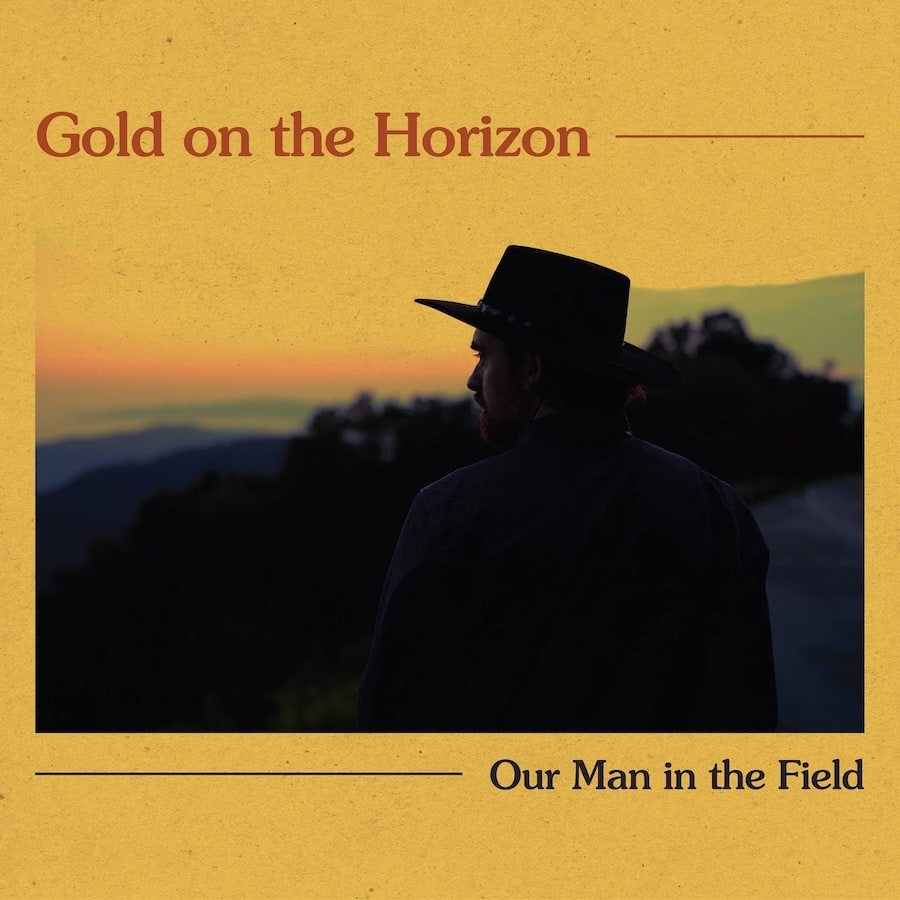
Gold on the Horizon is the follow-up to Alex Ellis’s (aka Our Man in the Field) 2020 debut, The Company of Strangers. Recorded in Portland and produced by Tucker Martine, and fully acknowledging its musical affinity with Leonard Cohen’s The Future, the album opens to Feel Good with its gospel backing vocals and noirish desert horns. It finds him reflecting on his pre-music days as a jobbing actor and a decision to join a prestigious London firm only to discover his agent had spent the money he was due on drugs and prostitutes; the song also addresses the issue of addiction (“Won’t call you up/When it knows you’re blue/Won’t stop you doing what it knows you shouldn’t do/And it can’t be blamed/For the moves you make/But it makes you move them all just the same”) and how going clean can still leave you with “the taste in your mouth”.
Quiveringly sung to a sparse accompaniment, Come Back To Me is another reflective number, here a longtime old school friend called George, and, assuming he’d rise to a glittering career, addressing his guilt in his dismissive response to learning he planned to become a teacher and a wish to reconnect (which they did during Covid). It’s followed by the slowly unfolding, percussive and pulsing L’Etranger, which, as all French lit scholars will now, refers to Albert Camus’s classic about feeling an outsider, the song speaking of being comfortable in your own skin (“In the company of strangers/I’m as happy as can be/And I want to be a sailor/So a sailor I shall be”) and self-reliant (“I believe there’s nothing up there looking down on me/oh I believe there’s no one out there waiting for me… I’m not expecting something/I’m just hoping for relief/I’ll put my faith in hope because hope is all I need”).
That refusal to tie your fate to some higher power also informs the pedal steel-coloured, scuffled Van Morrison soulfulness of Silver Linings (“You can keep your silver linings/They don’t work on me… You can keep your holy water/Does nothing for me/I’ve always been a slow drinker/And there’s no hope/For me”) from whence the album title comes, as he declares “I believe in something else/I just don’t know what it is yet/I know it’s out there somewhere/I’ll know/When I feel it”.
Initially pensive before musically opening up the soundscape, the keyboards accompanied Great White Hope follows a similar train of thought (“You’ve been having doubts and I feel the same…So where is this great white hope/Come to save us all/If I didn’t know I’d say that we’ve been fooled/The whole damn time”).
Go Easy is dreamier, more musically introspective, and was written for the former Winter Olympian ski jumper landlord of a London pub called the Betsey Trotwood, a venue dedicated to giving bands their first gigs as well as employment for out-of-work actors and musicians, artist coming together during the pandemic for fundraising shows to keep the pub him and his two sons afloat after he lost his wife to Covid, the song and the title an encouragement to “go easy on yourself”.
Reminiscent of Neil Young’s Harvest Moon, the riding pedal steel waves of Glad To See You is a gentle dance tune he wrote after meeting Mohan Bhart, a doctor with whom he was paired as part of a songwriting project run by the AMA and who, in charge of an inpatient hospital for people living with dementia up until 2020, was told to create an emergency Covid ward when the pandemic broke out, all but two of his staff resigning on the spot. Those nurses and his new colleagues giving him the strength to carry on, as captured in the lines “I’m so glad to see you/Not meant to let it show but I want to let you know/It’s not been an easy shift/But you give me a lift/And I appreciate it”, an upbeat reminder that “every wound/Heals in the end”.
Opening with strings and taking a country feel and more Morrison hints, Last Dance is a musically upbeat but bittersweet number about the break-up of two friends who lived next door to him and his girlfriend in Peckham, the relationship ending when he cheated on her, and that awkwardness of the eventual separation (“You’re leaving in the morning /What about tonight/Do we pretend/That it’s alright/Go to bed like it was any other night”). On an upbeat note, they both now are happy with new partners. A quiet drone giving way to picked guitar and drums, the midtempo How Long musically reminded me in part of Ben Glover on a song of loss and yearning, that offsets “my eyes are open and all these wounds have healed, scarred over” with “I’d walk thousand miles in any man’s shoes /if they walked me back to you”.
The brief cosmic drifting instrumental The Road Interlude (The Road itself will be a bonus track on the second CD run and 10” vinyl) provides the bridge into the closing huskily sung track, Long Forgotten on which, accompanied by synth drone, pedal steel, piano and female harmonies, he returns to the outsider figure, seeking to escape his past, others and himself as he wearily confesses “my head is weary my feet are sore/I don’t want to run no more…I’ve been travelling I can’t tell you why I do/moving on from town to town/I don’t ever see things through” and pleads while “it’s true what they said/there is a price on my head/but before you dial those numbers /won’t you please listen to me instead” as the lyrics unfold “It was some other man/Someone else’s hand/Someone else’s crime/Not my own” and that “it’s not so easy and it’s not so quick when it’s your soul you’re trying to kick”. His only wish now captured in “long forgotten is where I want to be down at the bottom of some old memory”.
Ruminative, existential in parts in its questioning of the existence or otherwise of God, steeped in empathetic humanity but also veined with doubt in its contemplation of life, it’s an album to immerse yourself in and let it wash your soul.
Album launch on 25th November at The Slaughtered Lamb, London.
Tickets and more tour dates here.