
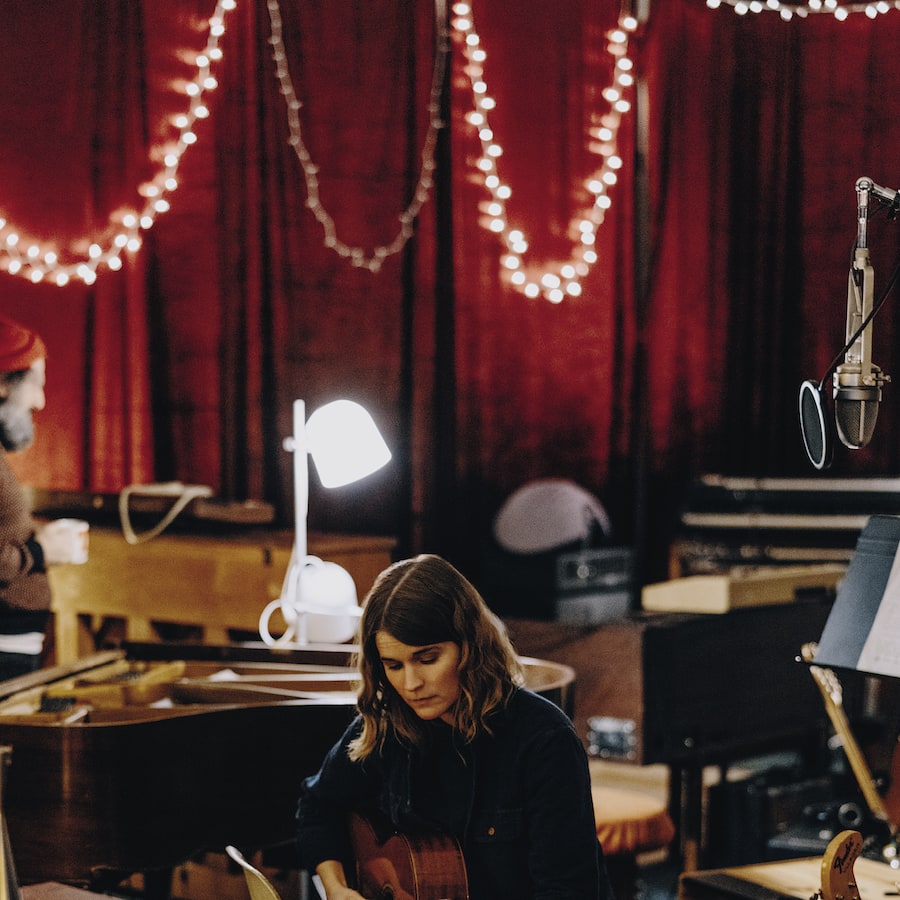
Born and raised in New Jersey, Avalanche is Jenny Owen Youngs’ first full-length studio album in ten years and her Yep Roc label debut. During that time, she’s had a book deal, made podcasts, moved from Brooklyn to Los Angeles to coastal Maine, and gotten married, divorced, and married again. As her label says, “She’s done everything, it seems, except release another album”. She’s joined by multi-instrumentalist and producer Josh Kaufman (Bonny Light Horseman, The Hold Steady, Cassandra Jenkins, Josh Ritter) and drummer Matt Barrick of The Walkmen for, as she describes it, songs “of moving from destruction to restoration, traveling through pain to possibility”. There are also several co-writes with S. Carey, Madi Diaz, The Antlers’ Peter Silberman and Christian Lee Hutson.
It begins with the title track (written with Diaz), opening with hesitant piano before fingerpicked guitar notes arrive, the song more restrained than the tumult of emotions captured in the lyrics (“When I try to say the things I can’t/It comes out like an avalanche/How else do I prove that I adore you/Something about my savage heart/That wants to tear your world apart/And stitch it all right back together for you”).
Carried by hissing beats, on Where The Knife Went In, talking about the song, she revealed, “There’s nothing quite like the feeling of meeting someone and discovering that their scars match your own, so to speak; this can create the opportunity for accelerated intimacy.” She adds, “This song is concerned with reveling in that closeness”, in which she sings “When I pulled you in/To the place on my body/Where the knife went knife went in”.
Love found or lost is a running theme, Goldenrod, again crafted on sparkling piano and guitar, moving from memories of youthful friendship (“We’d go driving around downtown/ Smoking in parking lots/And letting the ash burn down/On the ones we forgot”) to tragedy (“You never felt a thing/That’s what the paper said/Your sister just losing it/And the street glowing red/As soon as the call came in/I got the hell out of town/I couldn’t stand to see them/Put you into the ground”).
A co-write with Christian Lee Hutson, Everglades takes the pace up with nimble guitar and brisk shuffling percussion, the track and her voice reminiscent of Annie Dressner, and again veined with regret (“I tell the truth but in between/I say a lot of things I don’t mean”) while the funereal slow rhythm of the intimately sung Bury Me Slowly explores childhood trauma and how it shapes us – sewing together a car wreck (“I lost my own car/She’s strewn cross the highway”), relationship uncertainty (“Tell me I’m yours/Or tell me that I won’t/Be in the morning”) and vivid memories (“I hid in the bathroom/Next to my brother/While I was listening/To sounds of my mother/Learning the lesson”) ending with the prayer “Don’t let me grow to be/The bottomless monster/That I have seen“.
Reflecting on the past and the anticipation of what might have been is the idea behind Next Time Around (“One day you might grab a seat/On the empty barstool next to me/Or you’ll drop your books and I pick em up/When I hand them back, our fingers touch”) because “when I fall, I fall good and I fall hard/Can’t tell between what I need and what I want”) with its folky fingerpicked verses and more robust swayalong chorus.
For the choppy handclap shuffle rhythm and high-pitched sung, It’s Later Than You Think, Youngs sings, “Got a memory to amputate/Digging for the novocaine /Looking for some relief…Got a finger to my wrist again/Thrumming underneath the skin/Is singing be here now …I mostly don’t know where I’ve been/Or what I thought about“. She reveals how the song was written at a time of physical disconnection when her “phone felt like my tether to life as I had known it” and how “scrolling is a slippery slope and it’s easy to overdo it; it’s engineered that way. This song is a reminder to myself that my time on this planet is finite and precious, and that I want to spend it wisely on what matters. (Most of the time.)”
Taking the tempo down to a slow walking beat, Salt, another Hutson co-write and on which he sings harmonies, is a number about coming to the realisation that ending a relationship is better than trying to keep it alive (“I gotta be honest, we have a problem/Got a call from the bar in Clarion/You left your wallet, career alcoholic… If I could make enough money, I’d move out to the country/Where no one can bother me/I think it just hit me, I don’t want you to come with me“), or, as she puts it “anybody worth their salt/Knows the arrow hurts worse when you pull it back out“.
As a codicil to that, the breathily sung Set It On Fire, with its circular dampened drum pattern and moody guitar lines, is about letting go, “Trying to hold what was already gone” and taking the plunge into something new (“You make a little whirlpool in my heart/Tiny constellations pulled apart/Killing what I can’t control, I’m fine/I love you I’m ready to set it on fire“).
It ends, though, seemingly finally bringing herself to bid farewell to a relationship that’s run its course (“I been circling/Looking for anything/That I could say to you/To dull the edge/Am I avoiding it“) on the ruminative, whisperingly slow waltz piano ballad Now Comes The Mystery and the mixed emotions that ensue (“Feeling my pockets now/For missing keys/I don’t know what to do/To say goodbye to you/Maybe another day, I’ll know why“), although the lines “Somehow I felt you go/Before I heard it though/I know you’re on your way/From where you came/Beat of an archer’s heart/Back up among the stars” hint at perhaps loss of a different kind.
While the album has been a long time coming, much like the phenomenon of its title, it will sweep you up in its path.