
Eilen Jewell
Get Behind The Wheel
Signature Sounds Recordings
5 May 2023
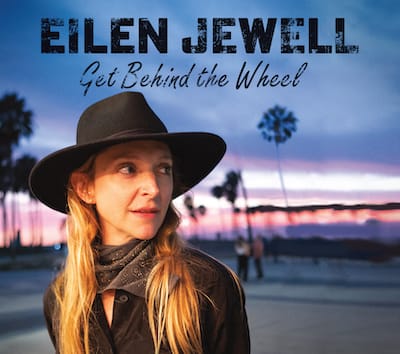
Battered in quick succession by the end of her marriage, the deaths of friends and family, the pandemic and “drinking too much to escape all the stress”, Eilen Jewell took off to a cabin in the mountains of Idaho to recover with meditation, psychedelics and wilderness walks. It’s from this melting pot that Get Behind The Wheel was forged.
Recorded with session musicians that include Fats Kaplin, Will Kimbrough and Jerry Miller, it kicks off with the defiant Alive, which, starting out tense and brooding with echoing guitar before becoming noisier and more ragged, is about rebirth, moving from broken to whole with a lust for life (“Fill up my glass, I want more/I run on these fumes, accelerator’s floored/You say you wanna kill your thirst, but the flask is cracked/How you ever gonna quench it like that …So I pour out my heart and light the fire/And everything true comes alive”).
Anchored with steady drum thumps and Kaplin’s pedal steel, Crooked River is one of the more country numbers, the title and son referring to a spot she found while walking the trails in the mountains, becoming a symbol of what she was going through and how the path forward isn’t always going to be straight.
Turning the funkier side of Southern country, Lethal Love she describes as about love’s shadow side “a dangerous carnival of hungry ghosts, a Pandora’s box full of eternal craving, inhabited by trapped, debauched spirits playing deadly games for the hell of it”, but, rather than a warning it’s about plunging into the ‘warm quicksand’ and making the most of it (“No one here who runs from here makes it out alive/I don’t know why anyone would try, it’s such a sweet paradise/And I just want more of what you got”).
Having somewhat revelled in her solitude and loneliness, the pandemic brought home the importance of connection and togetherness, realising how much it’s needed only when it’s taken away, an awakening that, spurred by encounters with random strangers, resulted in Come Home Soon (“Old Shade he threw his soul away/Now he’s made of thirst and Tanqueray/Well I’m packing up mine for the road again/From the twisted joints of Chicopee/And through the acid streets of Venice Beach/And if we could hold on to this fading day/Could we be the ones who find our way”).
Strummed acoustic and pedal steel colour the rolling country of Winnemucca, a ‘thinking of home’ road song (“Creosote and coyotes and a blazing sky/A sturdy Winnebago and a box of wine/Waiting for me by the highway side/When I get back to my baby I’ll be feeling alright”) and another number about a location, here the city in Nevada.
Coming to the halfway mark, she takes time out for a couple of covers, the first a faithful reading of Could You Would You, an old Van Morrison number he recorded with Them back in 1966 and which echoed the signature guitar line from their earlier cover of Here Comes The Night. That’s followed by Breakaway, originally recorded by Irma Thompson and later a hit for Tracey Ullman, here given a slowed-down treatment to accentuate the underlying heartbreak of the lyrics.
It’s back then to the self-penned material with the slow-paced, guitar-twanged You Were a Friend of Mine, which speaks to the pain of something beautiful coming to an end, of betrayal and grief and, while it’s easy to assume it’s about her divorce, its scope encompasses loss of all kinds and the wanting to cling to a memory of what was (“We beat our thoughts to a pulp and they rot there in the bed/Every word is spoken and still nothing is said/And when all the fallow fields are poisoned and dry/Won’t you know me forsaken though am I”).
Directed by Francis Ford Coppola in 1983, The Outsiders was a coming-of-age crime drama about two rival teen gangs, a film Jewell saw when she was seven and opened her eyes to a world she didn’t know existed. Thirty-seven years later, the bluesy slink Outsiders is her homage (“Those wild and beautiful things/Turned-up collars and rolled-up jeans/Tracks of tears caked with mud/All mixed up with the orphans’ blood/Those wild and beautiful things/If only someone could see/The gold that lies beneath”). The penultimate track, a dreamy dancefloor shuffle in the arms of pedal steel, mandolin and twanged guitar, Silver Wheels and Wings, was spawned from the psychedelics and meditation she undertook in her journey back to finding herself and the paradox of how by embracing loss, you can find freedom, light emerging from the darkness. Conjuring the psych noir folk of Jefferson Airplane and Buffalo Springfield, it closes with The Bitter End, a five-minute condensation of the album’s themes about confronting the hurt and transforming it into healing, starting out musically and lyrically stark and forlorn (“So this is how it slips away/With a whimper and a bang/This is how our banners fade/Caught in the devil’s own parade”) and gathering strength as it builds (“This is where you have to start/ Oh you crazy, crazy heart/From the ashes, from the dirt/From the wound, from the hurt/You have to break before you can bend”). An album that serves as a testament to Nietzsche’s assertion that what doesn’t kill you makes you stronger, she’s clearly back in the driving seat.