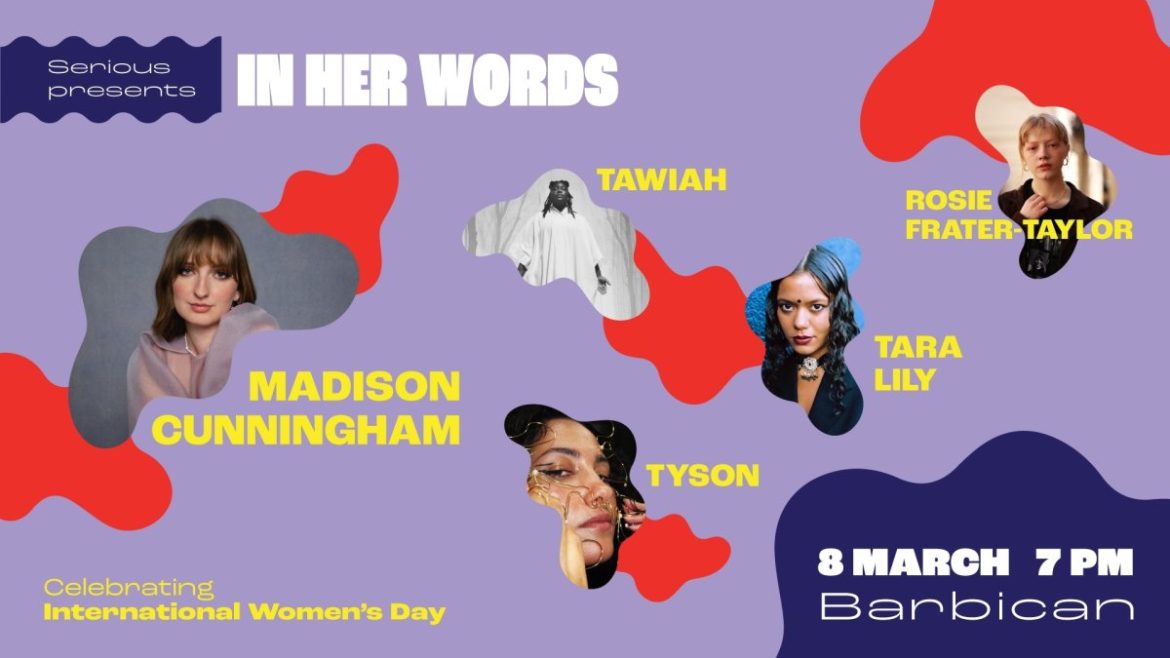
As we approach International Women’s Day (8 March), Madison Cunningham talks about her new album Revealer, being a woman in the music industry, and her upcoming concert at the Barbican – ‘in her words’, which celebrates the music of amazing female artists with a headline performance from Madison, plus TYSON, Tawiah, Tara Lily and Rosie Frater-Taylor (Tickets here).
A few months ago, I had never heard of Madison Cunningham. I was sitting in Riot Bar in Dublin, near the Liffey River, when one of my friends mentioned her name to me. “She’s a mind-blowing singer-songwriter,” he said, “And her guitar playing is class.” I listened to her the next day, agreeing with their apt description. So, when asked to interview Cunningham for the International Women’s Day concert at the Barbican, I jumped at the opportunity.
The Zoom call started like all Zoom calls do – somewhat awkwardly, with me wondering if I looked cross-eyed on the screen and if my PJ bottoms could be seen on camera. Cunningham seemed very fresh and put together for what was still a relatively early morning in L.A. “I usually get up around seven,” she explained.
We started by talking about her songwriting. Cunningham is a musician who writes by rewriting, tweaking, and experimenting, which leads to the thoughtfully crafted, detail-oriented songs you can find all over her latest album Revealer. One of her favourite songs on the album is Life According To Raechel, a song for her grandmother who passed away during the writing of Revealer, a song that “just kinda happened”. Other favourite contenders were Sunshine Over The Counter and Your Hate Could Power A Train, for being playful in the chords, melodies, and ideas and being fun to play. “What’s the point of making music if you don’t enjoy it?” she asked.
It was a good question that prompted me to ask how she’d come to songwriting in the first place. “My dad wrote a lot of songs growing up and I watched him do it. I was probably around seven when I started writing my own stuff, which should never be shown to the world ever!” she joked.
Cunningham’s love for songwriting developed simultaneously with her passion for guitar, and she explained how they exist in tandem for her, with one skill challenging the other. “When I write songs, music often comes first. I have a lot of songs right now that are full arrangements – the melody, the shapes and the chords, the arc of it, but I don’t have the lyrics yet. I’m just sitting on these ideas and waiting for something to sing about.”
While this method may appear unorthodox to some, it works. Her lyrics are poetic and polished, with surprising turns of phrase, ironic observations, and the detail of a writer who pays attention for a living. “Lyrics are important to me, and I sweat over them the most,” she admits. “I read a lot of poetry. Last year, it’s been a lot of Mary Oliver. She’s so deep and imaginative that I’ve stuck by her side for the last twelve months. And I get the sense that she’s constantly on walks, so every time I read her, I think ‘Damn, it’s time to get out of the house!’”
Talking about lyrics, I remember the line from her song Anywhere, “Walking after dark/ Holding tight to my keys/ You don’t give a second thought/ Walking where you please”. “The song is describing a very specific instant, where I’m talking to a person who’s expecting a lot of me and I’m clapping back, saying ‘It’s easy for you to say that for all these reasons’. That line about the keys was a quick way to say that, as women, we are always looking for escape routes. That’s probably the only song on the album that speaks directly to the gender dynamics.”
How has being a woman affected her as an artist? I ask. “I have been very fortunate to have been surrounded by a lot of men – women too – who have empowered me. I was very doubtful, insecure, and shy, and there were a lot of musicians around who said to me: ‘We believe in you. Here are the keys. Do what you want to do.’”
The industry is not without its flaws, though. Cunningham reflected on other aspects of being a woman in music, where the gender dynamics are still felt. “We haven’t eradicated it yet. Sometimes, you don’t realise it until later, when you think: ‘Oh, if I were a man, you wouldn’t have questioned me like that.’” That brings me to another question that I’m always interested in when talking to female musicians – had the things she had chosen to do as a musician been affected by the fact that she’s a woman? “I don’t totally know. That’s probably something I should ask of myself. When I picked up electric guitar, I was well-aware that a lot of men claimed it as their instrument and maybe because I was a woman, I was drawn to it – to provide another voice, another angle. I do feel like females get cast in these funny categories. I’ve been placed in americana and folk a lot, but I don’t see myself as a folk musician. I don’t identify with genres anyway – music is fluid and I think we should move beyond that. But I think I’ve been placed in categories that are traditionally more female-led.”
I remember that she had opened for Harry Styles, and her music genre was not wildly different from his, yet, it was hard to imagine anyone calling Harry Styles a folk musician. “There are so many layers to it that we, as women, have not even tapped into yet. But we’re doing our best,” Cunningham said.
I wondered if that awareness intimidated her when she entered the music industry. The singer-songwriter moved to L.A. to pursue a music career when she was 21. “I don’t remember feeling scared. I remember feeling green and ambitious to learn. When I arrived in L.A., I hit the ground running hard. Writing every day, all hours of the day, trying to pay rent. I ended up travelling a lot doing this radio show called Live from Here because it was the exact amount that I needed for rent. I played with Chris Thile and that shaped the first two years of being in L.A. That’s when I wrote Who Are You Now.”
What was the difference between making that album and making Revealer three years later? “I became a little surer of myself and got more demanding in a healthy way – of myself and my team. I think it really strengthened what we’re doing and building, and I think vision tends to do that. With the last album, I also needed the support that was available to me, and I leant on that. For Revealer, I did a lot of leaning on myself, which was lonely but important.”
What stood out to me when listening to Revealer was the nod to Cunningham’s last album, a song titled Who Are You Now. “That song was unfinished when I put out the album, which was untitled at the time, so I called it Who Are You Now. But then I put this song on Revealer and I think it was a funny nod to that record. Maybe I’ll put a song called Revealer on the next album.”
To finish up, I ask if she’s excited about coming back to Europe for her concert at the Barbican on 8 March. “Playing in Europe is so much better. Everyone is just nicer and more excited. I’m thrilled to go back – we toured Europe in November, and it was one of my favourite tours. I’ve played the Barbican before, opening for Andrew Bird, so it’s crazy to return and to headline.”
We finish on that note, and Cunningham leaves to go write more songs and sit in the sunshine, probably channelling her inner Mary Oliver. It’s already evening in our half of the world, so I put on Revealer, sit back, and listen.
Get tickets for “In her words” – 8 March 2023.