
Benjamin Dakota Rogers
Paint Horse
Good People Record Co
17 February 2023
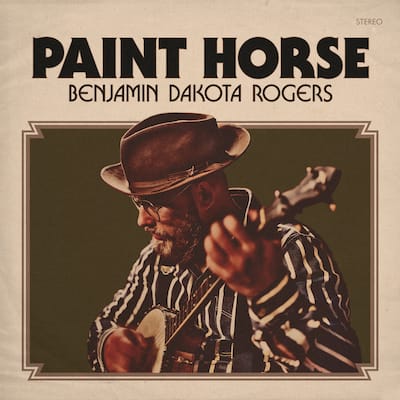
Benjamin Dakota Rogers’ ‘Paint Horse’ is a plaintive offering, veined with the sensibilities of an accomplished storyteller and steeped in the folk music of his roots.
Growing up on his family’s farm in Southwestern Ontario, Benjamin Dakota Rogers grew vegetables and listened to a lot of fiddle music. Today he lives in a converted barn and plays guitar. That bucolic life is evident from the start with the wearied, quietly strummed cowboy ballad Little Old Paint Horse with its chorus, “I ride a little old paint horse she carries me on my way /She sure a foot in sturdy wild is the rain/All the cattle they are lowing as I’m singing them to sleep/And the stars are like a blanket god hung over me”, Sam Clark accompanying on fiddle and Peter Klassen on bass as throughout his latest album Paint Horse. That love of nature is echoed later in a return to the prairie for the slow-strummed Wild Wind Can Have Me, a paean to surrendering to its wild beauty that comes complete with cowboy yodel.
He turns to storytelling for the spare, moody John Came Home, a murder ballad as a soldier returning from the war discovers his wife has run off with his brother and takes bloody revenge (“John crashed in with his pistal crying in the morning just before the dawn/He took out his knife and he carved out the light of a future in the eyes of the lord/Strung him on high silhouetted in the sky let the ravens pick him to the bone”), before confronting his wife waiting for her lover and declaring “I won’t take your life but I want to look into your eyes when you see I killed the man that you love”.
Knives loom large in his lyrics, another being wielded in the fiddle and guitar Appalachian-like Charlie Boy, a traditional-sounding murder ballad tale of the rebuffed lover (here the woman claims she’s pledged to another by her mother) exacting his revenge, proposing various ways he might rid her of her intended and she is arguing the consequences, though apparently not that persuasively as it ends with his shooting him at the altar and going to the gallows. Again in narrative mode and again featuring a death by blade, Jeremiah is an urgent mountain folk blues that tells of Jeremiah Colter, “the biggest man in town”, a gold prospector, and how he killed the bandits trying to rob him of his find.
That’s preceded by the album’s sole cover, a desert dry version of Red Lane’s 1967 Blackjack County Song, which relates the killing of a Georgia sheriff by members of a chain gang, rejected by Charley Pride as too controversial before being recorded by Willie Nelson and ultimately banned by many radio stations.
Greyhound is another vocally rasped and drawled drifter’s love (“The girl at the bar she thinks I’m handsome/And I can’t tell if she’s lonely or maybe she thinks I’m the one/It doesn’t really matter I’ll be gone in the morning/But I wouldn’t mind laying here with her in my arms”) that also touches on restlessness as he sings “Maybe I’m just like my grandfather/He built houses he couldn’t build a home/She says I’m just overthinking/But I’m tired of waiting in the driveway trying to turn off a storm”.
A knife and romantic disappointment go hand in hand in the sprightly jogging backwoods folk sounding Back To You with its suggestion of a failed contemplated suicide (“Well, I gambled my last dollar on a girl in a sequin dress/I was just outside of Philly trying to thumb my way back west/In a dirty bathroom mirror, I tried to cut myself off/I was always all or nothing and my courage keeps getting lost”) as the narrator determines to make it home to the woman he left behind in a fit of rage (“I wish missing you was easier than you’ve been missing me/All the anger in my bloodline had me going for my knife/I felt guilty I felt crazy I cried the rest of the night”).
Another story, less intense but no less sad, conjuring echoes of early Guy Clarke, Arlo unfolds a portrait of a man whose dreams have all become dust (“He used to own some cornfields up in old Illinois/Developments grew like cancerous tumours and the government bled him dry/He held on just long enough to watch his son grow up/The bank called they took it all left him with nothing but his luck”) and now, his faith in a bountiful God faded, he drives the freeways and “carries around his wife in a Tupperware on the seat/And he’d swear he could see her ghost flicker when he flips on the high beams/When the driving gets too quiet he’d sing her the songs /That used to make her dance/A little blaze in the morning to chase away the night time’s trance”.
There’s a lighter mood for the nimbly picked Maggie which, Zoe Sky Jordan on harmonies, recalls Dylan’s singing of traditional folk songs, another character sketch of a free spirit (“she’s a wildflower everybody knows/You can’t pick her you can’t plant her you can’t tell her where to grow”) while the narrator laments his unrequited love. It’s not the only song named for a woman; Eloise is a sprightly bluegrassy number in which the singer laments how his bride treated him mean (“you lie steal and cheat and you take from me all the things that I/Would’ve given to you”) before running off, though he comes to realise he’s a lot better off. In contrast, the slow waltzing Rosie relates the downbeat story of a girl venting her anger outside the church at being abandoned by her folks (“She says where was your God and my momma was gone and my father couldn’t look me in the eyes”) who he eventually finds in a pool of blood (“because someone got angry and they busted her body and left her to die in the mud”) and buries her (“out in the western fields behind nowhere/There’s a girl with a flower for a name”).
Finally, introducing Burke Karral on pedal steel, it ends with the simple waltzingly strummed Goodnight (“Good night sweet Suzanne/Good night my love/Good night oh dear mama/Good night heavens above… Good night everything I’ve done wrong”) that can’t help but call to mind Sweet Baby James. Taylor should relish the comparison. Simple, plaintive, veined with the sensibilities of an accomplished storyteller and steeped in the folk music of his roots, it never draws attention to itself, but it never fails to hold your gaze.