

Joshua Burnside
Late Afternoon in the Meadow (1887)
Attic Things Records
18 November 2022
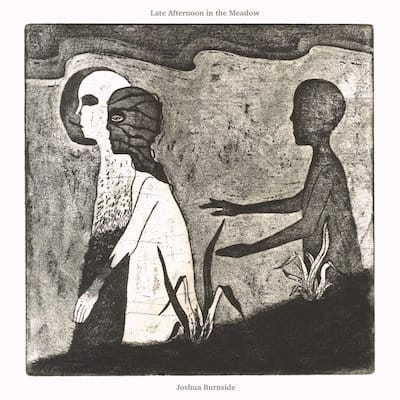
Two years on from the aptly titled Into the Depths of Hell, we find Joshua Burnside plumbing those darkest chasms once more. Yet, on his latest EP, Late Afternoon in the Meadow (1887), there is also the pervading sense that the experimental folk singer is craning his neck to better make out the stars as well.
The Ulster songwriter’s sophomore record was a complex blend of despair, humour and euphoria, which gazed both out and in. To quote one of its song titles, it waged War On Everything as it contended with matters of nationalist conflict, class struggle and climate emergency. Throughout the album, the production, arrangements and distorted found sounds either intensified the feeling of unease or sat entirely at odds with it, adding further to its compelling make-up.
On Late Afternoon In The Meadow, this contrast is even more striking. The EP takes inspiration from Camille Pissarro’s 1887 impressionist painting of the same name. Pissarro was known to employ a pointillist technique that places different coloured dots alongside one another in order to create especially evocative and wistful scenes. It could be argued Burnside does something similar in the way he pairs together opposing imagery, offsetting the life-affirming and sacred with the crushingly bleak and mundane. This is most evident on its lead single (also titled Late Afternoon in the Meadow), where he wrings every ounce of emotion from the subject with his stirring, understated delivery.
Opening with a modular gurgle, the track hollows out to his lone, tumbling voice and piercingly vivid words: “I saw a man jump off the Clifton Street Bridge / On to the Westlink / Harder than a cliff edge / Oh man, Oh man / The way he fell / Like a sack of spuds / A ringing bell / Down a stone well.” It tells the story of a Belfast man whose life has been mired by poverty and missed opportunity. “(It’s) about someone at the end of their tether,” he writes, “and if you are feeling this way, then I dedicate this song to you.” Those lines appear all the more severe, silhouetted against the sparse backdrop of acoustic and jittery synth. Occasionally, we hear a metallic clatter as if to symbolise the bell’s echoing descent.
Lyrically, it recalls Joanna Newsom’s Sawdust & Diamonds: “There’s a bell in my ears / There’s the wide, white roar / Drop a bell down the stairs / Hear it fall forevermore,” which contemplates eternity and also angles at the possibility of “somewhere warmer, kinder, softer on the soul,” as Burnside so poignantly puts it. The EP closes out with the hopeful rally of Where White Lilies Bloom, its gentle melodies braiding and billowing like a warm wind through a lea. It could even be seen as the aural equivalent of the “skies of Pissarro,” which Burnside references during the tender uplift of Late Afternoon in the Meadow’s chorus.
Unlike the organic, quick conception of Late Afternoon in the Meadow, opener Woven apparently took Burnside years to perfect. He recently revealed in The XS Noize Podcast that he had scrapped the song (then known as Black Thread) due to it becoming over-complicated “garbage.” However, what reaches our ears couldn’t be further from his original assessment. “I needed to trust that the strength of the melody and the strength of the words alone could carry the song, instead of trying to fill in every little gap,” he acknowledged. Its feathered sonic textures and gorgeously stacked vocals are bookended by one of his signature samples, in this case, a peculiar cassette recording of someone called James Kelly, which he stumbled upon at Vault Artist Studios.
Louis Mercier is the fictional descendent of Noa Mercier, a standout from Burnside’s second record. It’s another track presumably salvaged from his ‘lost’ concept album about Patrick Murphy, aka ‘the Irish Giant’. While the latter was centred around Murphy’s outpouring of love for a trapeze artist and unfolded like a Seven Swans B-side, the gaudy waltz of Louis Mercier rather evokes Beirut and picks up thematically from where Noa and Patrick passionately left off: “Little Louis / Four years old / Saw a monster in his home / Late at night / Through the keyhole / Lamplight soft and yellow.”
It then flashes forward to Louis as a conquering French legionnaire, Burnside using this opportunity to keenly poke holes in a colonialist past. “From the deepest part / Of the Human heart / The greed of man / Will often start,” he intones, as he explores how we ignore the trauma and crimes of our ancestors in order to preserve nationalistic integrity. “They forgot,” he laughs, exasperated, above the skip and pluck of banjo and brass.
With several dates on the road supporting Ye Vagabonds behind him, his biggest headline show to date just over a month away, and recent news that Rana the Fortunate (a song recorded with Lemoncello’s Laura Quirke) has been shortlisted for best single at NI Music Prize, it seems more and more are waking up to Burnside’s sensitive songwriting talents. Late Afternoon in the Meadow (1887) only reinforces what we already knew. With his third album scheduled for release next year and set to be a stripped-back collection examining the rich literary connections between Ireland and Paris, and with his first child due soon, 2023 is looking immensely promising for Burnside and his fans alike.
Pre-Order Late Afternoon in the Meadow via Bandcamp
Live Dates
Dec 23 – Ulster Hall – Belfast, UK
http://www.joshuaburnside.com/
Album Artwork by Wilhelmina Peace