
Basin Rock are to release an album of never-before-heard 70s British folk by Trevor Beales, recorded by himself in the attic of his family home in Hebden Bridge when still a teenager, sometime between 71-74 – when the mills were closing down and before the hippies arrived.
Basin Rock declares Fireside Stories (out on 2nd December – pre-order Basin Rock | Bandcamp) as one to file next to Davey Graham, Michael Chapman, F.J McMahon, Dave Evans, Bert Jansch and Jackson C Frank, as influenced by jazz, blues and steel guitar as any of the old songbook classics from ancient Albion. After you hear it, you’ll agree…
When we talk about British folk and the radicals, drop-outs, heads, musicians, artists and writers from the 60s and early 70s in Britain, we’re maybe more inclined to think of Cornwall, where the careers of Ralph McTell, Michael Chapman, COB and Brenda Wootton, as well as many others, were launched. That rugged coastline and lush green pastures may seem like a million miles away from the Calder Valley, but it’s from here that the story of Trevor Beales starts.
He was born in Hebden Bridge in 1953, and it’s from where he drew musical and lyrical inspiration. Radicalism has played a big part in the cultural history of Hebden Bridge which is today often perceived as a bohemian backwater. According to the excellent sleeve notes of ‘Fireside Stories’, written by Benjamin Myers, “The first seeds of Hebden Bridge’s famed independent streak had been sewn as far back as the 1850s when a co-operative movement was formed by workers in the cloth industry. Over time, those seeds of radicalism and collectivism ensured Hebden Bridge evolved into a place where people could be themselves and all shades of individual oddness not only tolerated but actively encouraged.”
In contrast, he adds: “But back at the turn of the dreary 1970s, it nevertheless remained a monochrome world defined by its unforgiving surrounding landscapes, where the old gritstone over-dwellings were stained with soot, rain lashed down for weeks, and during the darker seasons the sky pressed down like a coffin light. ‘Valley bottom fever’ is the term that locals use to describe the portentous feelings of gloom and entrapment that grip in midwinter.”
Beale found escape or a means of expression through his guitar which he began playing from the age of ten and then, inspired by the likes of “Bob Dylan, Django Reinhardt, The Byrds, Dave Evans, and James Taylor”, he began writing and playing his own songs, “…performing them at local (though often remote) folk clubs and pubs such as The Cross Inn and The White Lion (both in the hill-top village of Heptonstall), The Shoulder Of Mutton (at Blackshaw Head) and The White Hart (Todmorden).”
What sets Beales’ loner-folk apart from many at that time, besides a voice that belies his age, is, as Myers says, his “suffer-no-fools sense of realism that is defiantly Northern”. The music is incredibly striking, as Myers says:
“Here is a postcard from the past at that crucial musical period of transition, when the idealistic exponents of the 1960s emerged into an austere new decade that was to be shaped by strikes, rising unemployment and economic upheaval.”
Watch the accompanying videos to ‘Then I’ll Take You Home’ and ‘Marion Belle’ below. The image is a landscape photograph of Hebden Bridge by Charlie Meecham, 1969-70, which has been adapted for the video by Nick Farrimond.
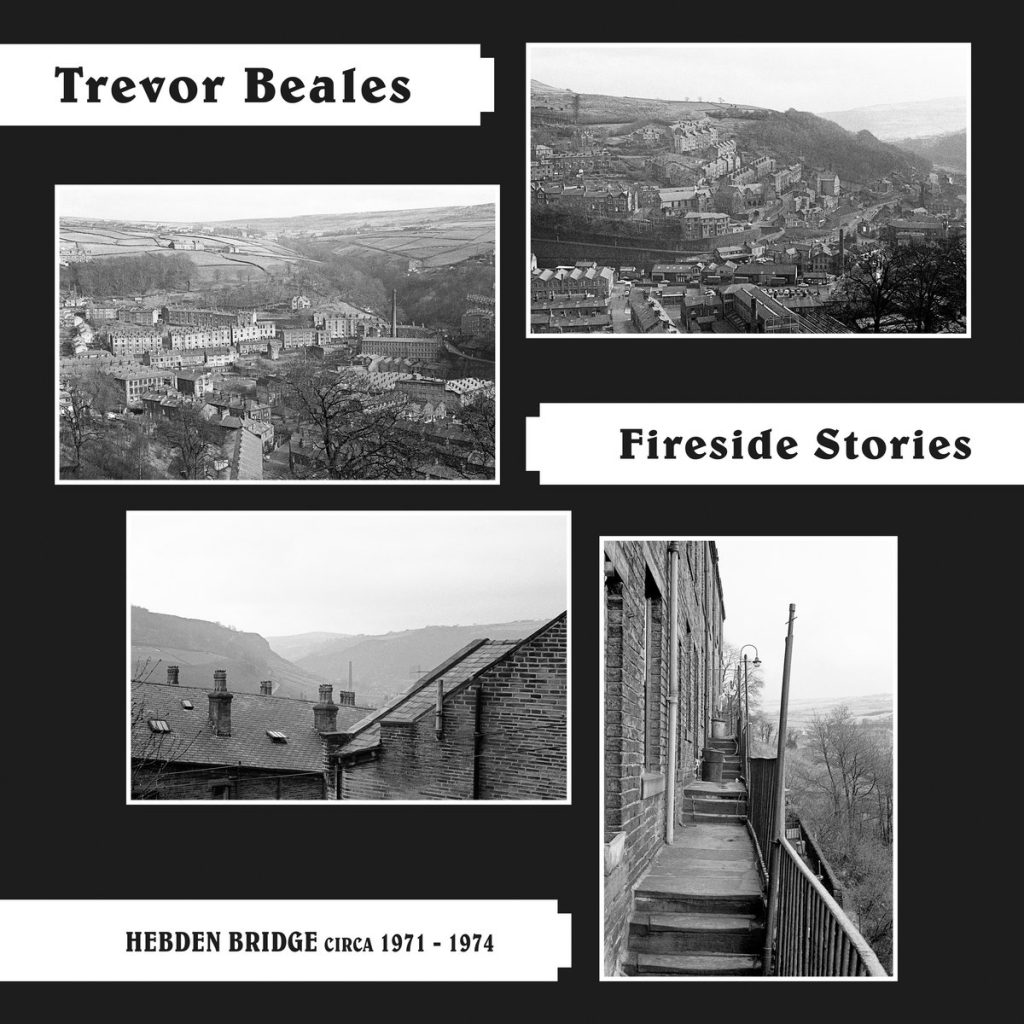
‘Fireside Stories (Hebden Bridge circa 1971 – 1974)’ available to pre-order now on Basin Rock. It is released on 2nd December and is available on Digital/CD/Vinyl.