
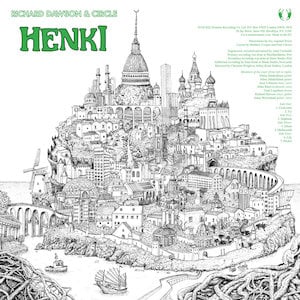
Richard Dawson / Circle – Henki
Domino Records – 26 November 2021
Much of Richard Dawson’s recent work – particularly his solo album 2020 and the more guitar-based moments of his Hen Ogledd project – has been characterised by a move towards a tougher, spikier sound. As an unabashed fan of the heavier end of the musical spectrum, it should come as no surprise that he jumped at the chance to record an album with long-running Finnish experimental metal band Circle. It shouldn’t even come as a surprise that the result of the collaboration is a concept album about historical botany: after all, this is a musician whose songs have tackled subjects as wide-ranging and specific as space travel, schoolboy football and localised flooding.
Given Dawson’s gleeful immersion into the more outre aspects of his various musical personas, you might expect some child-in-a-sweetshop pillaging of genre tropes: lengthy guitar solos, galloping bass, roaring vocals. But Circle have never been that kind of metal band. Over three decades, they have experimented with ambient, prog, krautrock and folk metal, and their willingness to indulge Dawson’s complexities with a combination of psyched-out folk-rock and impressionistic soundscapes makes them the perfect foil. In fact, what really hits home about Henki is not the shock of two differing musical cultures clashing but the subtlety of the storytelling and the melodic sensibility that hides behind the dauntingly long and vividly detailed songs.
There is a moment about eight minutes into the twelve-minute Silphium when an experimental collage of sound is pierced by a piano so delicate that it’s almost impossible not to think of some newly discovered and beautiful flower pushing its first shoots through the earth. But Dawson has always been a master at wringing unexpected emotions from unusual places, and here the delicacy serves a melancholic end: the song is based on the history of the silphium plant, also known as laserwort, which was prized in antiquity for its curative and culinary purposes but which has long been extinct. What could be a dry and didactic song becomes a meditation on loss and separation that feels all too contemporary.
The rest of the album is similar in feel if varied in execution. On each track, Dawson tells us the story about a particular plant while also telling us something about ourselves. Opener Cooksonia takes its name from a long-extinct primitive plant group, using it as a jumping-off point from which he explores the biography of Isabel Clifton Cookson. Musically it begins as ragged, percussive pagan folk-rock, while Dawson’s vocal delivery at times mimics sea shanties (fittingly so, given that part of the song deals with Cookson’s time at sea). The personal details of Dawson’s subject build-up, moving from the banal to the poignant as Circle’s playing becomes more liquid and luminous.
Ivy is more instantly dramatic, a prog-metal instrumental section surrounded by a delightfully disturbing narrative that links the myth of Dionysus, god of wine, to the vines of the title. At its heart is the juxtaposition of pleasure and poison, an idea that finds an outlet not only in Dawson’s rich storytelling but in the musical shifts between melody and discordance. It’s not unlike a fuller-sounding version of some of his Peasant album, only here gods and not villagers are the subject. Silene examines the nature of time using the example of a tiny prehistoric flower preserved in ice and brought back to life by scientists. A low throb and a clatter of drums provide the elemental bedrock on which Dawson’s voice – rising to a striking falsetto – swoops in and out. An electric guitar with a pastoral feel to it takes centre stage towards the end before the song fades out in the album’s sweetest moment.
Methuselah is Silene’s polar opposite, a tale of science gone bad. It describes the exploits of dendroclimatologist Donald Rusk Currey, who in 1964 in a feat of extraordinary arrogance and no little irony felled a 5,000-year-old bristlecone pine, the oldest living thing on earth. Appropriately, the song begins with an angry, twitchy bustle, followed by a brisk and hard-hitting guitar section that wouldn’t have felt out of place on Iron Maiden’s prog-metal opus Seventh Son of a Seventh Son. It is perhaps Henki’s most overtly and traditionally heavy song, and one of the most satisfying moments. Lily is another guitar-reliant song. Here the riff is simple, minimal and effective, leading into one of the catchiest choruses in Dawson’s entire oeuvre. The least ‘plant-based’ song in the album, it chronicles Dawson’s mother’s time spent working in the Royal Infirmary in Newcastle and the ghosts she saw there. It is another glorious piece of theatrical folk-metal, but it also manages to be extremely touching (and the video, featuring snooker legend and experimental music aficionado Steve Davis, is a joy).
Dawson saves his best rock singer’s roar for the final track, Pitcher, which begins like Meat Loaf trapped in Cafe Oto before something that sounds suspiciously like folk-rock guitar doing battle with 80s synth metal carries the album to its half-crazed final moments, in which the song’s protagonists – two missionaries – apparently climb into the perfumed mouth of a giant carnivorous pitcher plant while Dawson repeats the phrase ‘tower of death’ multiple times. Yeah, it’s bonkers. It’s also brilliant. There is no other songwriter working at quite the imaginative level that Dawson is consistently reaching these days, and in Circle, he has found a band whose richness, variety and adaptability (not to mention their glorious weirdness) is the perfect complement to his unique vision. Henki is a strong late contender for album of the year.
Henki is available to pre-order on DomMart-exclusive coloured double vinyl with patch, Indies-exclusive coloured double vinyl with a 12” art print, double vinyl, CD and digitally.
Photo credit: Antti Uusimäki