
October last year, saw the publication of The Lost Spells – a follow-up to The Lost Words:
Kindred in spirit to The Lost Words but fresh in its form, The Lost Spells is a pocket-sized treasure that introduces a beautiful new set of natural spell-poems and artwork by beloved creative duo Robert Macfarlane and Jackie Morris.
Each “spell” conjures an animal, bird, tree or flower — from Barn Owl to Red Fox, Grey Seal to Silver Birch, Jay to Jackdaw — with which we share our lives and landscapes. Moving, joyful and funny, The Lost Spells above all celebrates a sense of wonder, bearing witness to nature’s power to amaze, console and bring joy.
With this news also came the promise of a new album (scheduled for later this year), new concerts – and – a unique live-streamed concert on Tuesday 27th April at London’s Natural History Museum to raise funds for the museum’s ambitious new conservation venture The Urban Nature Project.
Next week’s live-streamed concert is to be performed, rather fittingly, beneath ‘Hope’, the magnificent blue whale skeleton that is currently suspended high up in the breath-taking Hintze Hall entrance space to the Natural History Museum – You can find full details of the event and make a donation here: https://www.nhm.ac.uk/events/spell-songs.html
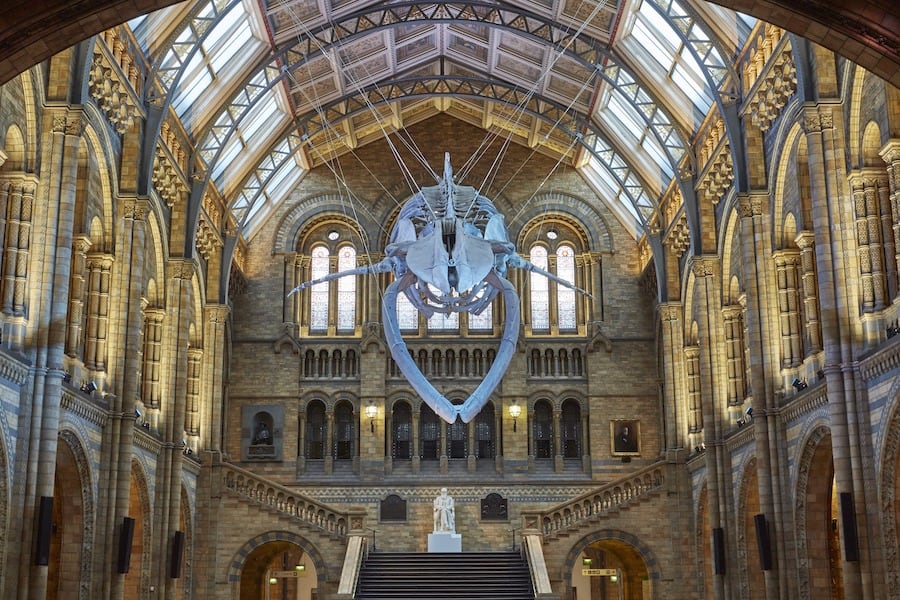
Robert Macfarlane and Jackie Morris will join Karine Polwart, Seckou Keita, Julie Fowlis, Kris Drever, Jim Molyneux, Rachel Newton and Beth Porter – for an evening where music, art and poetry combine forces to call for a more environmentally enlightened future.
I spoke to the Natural History Museum Head of Garden Activities, Lauren Hyams about the Urban Nature Project as well as the Spell Songs ensemble including Jackie Morris whose on-stage presence gently and powerfully aligns the creative forces of art, music and poetry, her new performance role being that of conjurer of creatures and a speaker of spells.
These spells are nature poems created by Robert Macfarlane from The Lost Words book designed specifically to be spoken out loud, in the manner of an incantation or spell. Jackie approached Robert with the idea for this ‘cultural phenomenon’ of a book that touches on the loss and hope inherent in our relationship with nature. Commissioned by Folk by the Oak Festival, Spell Songs is the musical companion piece to The Lost Words book.
Urban Nature Project
As part of the Urban nature Project, the Museum’s five-acre site in South Kensington is being transformed into a welcoming, accessible and biologically diverse green space in the heart of London.
Some projects come at just the right time and the Urban Nature Project is no exception, as the Natural History Museum’s Head of Garden Activities, Lauren Hyams explained: “140 years ago our NHM predecessor colleagues intended to complete the gardens but the story is they ran out of money!
“The pandemic, the planetary emergency, and the upsurge in environmental concern amongst young people has opened new possibilities for meaningful change. The pandemic has further highlighted the importance of access to green spaces and connections to nature in urban areas for mental health and wellbeing, particularly for those living in deprived areas so we can’t wait to get started providing opportunities to learn about and explore nature.”
While the project goes far beyond the physical transformation of the five-acre site the transformation is an exciting one for those familiar with the gardens as Lauren revealed.
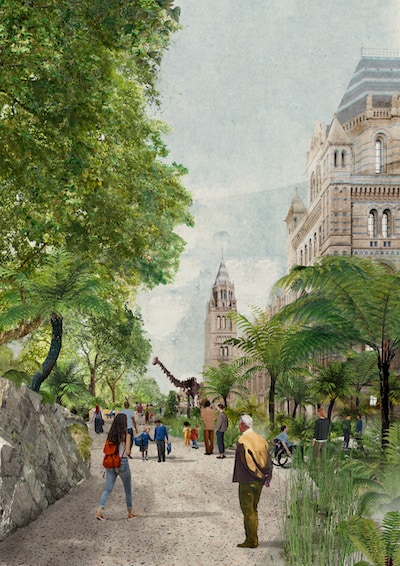
“There will be a significant change in the gardens that visitors will notice as soon as they arrive – not least a 26m bronze cast of ‘Dippy’ the Museum’s famous diplodocus, overlooking the East gardens, which is probably where the most visual changes will take place. In the East, we will tell the story of the Earth’s history. With plants and fossils reflecting each geological era, visitors will appreciate – visually – how old our planet is and learn about the profound impact humans have caused in a short space of time. For the first time, visitors will be able to experience the epic story of our changing planet by immersing themselves in a living representation of its past, present and future in the transformed gardens.
“In the West gardens, the site of the current wildlife garden, the UNP will both protect and increase the biodiversity currently established – this includes a range of habitats such as woodland, grassland, scrub, heath, fen, aquatic, reedbed and hedgerow. The west gardens will be a ‘model’ for urban nature, with different habitats showcasing the biodiversity that can be found in the UK’s urban spaces. Featuring an outdoor learning centre, the west garden will be the platform for the Museum’s national programme with activities aimed at multiple audiences.
“I am most looking forward to seeing visitors experiencing the epic story of our changing planet by immersing themselves in a living representation of its past, present and future. They’ll be able to run along dinosaur trackways, touch rocks that are over 3 billion years old, and listen to the sounds of worms moving beneath the ground. Visitors will be encouraged to adopt new ways of ‘seeing’ and to explore nature. The garden brings to life the hidden stories under our feet in the soil, sheltering in hedges, and the microhabitats on surfaces.”
Lauren tells me that the garden’s transformation is due to begin in Autumn 2021, and should be complete in 2023. As you’d expect, the project, including its carbon footprint, has been carefully considered. “The whole project is carbon negative, meaning we produce less carbon than we started with, so finding companies to work with who have the right environmental commitments is key.”
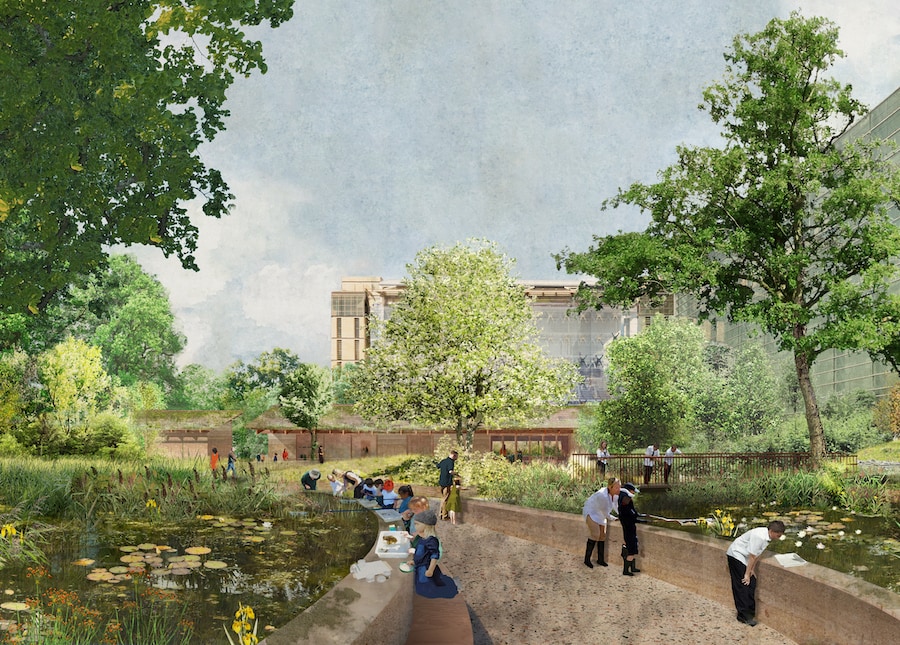
Learning and education are a key focus of the project and none more so than the idea behind the Living Lab. “The idea behind the Living lab is that the whole five-acre site is going to transform into a living lab with outdoor ‘classroom’ areas and a natural ‘amphitheatre’. The gardens themselves will become a hub for urban nature identification and field survey skills. We will pilot a range of technologies for monitoring change in urban environments, including eDNA and acoustic monitoring, and will share these with our partners through a data visualisation interactive installation. The whole external space will combine to act as an immersive and interactive environment that people can learn and be inspired in.
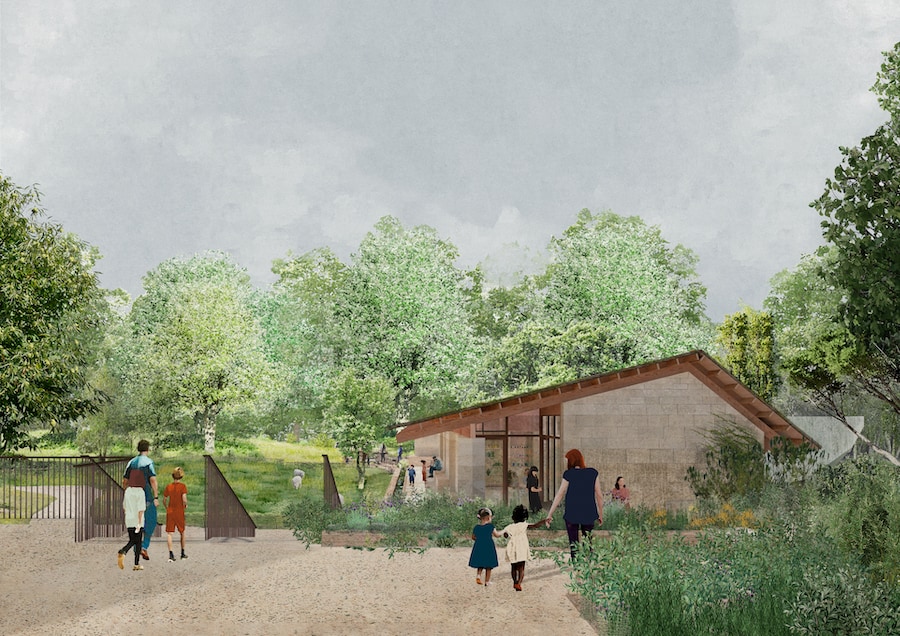
“As part of the UNP we are also building physical spaces for our education work – The Learning and Activity Centre will combine vital facilities for scientific work, monitoring, learning activities, maintenance and supporting the volunteer community. It will provide a much-needed classroom space for year-round learning with an immediate connection to outdoor learning activities, together with improved staff facilities including a work area, a mess room, garden tool storage and yard space. The centre itself will be a low energy, sustainable building which will include rainwater capture, ground source heat pumps and a green roof to minimise the carbon footprint throughout the lifetime of the building.”
The project’s reach goes way beyond the five-acre site with a strong emphasis on networking and partnering. “…we’re working with a really strong network of 11 national partners and together, we aim to both monitor and track biodiversity changes right across the UK and inspire and train the next generation of amateur and professional naturalists. Essentially, as a global community, we do not yet know enough about how to mitigate pressing environmental challenges such as climate change and biodiversity loss and the overarching aim of the UNP is to develop the scientific tools and skills urgently needed to monitor, understand and protect urban nature for generations to come.
“Partnering with a range of museums and wildlife organisations and through a UK-wide learning programme for young people, families and schools is the only way we can achieve this ambitious goal. Our partners play a crucial part in helping us understand and analyse how wildlife is responding to the unprecedented change it is facing.”
Naturally, there is a crossover between this project and the books The Lost Words, The Lost Spells and associated musical project – the latest book was “written to be read aloud, painted in brushstrokes that call to the forest, field, riverbank and also to the heart, The Lost Spells summons back what is often lost from sight and care, teaching the names of everyday species, and inspiring its readers to attention, love and care.”
Lauren tells me that the biggest drive for the Urban nature Project is “…to make our towns and cities healthy and sustainable places to live for people and nature. Our aim is to support people to build our connections with nature on our doorsteps. This project will provide the science, the tools, the training and national, collaborative activity programmes to put more nature into our daily lives and help protect and enhance urban biodiversity.”
And as for the live concert next week on 27th April…”We’re encouraging everyone to join us for a magical night of music and poetry on 27 April when the Spell Songs concert is livestreamed from the iconic Hintze Hall at the Natural History Museum. To find out more, donate and watch, visit here. People who are interested in finding out more about the Urban Nature Project can visit our website here.
There is also good news for schools – “…we are launching our school’s programme in Autumn 2021 where we will be working with national partners to engage 1500 teachers and 16000 school students in a learning programme to explore their local urban nature. We will also work to engage 80,000 people with citizen science projects, engagement opportunities and much more. We’ll be reaching out to teachers across the country with more information on this national programme at the beginning of September.”
Lost Words, Lost Spells and Spell Songs
I posed a number of questions to Jackie Morris, Karine Polwart, Seckou Keita, Julie Fowlis, Kris Drever, Jim Molyneux, Rachel Newton and Beth Porter. While their answers had some crossover they were very revealing answers that explore the depths of this project. I have left Karine Polwart’s response to last as I wanted one of them to dive a lot deeper into Spell Songs and Karine, who has been involved in a number of other environmentally focused projects and is currently an Artist in Residence at the Royal Botanic Garden in Edinburgh, was an obliging candidate. Her response could easily have been another interview article but I love the contrast of all the responses on one page, despite the length, so I hope you do too.
There is no denying that the books by Jackie Morris and Robert Macfarlane (Lost Words, Lost Spells) have had a huge impact on readers. Combining that with music surely makes Spell Songs one of the most, if not the most memorable and influential folk project to date. I started by asking them where they felt the power of the Spell Songs lay, as this is arguably the most important aspect of the project…
Seckou Keita: “In bringing people together around a common cause. It brought us together- a varied group of musicians, to collaborate and produce something new. I think its also has the power to communicate an important message through the power of different media – also coming together – words, art and music. The beauty of the book inspired so many young people and adults. The music has added another dimension and brought the book to a different audience.”
Beth Porter: “It was clear from the moment we first gathered in a room together that this was a group of listeners. Listening is a very powerful tool and I feel that The Lost Words and Lost Spells encourage us all to do that too. Having a shared inspiration gives a real focus for songwriting and for wanting to share that with the world.”
Jim Molyneux: “The words and paintings in the book are things of such beauty. Music, too, is a beautiful thing (in the past year I have become more sure of that than ever, I have dearly missed live music). These art forms combined with the very topic of nature itself evoke such a strong feeling in people. I didn’t realise until we performed these songs just how strong these feelings are within us, but to me, Spell Songs makes us consider our innate connection to nature, through the means of music, art, and words, and the combination of all of those factors is very powerful. ”
Julie Fowlis: “I think its power lies in the way in which Jackie and Rob’s work within The Lost Words enchanted readers from all over the world – as Jackie described it, ‘protest can be beautiful’. It reached out in the most inspiring way to readers, young and old, and Spell Songs was a musical response to that. The idea of naming and knowing, celebrating and caring, for the natural world around us.”
Rachel Newton: “The power in Spell Songs for me is the fact that we have such rich material to work from with Jackie and Rob’s art, which in turn is inspired by their own deep connection with nature. It’s something that everyone can understand and relate to in their own way. I’ve certainly found myself noticing the beauty and poetry in nature more since being a part of Spell Songs and this year of pause has, if nothing else, granted time in one place to allow both that appreciation to grow and the space to notice. “
Kris Drever: “Where Spell Songs power lies is in its mystery, it’s a lot of different things to a lot of different people but if you try to pin it down it’ll wriggle off through a hedgerow and snicker at you. Everyone has their own narrative and everyone interprets the meaning of things differently but miraculously it often seems that (what I presume to be) the original intent aligns more or less with the various interpretations, at least those that have come back to me. ” He adds “Good art is multi-faceted and can say things very powerfully without being overt. That to me is what Spell Songs has achieved very successfully and that’s down to the open-handed humanity and honesty of its co-authors.”
One area which provoked a number of more varied responses was education – whether they saw their role changing and expanding – as an educator and not just a musician.
Seckou: “I think as a griot, teaching has always been a part of me. Traditionally and culturally we have always used music to convey and raise important messages. Music has that universal power. The key for us as a group is to try and create music that will bring the message to new audiences. If that starts or continues conversations with people about our planet and how deeply connected all living things are, then all well and good. Our music is a contribution to the debate and the discussions being generated by children, young people, scientists, activists, teachers and others who are championing a more compassionate society.”
Beth: “Yes, I think we can educate people via the medium of song. Going back to the power of song, it can have a different effect to that of a classroom lesson or words alone. I think there is emotion that can be translated in song that can have a lasting effect on those who hear it.”
I also spoke to Jackie Morris more specifically on whether she felt the role of art in education had changed in the UK.
Jackie: “I don’t think the role of art in education has changed, because we have remarkable teachers who understand how children learn. As a result, despite pressure from government, who have no understanding of how to educate, teachers have persisted to recognise that connecting with creativity is one of the best tools available to educators. Robert and I have both seen remarkable work based around The Lost Words, engaging children with literacy, art, science, geography, even maths. Just utterly remarkable work. We also hear from schools about how children have drawn their parents into their work.
“What would be wonderful is for teachers to be supported in this by the government with more emphasis on learning and less on testing. Because education is about learning, finding your own voice, your own interests and passing exams is such a small part of this, and also one of the best ways to slam a door in the face of a child who in any way differs from what is accepted to be ‘normal’. There is no such thing as ‘normal’ We are all diverse, we all learn in different ways and this is gloriously expressed through creativity.
“One thing I do know is that Science and the Arts need to work hand in hand.”
Watch The Lost Words Spell Songs, accompanied by Jackie Morris painting otters with Sumi ink and river water, at Birmingham Town Hall May 2019 below:
Karine Polwart on Spell Songs
The Power of Spell Songs
As musicians and writers, we were gifted amazing source material in the words of Robert and the images of Jackie. So a huge part of its power comes from a solid rooted heartful place and I guess what makes it distinctive from the Lost Words and Lost Spells books is that its music.
Music inhabits our bodies and our persons in a different way than other forms of art. It’s visceral, it’s immersive, and it’s an emotional journey, so I think Spell Songs as a piece of work is very emotional and it’s not afraid of melancholy and darkness. It’s not a dark collaboration but it’s a collaboration that isn’t afraid to walk that line of melancholy and darkness and sorrow? But it manages to be beautiful at the same time. So I think, by good fortune, it’s tapped into one of the feelings of the time, which is a feeling of loss and lamentation for what’s been lost in the environment around us. Part of its power is that it’s a collaborative work and it’s much bigger than the sum of its considerable parts, I mean, all the component musicians and writers make beautiful work and when you bring musicians together for project-based collaborations they don’t always necessarily produce work that has its own character? And they don’t always necessarily produce work that is greater than the sum of what each individual brings but, in this case, that is true.
This feels like a truly collaborative piece of work in which we’ve all managed to stamp our identity on it but also leave space for everyone else. So there is a spaciousness and generosity about the way this project was made and I think that is reflected in the content and the sound and I think that spaciousness and generosity come from Jackie and Robert’s original work that we took as our starting point.
I think also it’s been conceived as a journey, so, we’ve put the material as an album and as a live performance in a way that’s designed to be sat with, so it’s a project that rewards continuous attentive listening and in an era where most music is consumed as individual tracks and songs, I think this project is different, it’s designed to be listened to in stillness and as one kind of continuous movement.
The other thing I would say about the live performances is there’s something which we’re all powerfully aware of now having not had the experience of live music for a year now, there’s something powerful about being emotionally vulnerable and touched in the company of other people in a room, it’s an irreplaceable experience. There’s something about being moved collectively that I think we’ve been able to capture in the live performances. So, it’s a very special project to all of us involved and we’re aware that much of that has to do with the quality of what we were offered and some of it has to with the happenstance, good fortune of just how these musicians, writers and people have collaborated and cooperated with each other.
Public Response to Spell Songs
I think the project, as a whole, has had immense feedback and not only about how people interact with nature but how they mark their own human lives, so songs from the project have been used at peoples funerals, I find that very, very moving, that the songs have assumed a place in people’s lives, you know a symbolic role, and that’s very touching, there’s no more powerful use of music than that, as far as I’m concerned.
There are some beautiful projects all around the country, if I could namecheck just one, it would be a project in Glasgow called the Lost Woods which was actually inspired by the Lost Words book from Robert and Jackie originally, and they’re doing beautiful work in the city around tree planting and local ecology, and the connection to Gaelic culture in the city, it’s an urban-based project, I think that’s one of the key things behind the project collaboration with the Natural History Museum when we think about connection with the natural environment, it’s not about connection with spaces out there in the wild, it’s about the communities and environments we inhabit on a day-to-day basis and that includes gardens, road verges, parks, it’s urban environments as much as it is rural environments. So yeah, I think there are too many examples of how both the Lost words and Spell Songs has touched people to even mention. I’ve been delighted that my local school, here in the village in Pathhead, Midlothian has used the Lost Words as a resource in their teaching and brought some of the songs from Spell Songs into the classroom here in my own village, and that’s really encouraging.
Educator and musician?
…I would have to say that I don’t feel I am an educator, I think to be an educator is a very specific set of skills and crafts, there’s artistry in being an educator and I don’t think that’s what I am. I think from my own practice as an artist I am innately curious so everything that I do get involved in feels like an inquiry. I start out with something that I am interested in and I want to find out more about it and I want to share it with people but I’m not sharing it as an educator, I’m sharing as a kind of companion and curiosity or something like that. But certainly, I would say over the past few years not only as a result of Spell Songs but as a result of several of the projects I’m involved in that have related to local peatland ecology here in Midlothian to the work of the Royal Botanic Garden in Edinburgh where I’m currently an Artist in Residence.
The idea of the engagement with place and asking questions about the places we live in is absolutely fundamental to what I do and there is a political intent behind that and I would say that’s one of the other powerful things about Spell Songs, and about the Lost Words and Lost Spells books, is that they are pieces of art made with a very strong sense of ethics underpinning them and there’s a political intent around drawing attention to how humans cohabit with other forms of life but the works are not polemical, they’re not lectures, they’re not arguments, they’re not hectoring, they are kind of slower and subtler creatures, so that’s a big part of the Spell Songs power, and I think it’s essentially what I do, I’m not trying to teach people anything. I am interested in sharing my love and my anxiety, so I guess I’m looking always to connect with people rather than educate them I think.
So, I salute the educators in the world, the teachers and lecturers, and community activists who are engaged in everyday educational activity, I totally salute them for the way they’ve been able to incorporate the work of Spell Songs and Lost Words and Lost Spells into their work. Yeah, it’s a little ecosystem where each of us has a role to play but just to clarify, my role is to be curious, to love things and share my love and curiosity and my fear and concern for the places and creatures and lifeforms that I live amongst.
The Future of Art in Education
I think how art is used in education is a matter for educators and I think it’s great when artists and educators collaborate on projects because I think we bring different skillsets to any classroom or learning environment,
…I’d love to see more creativity in the classroom addressing all kinds of learning and it’s a brilliant way to engage children and young peoples curiosity and desire to learn and to open up spaces that are essentially more about how we feel and what we value so yes, I think that’s all good.
Spell Songs Live Streamed Concert – Tuesday 27 April 2021
On Tuesday 27 April 2021 Spell Songs will perform a unique live streamed concert from the iconic Hintze Hall in London’s Natural History Museum, raising funds for their Urban Nature Project.
To find out how you can enjoy the performance and support the Museum’s ground-breaking new project go to https://www.nhm.ac.uk/events/spell-songs.html