
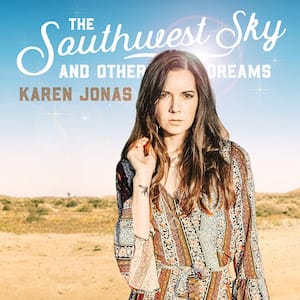
Karen Jonas – The Southwest Sky and Other Dreams
Independent – 28 August 2020
Her first new material since 2018’s Butter and the follow-up to last year’s retrospective re-recordings Lucky, Revisited, this is the Virginia-based singer-songwriter Karen Jonas’ fifth album. It’s also her first with a settled, solid band featuring longtime guitarist Tim Bray, pedal steel player and pianist J. Tom Hnatow and the rhythm section of bassist Seth Morrissey and drummer Seth Brown.
As with Butter, it ranges across several shades of Americana in its explorations of small-town stories and the struggle between ambition and inaction. It opens in familiar Texicana cantina-style with The Last Cowboy (at the Bowling Alley), a poignant but unsentimental portrait of a faded local hero years after all his friends have moved on as his mind wanders back straight back to 1972 when “the girls all watched as his right toe tapped on the polished wood” and “he was the king of the yucca valley” where “he used to play for the money/but there’s no money here anymore/he used to play for the glory—/god but the glory’s gone”.
Up next are the more personal memories of the mid-tempo honky-tonk waltzing Out In Palm Tree Paradise, a recollection of former lover who lived in the Mojave Desert, wishing him well and wondering if he misses her, acknowledging that “looking back now I can see how/this was never gonna work/I’m too stubborn/you’re too hung up on control”, but holding no regrets.
Tuesday kicks up the boogie somewhat for a song about being overwhelmed by the responsibilities and opportunities life offers and shutting yourself away instead (“I think Tuesday’s probably a wash, folks/I’m going back to bed”) before forcing yourself to rise above the stasis as she sings “I used to have a friend named Bobby/he was a singer in a band/looks like Bobby hit the big time/so I’m calling him again/maybe he needs a backup singer” because “I need something to wake up for”.
Turning to a rockabilly note and back to storytelling, Pink Leather Boots also explores the gap between fantasy and reality with a bass-slapping sultry shuffle as the guitar channels Django fiddle on a number about a lonely trucker at a strip club daydreaming that he could have a future with the girl with “red hair on the floor and one leg up high”, imaging how “he’ll take her home to meet his mom, he’ll take her out to meet his friends” and of “rings and a house he’d build/a big texas farm with a couple of children, a roadside stand and a herd of cows”, only, of course, to drive away in his truck once more.
Rockabilly resurfaces later too with Be Sweet To Me, Jonas digging into her inner Elvis and wearing her own blue suede shoes in the role of an indignant woman whose man doesn’t treat her right (“honey, don’t you know that I’m the best you got/why is keeping you happy like a full-time job”) and not chat up someone else when they go down to the bar on a Friday night, especially since she’s paying for the drinks.
Between tracks, however, the pace sinks back into melancholia with Maybe You’d Hear Me Then, a snapshot of a wearied and disillusioned housewife stuck in a marriage gone stale (“you drive the long way home/as if you’ve got nowhere to go/and I pretend to be asleep when you walk in the door”) and a life “one step ahead of the welfare line”, at the mercy of “an indifferent god”. With her husband either oblivious or unable to face the reality, “working some nine-to-five/making plans for some better life/the southwest sky and other dreams you’ll never find”, she wonders “should I just hold it in…or wave my arms and scream as loud as I can/maybe you’d hear me then”.
There’s another frustrated wife sitting at home in the kitchen in the bluesy slow but gradually building swagger of Farmer John, the animals getting restless while she washes the dishes “trying to remember if he ever came to bed”, he “too fond of his whiskey and little bags of stuff he bought from cousin Isaac” and she threatening “I’m gonna put the kettle on/ if you’re not back before it boils I will telephone your mother/walk down to your brother’s house and tell him that you’re gone”.
A similar disillusion and sense of inner emptiness percolates through the slowly strummed, haunted desert tones of Barely Breathing where, living out by the highway, the protagonist has “a strained relation with reality” as she reflects on a once passionate relationship that’s become cold and suffocating – “it wasn’t long ago we were so in love/I see glimpses now but not so often”.
Opening with the line “my best friend called me crying yesterday/said she stormed out on her husband—splashed her wine across his face”, things are no more upbeat on the penultimate Better Days, a reflection on wasted years and an emptiness that’s so hard to fill summed up in the line “why do I need these pills just to be ok” and the image of “a waitress with a kid/she drinks at work some nights to take the edge off of it/she’s not proud to tell you, today she woke up with a stranger in her bed/she sent him out the back door before her kid came walking in”.
If that isn’t desperation enough, the album ends with Don’t Blink Honey, a steel weeping countrified strum that opens with the conclusion that life’s “a losing game…you work your whole damn life and still you never win” and how “we start off starry-eyed and aiming at the sun” but “by and by it’s gravity that leaves you on the ground”. But, ultimately, this isn’t about despair, it’s about seizing the moments “in between the place you start and where you land” and how, while it may be a struggle of hard calls and stumbles, you get by and when “you look up and see the stars that’s your whole life, really” so “don’t blink honey ‘cause …the world keeps turning and you’ll miss something/and there’s no time to waste”. An album forged in the scalding fire of four years of Trump and a world where hope has so often been trampled underfoot, Jonas has given us an album that reminds that while dreams may so often be shattered, it’s still better to look for glimpses of the light than resign ourselves to the dark.