
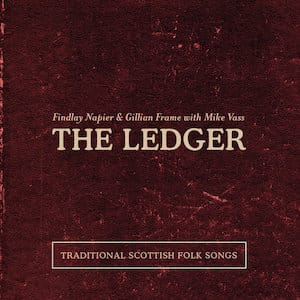
 Findlay Napier & Gillian Frame with Mike Vass – The Ledger
Cheerygroove (CHEERY008) – 1 May 2020
My first draft of this review opened with “In these difficult and challenging times, The Ledger comes as a collection of brilliant rays of musical sunshine, guaranteed to brighten up your day.” Having reflected for 48 hours, I now realise that the implied situational dependency of the first half-a-dozen words was extremely disingenuous of me; thus I believe what follows immediately below is a far better, more accurate and appropriate description.
The Ledger comes as a very welcome collection of brilliant rays of musical sunshine, guaranteed to brighten up your day and bring both smiles to faces and warmth to hearts.
A genuinely fascinating project, the inspiration for what is in effect the epitome of a high-class traditional folk song album came from a ledger kept by Findlay Napier’s grandfather, Findlay Cumming. Preceding the publication of what are two of the most influential and important books on the Scottish Folk music scene, 101 Scottish Folks Songs – The Wee Red Book, (not to be confused with the similarly titled Scottish football publication), and later as The Scottish Folksinger, during the 1950s and early 1960s The Scotsman newspaper published, each week, a traditional Scottish folk song with lyrics and melody alongside an explanatory article by famed folklorist Norman Buchan. The collection of these articles came to be published as the aforementioned books.
Contemporaneously, Findlay Cumming physically cut the said articles out of the newspaper and pasted them into a ledger. In early 2018, Findlay Napier, along with fellow musicians Gillian Frame and Mike Vass culled what were over sixty songs from the ledger down to the ten that appear on this recording.
In the beautifully produced booklet which accompanies the CD, each double-page spread has a sepia facsimile reproduction of the original article, musical notation and lyrics for each of the ten songs, truly fascinating and evocative pieces of musical history. As to the musicians, Findlay provides guitar, high strung guitar, lead and backing vocals, with Gillian contributing fiddle, lead and backing vocals. In addition to playing tenor guitar, fiddle and music box, Mike also recorded and mixed the album, at Gloworm Studios, Glasgow. Also featured are Euan Burton, bass and Steve Fivey, percussion.
As might be expected, this outstanding collection revisits some very well-known traditional songs, together with others which may be less familiar. Rest assured, however, that all are delivered with both consummate respect to the tradition and more than a nod to modernity.
On a first listen, as the opening song, Bonnie George Campbell drifted from the speakers I knew that this record was going to be something special. While I have great affection for the Anglicised versions of this Child Ballad 210 by Nic Jones and June Tabor in which the eponymous man of the title goes off to fight, but only his horse returns, this rendition, with lyrics, as with all songs on the release except for Van Diemen’s Land, in Scots vernacular, (which forgive my English ignorance may be braid Scots or Doric), is nothing short of exceptional, as the voices of Findlay and Gillian come together in perfect harmony over a gently lilting tune. An exceptional cornkister with which to kick off.
The theme of loss is revisited later on the album through Mormond Braes concerning a jilted Aberdeenshire girl who has lost her lover and is preparing to try again and get another, no grieving for her. However, there are, after all, many more fish in the sea, or, as sung here,
“… guid fish intae the sea, As ever was taken.
I’ll cast ma line an’ try again
For I’m only yince forsaken”
Two songs relating to another topic favoured in the folk music canon are also represented on The Ledger, that of transportation. The first, Van Diemen’s Land, is a cautionary tale describing the fate of a man convicted of poaching and sentenced to transportation to the British penal colony in Van Dieman’s Land, modern-day Tasmania. Variously known, in a variety of forms from collections around the world, as The Gallant Poachers, The Poacher’s Song and Poacher Joe, the version here is sourced, according to Buchan’s article, from Ewan MacColl’s Scotland Sings anthology. And what a stunning interpretation it is, Gillian’s crystal clear vocals very much to the fore, augmented by Findlay’s deep, resonant voice slightly lower in the mix. Later, we are treated to another ballad in the same vein, the popular traditional Scottish song known throughout the country, Jamie Raeburn. Reputedly a Glaswegian baker, Jamie was also sent out to the colonies having been convicted of petty theft, forced to leave behind family and sweetheart.
The song presented around mid-way through the album, is the classic Barbara Allan, one of the best known and most widely sung traditional ballads. Recorded versions that spring to mind in my collection include those from Shirley Collins, Nancy Kerr & Jim Fagan and Martin Carthy, and this CD’s offering, based on a fine Scottish version collected by Gavin Greig, of the dark tale in which ‘It was he that died for love, and she that died of sorrow’, certainly warrants a place at the highest table too, such is its quality.
There is, however, light and shade within the release, in terms of lyrics and subject content. The delicate, melodic lullaby Baloo Baleery, for example, constructed around the Scots word for lullaby, baloo, with its references to fairies and guardian angels before ending with
“Sleep saft my babby, sleep saft my babby
Sleep saft my babby in ‘oor Ben Dhu”
Similarly, the jaunty, upbeat Burnie Bushel, an iteration of James Hogg, the Ettrick Shepherd’s Birniebouzle, exemplifies just how varied, and accomplished, the musicianship is too. With Walking All Alane, a song modelled on The Twa Corbies and written, almost unbelievably, by a 13-year-old Ann(e) Neilson, Gillian again takes the vocal lead, the sweeping strings and guitars creating a swirling, dreamy atmosphere.
Haunting bass and guitar introduce Twa Recruitin’ Sergeants, versions of which date back to at least the early 1700s. Recruiting sergeants were familiar figures in the Scottish highlands, looking for recruits to take the King’s shilling with promises of an escape from the drudgery and poverty of rural life, and the dangling of a carrot offering adventure. The version offered here is compelling, Findlay’s vocal interpretation and Gillian’s fiddle are both sublime, and then the introduction of the military drum pattern/beats at three minutes in is an inspired touch.
“Pit a feather tae yer bunnet and a kilt abune yer knee,
An’ list bonnie laddie an’ come awa wi’ me”
All too soon, the final song, The Road to Dundee, is reached. An innocent song, popular in northeast Scotland in particular, but well beyond too, it tells of a woman who, on a “cauld winter” night, asks a man the way to Dundee. Replying that it is difficult to describe, he offers to accompany her. A mutual liking results in the exchanging of tokens, but they will never meet again. Far removed from the excellent version sung by Roy Bailey on his Below the Radar CD, this track is, once again, breathtaking in its production values and delivery and a fitting end to a thoroughly enjoyable album.
The Ledger is a traditional folk song album par-excellence and a work of great distinction, demonstrating the vital and healthy state of music today. It can be highly recommended, not only to those who are lovers of this genre, but to anyone who appreciates top-quality music delivered by very fine musicians.
The Ledger is due to be released on 1 May, and there is a live on-line launch party scheduled, details here
Order the album via Bandcamp: https://theledger.bandcamp.com/
Listen to a track from the album on our Folk Show Episode 73 here.