
As the days grow darker and the threat of bleak midwinter draws ever closer, perhaps the return of Folk on Foot might be able to offer you a little comfort. Hosted by broadcaster and former BBC executive Matthew Bannister, the podcast features artists such as Eliza Carthy, Martin Simpson and Show of Hands roving out to talk, sing and play in the landscapes that have inspired them.
Now on its fourth series, since starting just over a year ago it has made quite an impressive mark. Altogether the team have totted up around 110,000 downloads, have walked away with the silver award for ‘Best Arts and Culture Podcast’ at this year’s British Podcast Awards, and Bannister and producer Natalie Steed have both recently been nominated for further accolades at 2019’s Audio Production Awards.
During the latest episode, Bannister pays a visit to Nancy Kerr as they stroll along the Kennet & Avon Canal in Wiltshire, where Kerr often moored her narrowboat during her twelve years of travelling Britain’s waterways. The rest of the series includes performances from John Jones (Oysterband), Bella Hardy, Rachel Newton, Kris Drever and folk legend Peggy Seeger. We caught up with Matthew earlier last month to hear more from the man behind the microphone.
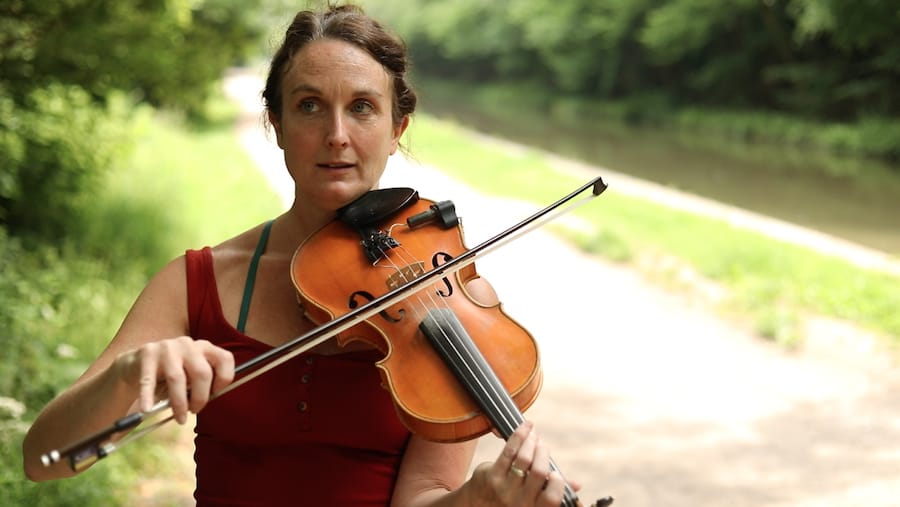
Nancy Kerr
You have had a long and successful career with the BBC and have worked on many shows in your time. I was wondering how you found the move into the world of podcasting?
Well, the thing that’s really amazing about Podcasting is it’s a free and democratic space where anybody can have a go. What’s lovely about it from my point of view is I have a passion for folk music, walking and telling stories in sound and when I wanted to launch that I didn’t have to wait for somebody to commission it or persuade somebody else, I just decided I’m going to put it out there and see if anybody comes. Fortunately, lots of people did.
Am I right in thinking you were an active part in Sheffield’s folk scene in your early days?
Yes, in the 1970s believe it or not. What happened is, I was learning the classical violin and I was also head chorister at Sheffield Cathedral. I had quite a classical education in my childhood. Then I heard an album called Liege & Lief by Fairport Convention. When I heard Dave Swarbrick I thought, “Blimey, that’s what a violin can do”. It just opened my eyes to a whole different way of playing.
Then I listened more carefully to the songs and the lyrics. I thought this is just amazing, these songs about witches, wizards, adultery and murder, all powerfully put together with that folk-rock mix that Fairport did. It was like a revelation to me, so then I started a band with a couple of other likeminded people and we used to do the folk clubs around Sheffield and North Derbyshire.
We actually got a session on BBC Radio Sheffield, someone called John Leonard was presenting a programme on there, who went on to be the man behind the BBC Folk Awards. I worked with him on Radio 1 where he produced Mark Radcliffe and Mark Riley. But in those days John was a folk musician. So, my first appearance on the radio was not as a broadcaster, but was as a fiddler player playing on a cover version of Richard Thompson’s I Want To See The Bright Lights Tonight.
Fairport must have been the gateway for so many people.
I sort of had a reconnection with folk music as well – because obviously it’s been there all through my life – but the ‘second coming’ as it were, happened when I was on BBC Radio 5 live, in the early part of the 2000s and we did a programme in a pub from Devon. They were doing a special about the Countryside. They sent me to a little hamlet in Devon to a community pub to do my late-night show. The producer said “Oh I’ve booked this band to play in the pub and they’re called Show of Hands”. I hadn’t heard of them but I had a listen to the album and I thought “this is fantastic”.
Then Phil Beer and Steve Knightley came and we sat in the upstairs of this pub with about ten other people, but obviously with hundreds of thousands listening on the radio. They played Country Life to me and that had a big impact on me. I thought here’s a song that’s very much of the moment, that speaks for the rural poor, that has a very powerful impact and that’s what folk music can do now. So, that’s when I reconnected with it. I listened to what Eliza Carthy and Seth Lakeman had been doing with it. It came back into my life in a big way about fifteen years ago.
Folk on Foot is such a winning concept because folk is so intrinsically connected with place and history. Aside from deeply informing the music, touring musicians spend their lives trawling the UK and can’t help but develop a bond with the landscape. The show is produced and recorded in such a way it could also seem as though it ties in with the rich tradition of song collecting and field recording.
Well, it is a bit like that I suppose, one of the biggest challenges that we have is recording outside, whatever the weather’s like. A nightmare for us is wind because it makes such a horrible noise on microphones. So, sometimes you find a picturesque spot but you have to go around the corner to find shelter to record it.
When we were recording with the Young’uns in Hartlepool, they have a song about the Sandwell Gate, which is the medieval gate that leads onto the shore where the fishermen used to bring in their catches. I said to them “Oh stand there in the gate to sing the song” and of course the howling wind came and you could hardly hear what they were doing. So, in the end, we took a picture of them there, but we ended up recording them behind some wheelie bins because it was a little bit more sheltered!
So, it’s a real challenge, when you’re on Dartmoor with Seth Lakeman quite high up and he wants to play in a particular spot or it looks great on the photograph, it doesn’t necessarily sound perfect. I work with some amazing producers and they are really good at producing some fantastic sound quality with very simple recording equipment, in quite challenging conditions. So, recording on-site can be quite difficult. I’d imagine the early song collectors did it inside, whereas we insist on being outside at all times.
However, in this new season, we did a session with Bella Hardy in Edale and it absolutely chucked it down. So, we did walk and talk in the rain but we took shelter in her Mum’s cottage to record the music, as we didn’t want to get her fiddles wet. It’s quite atmospheric, you can hear the peal of thunder and the rain rattling on our jackets. It’s a really atmospheric episode.
Quite often we get to hear artists performing songs in the setting that actually inspired them, whether it be a traditional ballad or their own original material. Do you feel when you interview musicians in these environments, they seem to be more receptive and open up a lot more?
Yes, I think so. There are two things that I think help them open up. The first I should say is we’re incredibly grateful to the artist’s because they’re giving up their time and they agree to play in some really interesting circumstances. I don’t think you could get this from any old musicians, some musicians are really precious about their playing. But folk musicians absolutely understand the link with place and understand a song has a new kind of resonance if you sing it on the spot, like Kris Drever and Scapa Flow.

With Kris Drever
Or Duncan Chisholm at Sandwood Bay, where he was inspired to sing his whole album about this amazing white sand beach, right up in the North tip of Scotland. We walked four miles to get there. But he says when he’s playing on stage or anywhere, he conjures up an image in his mind of that beach in order to get at the spirit of that music. So, when he’s doing it in front of you on the beach, you’re getting something really special.
Another thing that helps them open up is we spend a lot of time together. We’re together for half a day or more and walking’s a wonderful way of helping people open up because you don’t always have to look each other in the eye. It’s always a good idea to have a difficult conversation when you’re in the car because you don’t have to face to face confront people. I think walking encourages an intimacy that you don’t get if you’re sitting face-to-face in the studio. The guest gets to know me better and feel they can trust me and therefore people open up more.
I feel we really get to know each other. You know we spend a significant amount of time together and then you do feel like some sort of bond has happened because of that. And often they do share quite intimate details of their lives with me, which is obviously a great privilege.
You mentioned Drever and about Scapa Flow. There’s a very strong historical context to a lot of the conversations, but you also touch on musician’s connections with nature as well. Like Karine at Fala Moor, Jackie Morris & Beth Porter in Pembrokeshire and Sam Lee singing with Nightingales in Sussex for example.
Exactly and also Martin Simpson. Walking in the woods where he used to go with his Dad, where they used to get carcasses from the gamekeeper. He told this terrible story about how he got all the kills that the gamekeeper had collected to protect his birds, then Martin put them all on the stove to boil them up and then forgot about them. Leaving his mother this gruesome mess to clean up. Martin’s so passionate about birds and the wildlife, like Sam Lee.
Wildlife often interferes in the podcast in really spectacular ways. Like when we were recording with Karine you hear this curlew circling overhead and then when she starts singing about the lark in the morning you actually hear a skylark singing in the background. With Sam, you’ve obviously got the nightingale and often you hear the seagulls crying when we’re at the seaside with John Smith or with Fisherman’s Friends. I think those are some of the most magical moments.
A lot of the artists we talk to have a strong connection with nature. In fact, we’re doing a weekend in partnership with King’s Place (London) in March, called Wild Singing. There are three main gigs with Nancy Kerr & James Fagan, Eliza Carthy and Martin Simpson. The first half is going to be me talking with them about their relationship with the natural world and how it’s affected their music showing some of the film we shot with them. Then the second part will be the actual gig. So, that’s a really good way of putting onstage the relationship the people have had with us during the podcast.
When I spoke with Morris in the past, she described Spell Songs as a ‘beautiful protest’, do you think Folk on Foot follows suit?
I hope so. A lot of the artists have talked about the positive impact on your mental health, from being in nature. It’s restorative, relaxing and if you can take a walk in nature then something good happens to your soul. Then it’s only a short step from that to saying, therefore we need to take care of it, we need to preserve that which is under threat and is facing destruction. I don’t want it to ever become political or didactic because that’s not the atmosphere of it. But I feel you take away subliminal messages from listening to the conversations we have and the passions those we walk with have for the natural world. Aspects of our rural life are challenged and these musicians are drawing our attention to it in often a very subtle and tangential way.
People have often said to us about it feeling like a ‘virtual escape’ to go for a walk with us in the country. Even if you’re in the middle of a city, you put your headphones on and you are taken into the countryside by us. Now some of these walks are in the city, Stick In The Wheel took us through the East End of London, we’ve walked through South London with Kerry Andrews. But what happens on the way is you constantly find green space. And it’s this space that makes you feel happy about being in the city. So, you end up in Epping Forest or Brockwell Park at the Lido with Kerry Andrew. So, even there it’s being acutely aware that the natural world is part of the city too.
It is moving to hear sometimes how the songs came into being. We were talking to Eliza Carthy about Norma Waterson’s illness. We were incredibly fortunate when we were up there in Robin Hood’s Bay, that Norma was about and up for singing. The power of it is extraordinary when we were sitting around the table with Martin & Eliza Carthy and Mary, Anne and Norma Waterson, you’re literally sitting two feet away from those astonishing voices. The producer has tears running down her cheeks because she was obviously listening to it in a really intense way on her headphones whilst they were singing. I had this lump in my throat because there is something so powerful about the family bond, the vocal bond and the music being made right there in front of you.
That’s tradition right there!
It’s tradition made flesh. But also, those blood harmonies, those family voices blending together have a unique power.
Talking of tradition, you recently caught up with Peggy Seeger for the third series. That must have been amazing?
It was unbelievable. She very kindly invited us to go to her house on the outskirts of Iffley in Oxford and she was so generous with her time. She’s got such a huge story; the difficulty was knowing what to leave out really. We started right back with her childhood and her amazing mother who was a pioneering composer but who also transcribed folk songs collected by Alan Lomax and other people for the library of congress. The stories that she told about the way folk song got under her skin as a child, whilst her mother was working transcribing it, were utterly fascinating. Then, of course, all the conversation about Ewan MacColl.
We went for a walk around her village, she tucked her arm in mine and off we went to the community shop, to the local church, the church hall. It was interesting because she said that really, she has no roots because she’s been on the road so long and she’s been an American in Britain. She’s also got very strong views on tradition and how her music plays into that. It was very interesting talking to her about place because she’s renting this place in Iffley, as it’s close to her children and that’s where she wants to be. But there was a sense of being a bit more of an international citizen.
Of course, she was great on the subject of political commentary and Greenham Common because she’s actually got a bit of the common fence on her mantelpiece. She talked about this great song she wrote called Woman on Wheels, which is about a protester that she met who was in a wheelchair but was nonetheless using bolt cutters to cut through the fence. Peggy then interviewed her before writing this and the title what the protestor said to her. It was just a privilege to be connected through her back to all the history of folk music in this country and America.
Peggy said to me, “I love bolt cutters, they’re absolutely delicious” and when she got stressed when Ewan was ill, she used to take them and use them on a length of piping, as it was therapeutic just to cut something.
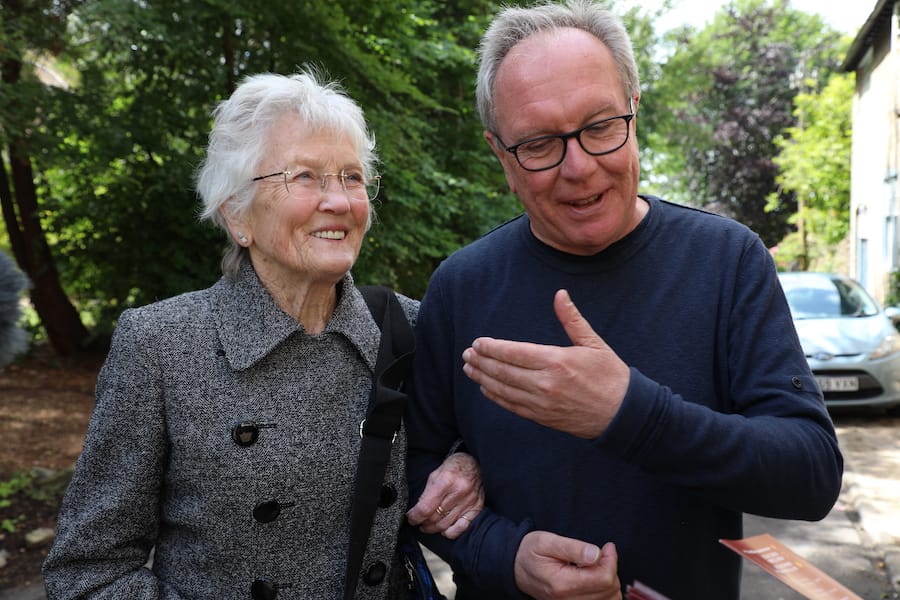
With Peggy Seeger
Then there’s John Jones as well. I hadn’t heard about the Reluctant Ramblers before.
Well, Jones has been walking to gigs for longer than we’ve been doing Folk on Foot. A lot longer actually. I said to him, “I think you’re the patron saint of Folk On Foot”. Over the years he’s sort of built up this group of people who go with him, quite a large group, you know there must have been about thirty-five people. He puts it on Facebook when he’s going to walk to his gigs and people just hitch up.
He’s done parts of the Pennine Way, the South Downs Way and on this occasion, he was walking to the Wickham Festival. We set off quite early in the morning, I think we did about thirteen miles. Friendships have been built up during the walks and they’re a bit of a community. He describes walking as, “his drug, his gym and his church” because he says it’s the nearest, he gets to spirituality. He does seem addicted to it; it makes for an interesting episode because he is someone who’s passionate about walking through the countryside. A genuine walker. It has this other aspect from other episodes as well because we get to hear from people who walk with. We hear why they’re there, what they get from it and how their connection with John has grown over the years.
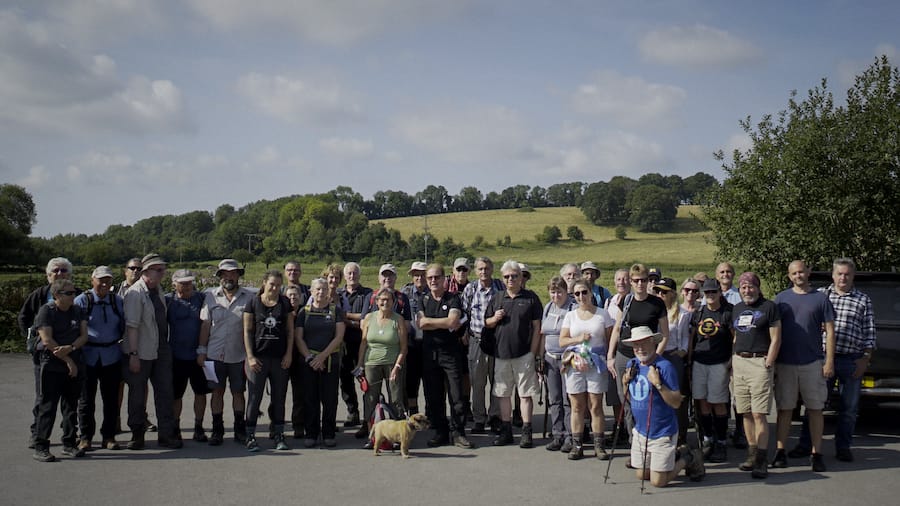
John Jones walking group
So, you’re hearing first-hand the connection between the artist and their audience?
Exactly. There’s an approachability and a humility to most folk artists in my experience. They genuinely are happy to meet their audience, answer questions and obviously in John’s case he’s got to know these people quite well.
Lastly, I was wondering if you were to be interviewed Folk on Foot style and you were to walk us through a certain place or revisit somewhere, where would you choose?
I think I’d choose the South Downs Way because I have a house in West Sussex. I’ve lived here for more than thirty years and I’ve walked a lot here. Certain parts of it I really love, the undulating nature of the countryside and the fact that on one side you can see the sea and then you turn to the other and see the North Downs. There’s something beautiful about that feature in the landscape that lifts you above what’s going on down below and allows you to lookout.
Of course, there’s beautiful links with the South Downs as well. Whether it’s Ralph Vaughan Williams and The Lark Ascending or the Copper Family from Rottingdean. On the South Downs I can always hear music in my head.
The podcast is available at folkonfoot.com or via Apple Podcasts, Google Podcasts, Spotify and most leading podcast apps.
You can also help support Folk on Foot via Patreon here: https://www.patreon.com/folkonfoot