
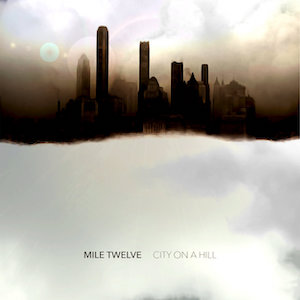
 Mile Twelve – City on a Hill
Delores the Taurus Records – 29 March 2019
Starting out in Boston in 2014, which gives rise to both the album title and the band name, a mile marker on route 93, the city’s main artery, Mile Twelve are part of the new bluegrass generation, taking tradition and shaping it within a contemporary approach. Comprising guitarist Evan Murphy and bassist Nate Sabat on lead vocals, David Benedict on mandolin, banjo player Catherine “BB” Bowness and fiddler Bronwyn Keith-Hynes, this is their second album following on from several nominations and awards from the International Bluegrass Music Association.
Murphy on vocals, they open with a lively transformative bluegrass reading of Richard and Linda Thompson’s Down Where the Drunkards Roll, setting the scene for songs about lost souls, proceeding to City That Drowned, a number with allusions to the story of Noah as a young survivor contemplates the flood that consumed the city where he and his family once lived, a retribution for the greed of those that ran it.
The Old Testament gets another reference in Jericho, a guitar-led waltz-time tune about a veteran who, retired from the army with PTSD after two overseas tours, loses his wife and his home, wandering the streets by day, his nights filled with metaphorical dreams of the battle of Jericho and of wanting to return to “bury my friends who have fallen and never been found”, underscoring how, for many of his kind, combat becomes the only place where they feel at home.
Sabat steps up the microphone for the first of two songs, Liberty, which, driven by frisky banjo and fiddle, addresses the plight of refugees forced to feel the conflict in their home country and seeking to build a new life and raise their children in the land of the free – “It’s not perfect but it’s home/In every moment I am thankful/This world is all you’ve ever known.”
The midpoint’s marked by the sole instrumental, Rialto, its harmonic twists of its orchestrated chamber music midsection with nervy banjo and dark fiddle lines building tension before reverting to the main theme. Barefooot In Jail then leads off the second stretch with an uptempo bluegrass waltz about a bloke waking up in jail with a black eye, minus wallet and boots after a night on the town when “I loosened right up with a couple Jim Beams/After that I can’t remember too well.” And there’s more drinking involved in Good Times Every Night, an old school country break-up number complete with ironic lyrics that might have been penned by George Jones.
Sparks fly from the banjo on the breakneck bluegrass Innocent Again as an ex-con bemoans the difficulty of living down a prison stretch and getting a second chance, while Journey’s End again turns the focus on Sabat for the theme of dislocation as the narrator talks of a recurring dream of waking up in a strange, dystopian city with a public square “Where a thousand people form a single line/Sad and silent they just wait there patiently/For a word or a sign” the image of “Endless bolted doors and boarded windows/Not a home for anyone” conjuring Trump’s America.
It ends with its second non-original, the wistful, slow-paced, fiddle swaying and close harmony Where We Started being North Carolina songwriter John Cloyd Miller’s portrait of rural America and characters stuck in a small Tennessee town as, “miles and miles from what we ought to be”, the narrator dreams of a finding a life beyond its borders.
With its Appalachian roots in 18th century British and Scottish ballads, bluegrass is one of the oldest and purest forms of American folk music. In the hands of bands like Mile Twelve, it remains a living tradition.
https://www.miletwelvebluegrass.com