
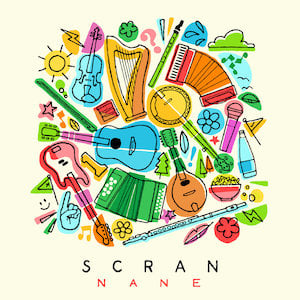
 Scran – Nane
Out now
When 2018 BBC Young Folk Award winner and Isle of Man native, harpist Mera Royle, appeared at Fairport’s Cropredy Convention last summer, she brought with her a group of teenage Manx musicians who made an immediate and lasting impression. They, with some additional members, have now released an album under the name Scran, an album that confirms the robust health of traditonal style music on the island. There’s no doubting the talent of these youngsters, talent that has been nurtured by the island’s cultural organisation, Culture Vannin, through its Manx music youth movement, Bree. This has now led to the album, Nane, Nane, by the way is Manx Gaelic for number one.
Nane is a mix of traditional tunes, more recent Manx compositions, a couple of which are from band members, and a couple of tunes that have no obvious connection with the island, but more of that later. The opening track is a classic traditional set, Chanter’s / Three Baatyn Beggey, the first tune from Ireland and the second, Three Little Boats in English, is Manx. The set may be traditional but it opens in a distincly non-traditional style with a rhythm set up on the bass strings of an acoustic guitar, it’s not clear if this is Fraser Rowe, he’s credited with playing electric bass. The rhythm is soon overlain with a guitar melody line laden with bent notes, a bluesy introduction that could easily slip into a Bert Jansch number. The track’s traditional origins become clear when Chanter’s melody is brought in, primarily on the fiddle, Mera’s harp adding fills. With the switch to the second tune, James McNulty’s banjo is added and a fast and furious Celtic session, Manx style, involving most of the band gets underway.
The second tune set, Fathaby Jig / Kiaull as Craic / Sac dy C’heck more fully explores the band’s instrumental palette. Underlain once more by Callum Rowe’s reliable guitar rhythm, the first, traditional, tune initially features whistle alongside harp before both are joined by accordion and then banjo. The second tune was composed by, and unsurprisingly features, button accordionist Owen Williams. The set concludes with a tune written by Manx whistle player Gilno Carswell. More of Callum’s bluesy guitar provides a bridge to this final section and then Raygie Dolloso’s flute alongside whistle and banjo, provides a fascinating arrangement of a tune already well known throughout the island. The only other composition by a band member is Sunset by the Sea, a delightful piano piece from Jack McLean. When not at the piano, Jack’s on piano accordion but, on Sunset, his piano is given star billing. After a couple of runs through the melody, button accordion, whistle and eventually strings join to make a gentle, lyrical arrangement, a beautiful counterpoint to the jigs and reels.
Birling is another set of three starting with the first song to feature on the album, Birling Ghorree Crovan, fiddler Aerin Roberts taking the vocal lead and most of the band joining in with the choruses. The song is immediately reminiscent of traditional waulking songs of the Hebrides, as well it should, the Manx Gaelic words are set to a traditional Hebridean tune. The remainder of the track consists of two traditional Manx tunes Carr y Phoosee and Gyn Ennym. A second song from Aerin closes a later track they’ve chosen to call Insignificant Set (because it’s in A minor). It’s a traditional Manx song, Arrane Saveenagh, a lullaby, and so gives another opportunity for a restful interlude between upbeat dance tunes. If the Internet is to be believed, the first verse shares its lyrics with Rock (or Hush) a bye baby, different tune though.
All but three of the tracks on Nane contain at least one component that’s a Manx traditional song or tune. It’s clear the promotion of Manx culture, in both music and language, lies close to Scran’s heart. The sleeve notes, for example, are written in Manx Gaelic. (Fortunately, an English translation is available from Culture Vannin via their ManxMusic.Com web site.) But, when compared with their Celtic neighbours in Ireland and Scotland, the canon they draw on is rather small. Fortunately, there’s a healthy cohort of musicians currently writing tunes in traditional Manx style and using Manx Gaelic for their lyrics. Scran make good use of this and acknowledge material from composers Gilno Carswell, Katie Lawrence, Sharon Christian, Greg Joughin and Sarah Hewson. Alongside promoting the individuality of Manx music there’s also a recognition that Manx society has never been totally isolated from its neighbours. The inclusion of traditional and contemporary tunes from both Ireland and Scotland sets Scran’s music firmly in the appropriate context.
But what of those “misfit” tunes I mentioned near the start of this piece? When Mera Royle took to the Cropredy stage last year, she opened with a piece for solo harp, Deborah Henson-Conant’s New Blues. Forget Celtic tradition, this is out and out bebop jazz and bebop has never sounded so good. Its welcome inclusion on Nane makes clear Scran aren’t prepared to be confined to a niche of the Celtic music world. Making a similar statement, the Bok e Spok section of Bokset is from Basque composer and accordionist Kepa Junkera, sandwiched between two Manx tunes, one contemporary, one traditional, it’s a good fit for the Scran style. What makes the track stand out though is its use of guitar sounding as though it’s going through a pedal or two.
The youth music movement, Bree, from which Scran derived, is led and mentored by Paul Rogers. Since 2016 he’s also been the guitarist with Jamie Smith’s Mabon. He’s listed as playing guitar and percussion on Nane and, alongside the rest of the band, gets an arranger credit. Clearly, he’s been a major influence on the development of the island’s young musicians and Nane is a fine testament to the success of his Bree project. Isla Callister-Wafer, who shares fiddle duties with Aerin Roberts on many of the album’s tracks, has already had a big decision to make, whether to stay on the island or pursue her education and a career elsewhere. She is currently studying at the Royal Conservatoire of Scotland. For most members of Scran, such a decision lies in the near future and so, it’s almost inevitable there will be changes before another album could be produced. But the structure and support are in place and the talent is there for all to see. We can surely look forward to more exciting, innovative music from the island’s youngsters. In the meantime, we can enjoy an album that bristles with youthful vigour and marvel at the talents on display.
https://www.facebook.com/ScranMusic