
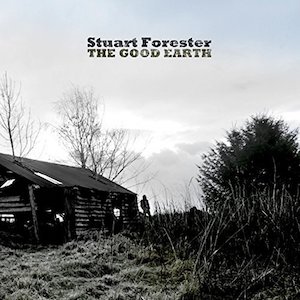
 Stuart Forester – The Good Earth
Melonstone Records – Out Now
It’s not very often that the weather accurately accompanies the writing of a review, but this morning the wind is blowing hard from the east and snowing from, apparently, the east and the west. The opening lines of the first track of Stuart Forester’s album The Good Earth are ‘I was born in a blizzard man, baptised in the mighty river Humber man’. Blizzard yes, but the Humber is many miles away. However, this is a song whose words tell of the struggles of life but whose tune is positive and driven, leading us to a partial redemption point: ‘But I’ve reached for the light ever since the day I was born in a blizzard with the blues.’
His website tells us that Stuart was born in Cumbria and spent his first three years in trailers and tents in Canada and Alaska. He returned to the UK, to Hull, and then to London and now lives in Aberdeenshire. This album covers a lot of this movement and landscape either through reflective memory or description, and as I get to know him through these songs, I get to see a man of many facets.
There is quite a sense, a flavour, of a Jim White album here, but nothing to really point to, both men being individual in their approach to their subjects and their music. The Good Earth is a road movie soundtrack, though not necessarily with the road bit. Perhaps more of a series of images using the landscape as a backdrop to the part of his story he wants to tell.
Having thought about Jim White, I was then struck by a glimpse of a short scene from the seminal film Searching for the Wrong-Eyed Jesus, a scene of a man who spends his time firing his gun at a road sign. I wonder if this was in Stuart’s mind when he wrote Dead End Road Signs, conjuring a picture of the post-industrial mid-west, where ‘The greatest foe of all is time gone by’. There are no jobs, the countryside may be beautiful but what can you do? Drink all night and shoot dead-end road signs in the day.
Baltimore takes the travelling Stuart to Ireland and the extraordinary story of the sacking of the village of Baltimore in West Cork, in 1631. Led by a Dutch seaman, known as Murad Reis, the crew, made up of Moroccans, Algerians and Ottoman Turks, captured 107 of the villagers who were taken as slaves to North Africa. The song relays the story from the point of view of one of the captured who, despite a life in chains will know he will see the emerald shores at his death.
In Red Brick Ballads whatever goes on inside the houses is the stuff of song, where the yin and yang of life is played out in ‘major and minor keys, songs of hope and dreams’. I really like the imagery: ‘Wishes in the windows woes behind the doors’, pictures to play with. This is good song writing, not over-egging it and giving the listener enough to build their own picture. As with the opening track, this is a positive song, a positive message: ‘I wrote a sad song yesterday, so I wrote this one to celebrate, a melody to ease the pain…’
Many of the tracks use these examples of symbolism to relay their emotion, but London Pride is simply a retelling of a day in the life, a trip up the Northern Line to meet up with some mates, have a chat, play some tunes and mainly drink the beer in the title. A bright and refreshing tale that shows the writer as having his feet on the ground (or just about in this case!) and that the normal can be included. I too can remember dancing around the room before falling over and being covered with a blanket, left to sleep until the morning.
The one track that he did not write is Come Where The Willows Are Weeping. Perhaps this is the love song of the set, one that fits the moment perfectly and is neutral to the clear, strong sense of place in the rest of the album. Still painting a picture, this is something else, not an image of clarity, of reality, of stark contrast which is what we get with Stuart’s own words. An impressionist painting hanging in a gallery of photographs, and without one, the other will not be seen for what it is.
In that opening track Stuart sets out to show the dark realism of his – and our – times, such as ‘poisoned oceans haunt my dreams’ yet its manifestation in these songs is not angst-ridden nor is it plaintive. There is a power and a steadfastness to these songs that can look back but also look forward. However there is also a great ability to illustrate and above all, this is an album about landscape, images painted for us by the words of Stuart Forester, and framed in the tunes of his guitar and the fiddles of Jonny Hardie and Carol Anderson. The images are clear, the album a gallery to be returned to time and again, so that we may be reminded of the pictures but also to see what we didn’t see last time.
http://www.stuartforester.com/