
‘Peter had a unique vision of the English tradition and was a first-rate setter of words and writer of songs, many of which, quite rightly, have entered the canon. He injected social and political discourse into the music scene via interesting narratives and historical subjects rather than proselytising. His tragic early death cut this work short – who knows what he’d be up to now?’
Paul Sartin is talking about Peter Bellamy, pioneer of the British folk revival, former member of the Young Tradition and prolific solo artist throughout the seventies and eighties. Perhaps Bellamy’s defining work was the epic folk opera The Transports (reviewed here), a deftly adapted tale about a pair of Norfolk lovers who met in prison after committing petty crimes, had a baby and were separated and miraculously reunited before being transported to New South Wales together. The story is true, but in the hands of Bellamy – who took his own life in 1991 – it is as gripping as any historical thriller.
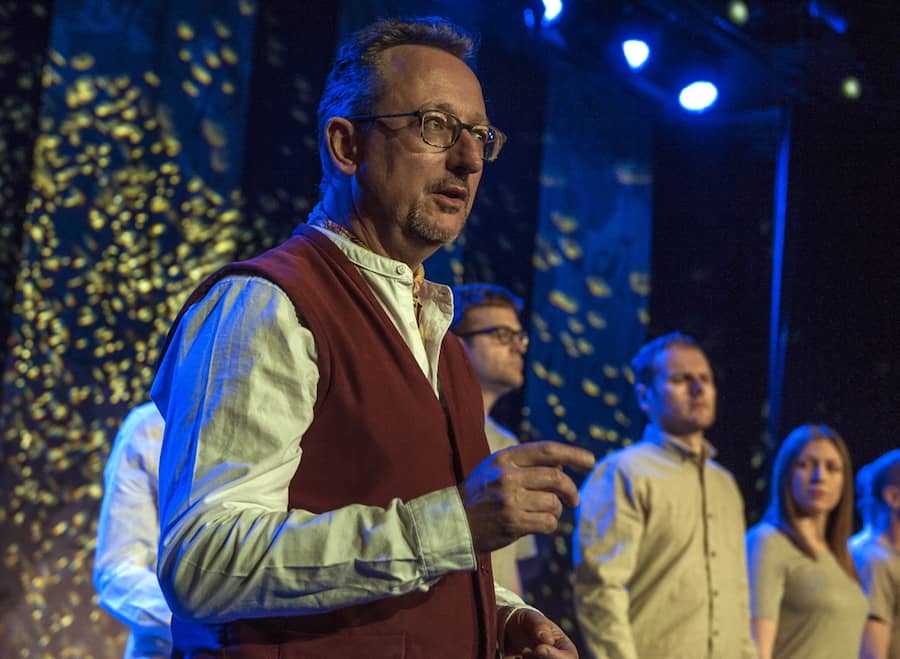
Former Bellowhead member Sartin, along with a grade-A cast of contemporary singers and musicians including Nancy Kerr, Saul Rose and various members of Faustus, Bellowhead and The Young’uns, has just released a new production of The Transports, recorded live and overseen by producer Andy Bell. There is brand-new narration between each track, provided by storyteller Matthew Crampton (image below), and the whole ensemble is currently engaged in a UK tour. Despite the busy schedule, both Crampton and Sartin have taken the time to talk to FRUK about the project.
Speculating about the potential output of great artists who died too young is difficult and perhaps ultimately fruitless, and the greater the artist, the harder it is to predict how their work would have turned out. In Bellamy’s case, the sheer strangeness of the voice – strident, self-consciously ‘bleaty’ but possessing an uncanny power – makes it even more difficult to say where his considerable talent would have taken him. As Sartin says: ‘His at times uncompromising musical style is not easy listening. I heard him only once when I was 16, and to my young ears, it was something of a surprise, to say the least! Nevertheless, I was totally gripped by it.’
How did the pair first come across The Transports? Sartin: ‘I was loaned a cassette of it by Oxford singer Ian Giles in the mid-1990s, which I still have failed to return. Then in 2011 I directed the band and singers and helped to rearrange it for a revival at Sidmouth Folk Festival in conjunction with the Southbank Centre. It was a great show, featuring many of the greatest talents of the scene (including the Young’uns), and was preceded by a talk on transportation by Southbank director Jude Kelly. Since then I have had numerous conversations and made fledgling plans to revive it again, but always felt that as it stood it was not a full evening’s entertainment, and was crying out for reworking, and not just the music.’
Here Crampton takes over the story: ‘Michael Hughes of The Young’uns saw my show Human Cargo, which uses story and folksong to explore emigration, slavery and transportation. He asked me whether I’d like to get involved with The Transports. With people like The Young’uns and Faustus already engaged, that was not a tough decision. I’d seen the show at Sidmouth, loved the music but came away with little idea of the story. I’m afraid I’m one of those people who doesn’t always listen to lyrics. So when Michael invited me to join the project, I went back to the original material – and was so excited by the true tale that I determined to find a way to incorporate it more strongly within the show.’
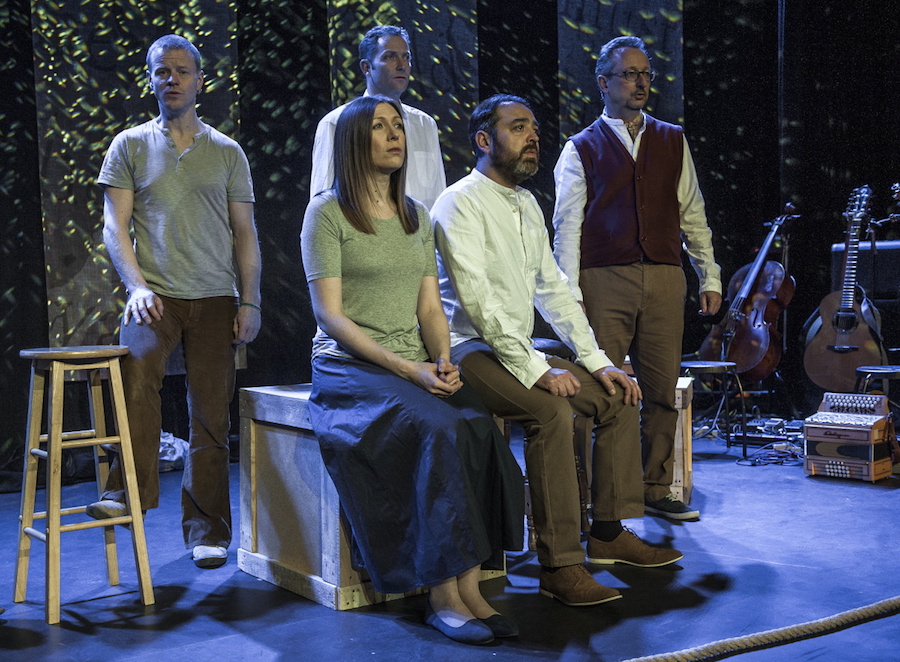
Stood L-R: Benji Kirkpatrick, Saul Rose, Matthew Crampton. Seated : Rachael McShane and Paul Sartin
There was still some way to go to get a complete cast together, but, as Sartin recalls, it wasn’t hard to find willing contributors: ‘The Young’uns were involved, albeit only as the shantymen, on the 2011 production, so it made sense for them to be involved, especially as one of them is the producer! I brought in the other two members of Faustus, with whom I’ve worked for over 10 years, so again this was a straightforward choice. Rachael McShane and I (and Benji Kirkpatrick) were in Bellowhead together, I’ve worked with Nancy over the years, and the Young’uns knew Greg Russell, so it was really a case of getting in people we trusted and liked and were familiar with. And almost everyone both sings and plays an instrument, so we could be economical with cast numbers.’

Matthew Crampton and Greg Russell
While the recorded version of The Transports reflects the live production faithfully, it is still by its very nature different from most people’s conception of an album. The most obvious departure is the narration. At first, Sartin admits, it was the ‘fly in the ointment.’
‘Perhaps listeners to other genres might have less of a difficulty with it (think Peter and the Wolf, or recitative in opera) but we were aware that although it’s by no means unique, it’s not the norm. In the production, we had to be mindful of integrating the recorded sound of Matthew’s narration with the recorded sound of the music. And we definitely had a few kittens over how to present the track listings as there are nearly 30 segments.’
As it turned out, the narration was an integral, not to mention impressive, part of the finished product. This is mostly down to Crampton’s skill as a writer and storyteller. I put it to him that the storytelling – as opposed to singing – has become somewhat overlooked, and he is quick to jump to an eloquent defence of his art.
‘Storytelling is as alive as ever at dinner tables, pubs and office water coolers. We all hunger for stories. Many of us can tell them well – and there’s no shortage of stories on TV or radio. Even in folk sessions you’ll often hear a storyteller. But what you seldom see is folk music tied to a single narrative arc which spans an evening. That’s the great opportunity presented by The Transports.’
Specifically, Crampton’s narration makes explicit the parallels between 18th-century transportation and contemporary economic and political migration. Was the changing political climate of today one of the reasons for wanting to update Bellamy’s original work? And, speaking more generally, what role does Crampton feel folk music has to play in political discussion today?
‘It’s good to give things a purpose. It provides the audience with a political touchstone that underscores the emotional impact of the music and the story. But this only works, of course, if the purpose matches both the nature of the story and the need of the audience. As I read the tale behind The Transports, I realised it’s a story of exile. The vulnerable people exiled from Britain in the 1780s were similar to vulnerable people crossing oceans today. Moreover, migration is one of the critical issues of our time – yet the debate has often become so toxic, and divisive, people hunger for a fresh way to engage with it. What better than an old story, and old songs, which give insight into human behaviour today? Folk music already contributes strongly to politics through songs of protest. With The Transports, we can contribute more obliquely through songs that tell a story.’
As Crampton implies, folk music is an inherently political form of expression, and this is just as true today as it has always been. Roughly half-way through The Transports, the18th-century narrative arc is interrupted by a thoroughly modern folk song: Sean Cooney’s deeply atmospheric Dark Water. This tale of the hardships of political migrants appeared on the most recent Young’uns album (reviewed here), but I’m interested in how it found its way onto this project, and why it was positioned at such a crucial point in the story.
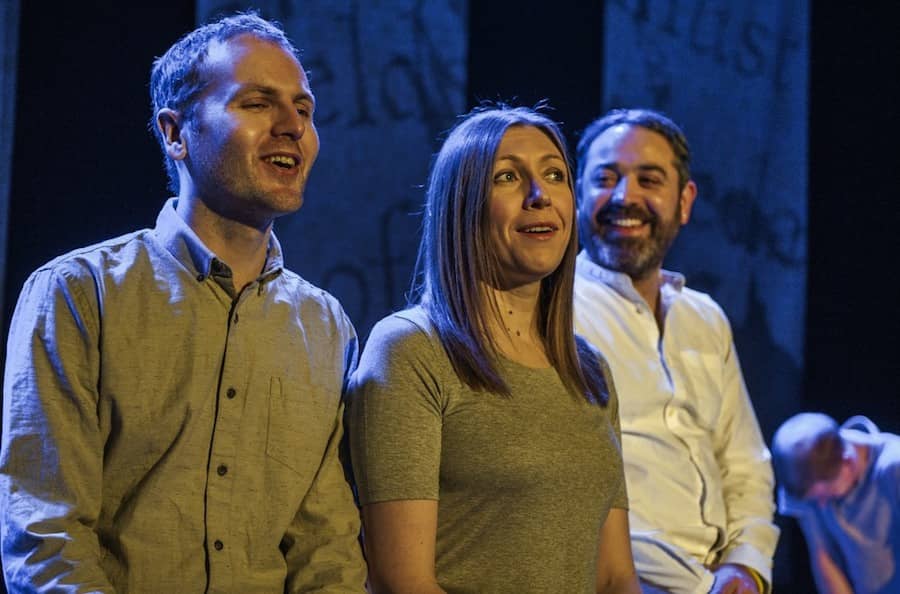
L-R: Sean Cooney, Rachael McShane and Paul Sartin
Crampton explains: ‘In the first production of Human Cargo, we sang Rosie Hood’s wonderful song Adrift, Adrift at the top of the second half, and I’d seen the power of including a modern song – on a modern theme – within an evening of centuries-old music. When people come back from an interval, it’s always good to surprise them and re-pique their interest. I loved Dark Water and thought it would be perfect for including in The Transports.’
‘Aware that it might stick out musically,’ adds Sartin, ‘I wove themes from it into the rest of the score, (and also used excerpts from the original – Black and Bitter Night – in my arrangement of it). I hope this also makes a subliminal point, linking the past and present stories.’
Another big call was the omission of Bellamy’s Ballad Of Henry and Susannah, which provided the narrative element in the original. It was replaced by the marvellously rousing Roll Down, a shanty led by Saul Rose. ‘I was keen to introduce spoken narration,’ says Crampton, ‘and felt it might be superfluous to have both that and the Ballad, which recurs throughout the original. Despite Dave Swarbrick’s amazing accompaniment, I think even Peter Bellamy felt the Ballad to not be the strongest musical element of the show, so removing it was not a great sacrifice. As for Roll Down, I think you have to end the show on a high, and Roll Down is as good a closer as you can find.’
The subject moves on to the history of the folk opera. I suggest that The Transports has a unique place in folk music, but Sartin is quick to point out precedents: ‘The Beggar’s Opera used and reused folk songs way back in 1728, so there is a precedent for folk and opera being used in the same designation! Perhaps Peter’s work was the first of this kind to employ newly-written ‘folk’ songs. Since then there have been a number of projects of this ilk, like those written by Mick Ryan and Graham Moore.’

And what’s in store for the future? Given the right source material, would another, similarly ambitious production be feasible? The first tour has been universally well-received, and the performers seem to revel in the collaborative nature of the project. As Crampton says, ‘We’ve had such fun as a company, such joy in blending story and song – and finding a way to perform that’s neither concert nor acting, but something else that audiences seem to enjoy – that we’re very keen to find another story that might provide a whole evening’s entertainment.’
Sartin is more coy: ‘I would never dream of trying to compete with Peter’s iconic work, or of ever writing something so brilliant. However, watch this space…’ And as for The Transports, when asked about whether it is likely to have a future beyond the current tour, Sartin is guardedly optimistic: ‘I’d love to keep this going. It’s been a big undertaking to get it written, arranged, rehearsed and recorded, so it would be a shame to not roll it out periodically. Conversely, it is a lot of work and we all have other projects, so it might be something to present every once in a while. Personally, I’d love to take it to Australia.’
The Transports is out on 12 January via Hudson Records.
Available via Hudson Records | Amazon | Propermusic
The Transports will take to the road in January 2018 on a 14-date tour opening tomorrow (January 10) at Cheltenham Town Hall and aptly bringing the curtain down on January 24 in Norwich – the city from which the story originates.
The Transports Tour Dates
10 CHELTENHAM Town Hall 0844 576 2210
11 LONDON Union Chapel 0871 220 0260
12 YEOVIL Octagon 01935 422884
13 MANCHESTER Dancehouse 0844 888 9991
14 PRESTON Guild Hall 01772 804444
16 BURY ST EDMUNDS Apex 01284 758000
17 BROMSGROVE Artrix 01527 577330
18 GUILDFORD G Live 01483 369350
19 SOUTHAMPTON Turner Sims Concert Hall 02380 595151
20 CHESTERFIELD Winding Wheel 01773 853428
21 LEEDS City Varieties 0113 243 0808
22 DURHAM Gala Theatre 0300 026 6600
23 BERWICK Maltings 01289 330999
24 NORWICH Maddermarket Theatre 01602 620917
THE CAST
Henry Kable: SEAN COONEY (The Young’uns)
Susannah Holmes: RACHAEL MCSHANE (Bellowhead)
The Father: PAUL SARTIN (Faustus/Belshazzar’s Feast/Bellowhead)
The Mother: NANCY KERR
The Narrator: MATTHEW CRAMPTON
The Turnkey: GREG RUSSELL
Abe Carman: DAVID EAGLE (The Young’uns)
The Shantyman: SAUL ROSE (Faustus/Waterson: Carthy/Whapweasel)
The Convict: BENJI KIRKPATRICK (Faustus/Bellowhead)
The Coachman: MICHAEL HUGHES (The Young’uns)
For more details and ticket links visit: http://www.thetransportsproduction.co.uk
Photo Credit: Elly Lucas