
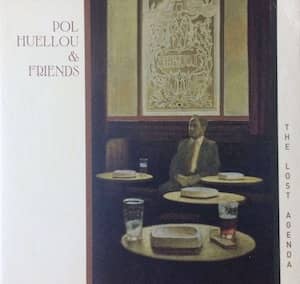
 Pol Huellou & Friends: The Lost Agenda
Goasco Music – 2017
As we see the publication of various end-of-year polls and lists e.g., Best Emerging Artist of the Year, Best Live Act, should there be an, admittedly oxymoronic, “Impossible to Define, Genre-Defying” Category, then The Lost Agenda, the latest release from Pol Huellou would most probably be a contender.
Jean-Paul Huellou, is a Breton musician, singer, lyricist and political activist with a healthy passion not only for his homeland region but also for Ireland, in addition to being an expert player of Japanese traverse and shakuhachi flutes, with the “Friends” appearing being luminaries of the Celtic/Breton world.
At a surface level, his music could be viewed as a synthesis of Japanese, Celtic and Breton influences, but this would be trite and be doing an injustice to what is presented in this release. On the first hearing, I was less than enamoured by this CD; I found it unstructured, incoherent and “difficult”, such was the way that the disparate offerings followed each other. Now, several plays later, I realise that this is probably the great strength of this intriguing collection. Huellou is a type of “sonic alchemist” who appears to be happy to confound and confuse.
Opening track Fortune My Foe, attributed to John Downland (1563-1626), the somewhat mournful song was current by 1589 and was alluded to by Shakespeare in The Merry Wives of Windsor. Sometimes known as the Hanging Tune, the melody was also often played at funerals in the 17th and 18th Centuries. Whereas original iterations would have been arranged for lute, on this recording recorder, guitar, acoustic bass and keyboards provide sympathetic backing to Pol‘s plaintive vocals.
It might be reasonable to assume on viewing Planxty Irvine/Se Bheag Se Mhor as the next set, by the 17th-century blind Irish harpist Turlough O’Carolan, that, given the line-up of artists and instruments, a traditional rendition, possibly involving whistle, bodhran and harp, would ensue. Rather, Pol proposes a version which utilises just a sanza, a type of African thumb piano also known as a kalimba or karimba, guitar and chromatic accordion. How successfully it works too, and not just in an Afro-Celt Sound System way. This version breathes new life into the tunes and really should be heard.
Phil Coulter’s The Town I Loved So Well, written about his childhood experiences in Londonderry during ‘The Troubles’ might seem an odd choice for someone hailing from Britanny, as he sings,
“Now what’s done is done and what’s won is won
And what’s lost is lost and gone forever
I can only pray for a bright brand new day”
Lyrics such as these, however, paint an unfortunately depressing view of past world events which transcend just one specific location and time. Minimal instrumentation allows Pol‘s voice to be shown off at its magnificent best. Weighing in somewhere between Lee Marvin and Tom Waits, the album credits photo of him clutching, possibly, a Gitane, maybe help to paint the picture.
For those who fall into the ‘traditional version only’ camp, you may wish to turn away now, as the next track, The Star of Co. Down again moves a continent or two away from versions such as those of The Pogues, not least because here lyrics are eschewed. Once again Pol’s sanza playing is to the fore, and is joined by Vasken Solakian‘s u’d (oud) and Paul Rodden‘s banjo to produce a tune that mixes, as a minimum, Arabic, African, Appalachian and Celtic influenced sounds.
Almost as if defiantly stating that there was a lack of musical diversity within the album so far, Pol next challenges the listener by giving way to Michele Kerthoas, whose rendition of Marlene Dietrich’s 1933 Moi, j’m’ennuie is delivered in a jazzy chanson-style, with acoustic bass, bass clarinet, keys and a fine guitar solo.
The opening track on Serge Gainsbourg’s 1962 No. 4 vinyl LP, the intriguingly-titled Les Goemons, (Seaweed), is rendered here as beguiling and entrancing, with lilting acoustic guitar, accordion and flutes, a reflection of his being based on the coast of Britanny and the inspiration that he admits he now gains from the sea and landscapes.
Don’t get comfortable, though. Just eur gigolo (not a mis-spelling) is based upon Just A Gigolo, made famous by Louis Prima in 1956. This version owes much to Fats Waller‘s piano-playing style, (not surprising as he recorded it too), with bass clarinet, thumping acoustic bass and jazz guitar adding to the fun. It wouldn’t be in keeping with the rest of the album, however, if there wasn’t a twist – and there is –Jochen Vogel playing his Celtic harp in swing style!
Next up, Cailín Deas Crúite Na mBó, a traditional 18th-century Irish ballad, is the closest the album gets to what is usually described as traditional Breton/Celtic/Irish music, opening with gorgeous Celtic harp before Pol’s enchanting tin whistle playing enters, with low-key swirling keyboards in the background, all combining to evoke romantic, Celtic landscapes.
With The Pretty Girl Milking Her Cow, we are treated to an up-tempo swing-jazz style performance, with Pol duetting vocally with Michele, followed by a tin whistle and bodhran instrumental break having a definite Celtic influence, before returning for a jazzy ending.
The penultimate track, The Tube has only u’d and harmonic flute mentioned in the instrumentation credits. It is, nevertheless, a rhymic mix worthy of ethno/world fusion artists such as Transglobal Underground. Another, fine piece in this melange of an album. There is no let up in terms of surprises as we reach the final track, Let’s Blues It, a traditional Armenian song with an overall sound akin to high-quality Toureg desert blues, notwithstanding the Japanese shakuhachi flute.
One track on this album contains lyrics which tranlate as “I’m bored”, that is certainly not a criticism that can be levelled after listening to this innovative and eclectic album. Take the plunge, but please just don’t judge it on one listening.