
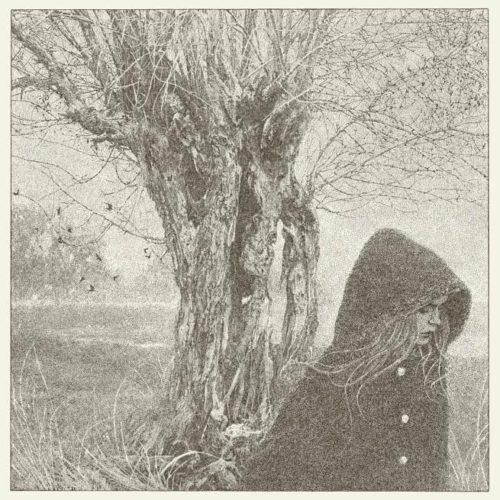
 Lankum – Between the Earth & The Sky
Rough Trade – 27 October 2017
A change of name can be a big thing for a band. Building up a fanbase means building up a musical identity and an identity of image: a brand, for want of a better word. This can take years of touring, performing, recording, and doing all the behind-the-scenes witchcraft that makes everything tick. To change your name after all this hard work can feel like an act of self-sabotage. So when the change comes about due to perceived moral necessity rather than as any marketing or legal decision, it is an especially brave call. Dublin folk rabble-rousers Lynched had been turning heads and impressing critics for a few years when they felt they could no longer ignore the ‘unavoidable implications [their name had] in regards to acts of racist violence’. No offence had been meant – the name was a play on the surname of brothers and founding members Ian and Daragh Lynch – but nonetheless, they took the important, and entirely correct, step to distance themselves from those implications.
So, what was once Lynched is now Lankum. The new name ditches any objectionable overtones, but it doesn’t lose the hint of darkness that is part of the band’s appeal: Lankum is the bloodthirsty protagonist of one of the more disturbing murder ballads. And thankfully the quality of recorded output has not suffered in the least. The four-piece – the brothers were joined by Cormac MacDiarmada and Radie Peat in 2012 – play a brand of folk music far removed from the staid, polite and essentially backwards-looking stereotypes associated with the genre. Their influences range from the obvious (the manic punk-folk of the Pogues) to the downright eccentric (their use of modernistic drone would have made LaMonte Young proud) via saucy snippets of music-hall and driving Krautrock rhythms.
Between The Earth And Sky’s opening track, What Will We Do When We Have No Money, begins with one of those drones, an earthy, deep, almost lewd sound played on uilleann pipes. Peat’s singing is raw and ragged and bears comparison with the likes of Hedy West or Jean Ritchie. It makes for an attention-grabbing, startling beginning. The song is a traditional travellers’ ballad, found in County Tipperary, but in this incarnation, it has an uncanny timelessness that is simply spine-tingling.
Sergeant William Bailey (recently premiered on Folk Radio UK), a traditional rebel song once performed by the Wolfe Tones, gets a stirring makeover. The combination of martial percussion and the band’s signature tin whistle gives a raucous, kinetic feel to the song’s conclusion. Peat Bog Soldiers is a more recent protest song, originally written in German and sung by early political opponents of the Third Reich. Lankum’s version is a heartfelt a capella piece which showcases the group’s often overlooked talent for harmony singing in the style of bands like the Watersons.
The Townie Polka is an intriguing original composition which meanders over a drone for seven minutes, an unhurried, serpentine piece that grows and shifts almost imperceptibly, while Bad Luck To The Rolling Water begins as a purely vocal piece before becoming a brazenly humorous singalong in the style of the Dubliners or the Pogues. It is a perfect example of the marriage of traditional form and modern content, and its themes are both universally recognisable and typically Irish as if the books of James Joyce or J.P. Donleavy had been set to music.
Déanta in Éireann, at more than eight minutes, is another lengthy, drone-based piece. Its lyrics satirise the stereotypical view of the Irishman abroad with a vicious wit, while not shying away from a very real sense of pride. It ends with a send-up of a music-hall tune, and the effect is a kind of postmodern cut-up that links Joyce to the Beatles. It is a stirring, funny, rightly embittered tour-de-force. Following it is The Granite Gaze, a tender and passionate cry which, like a number of songs on this record, grows into something else entirely as a restive and shifting middle section builds steadily then gives way to a final, pained verse.
Perhaps most ambitious of all is The Turkish Reveille which, on the double LP, unfolds over a whole side of vinyl. The song itself is a version of a very old ballad better known as The Golden Vanity, The Green Willow Tree or The Lowlands Low. The sheer amount of space given to the song, its glacial progress to its inevitable (and morally infuriating) conclusion is impressive in itself. There are few art forms that can take so much time to tell such an ambiguous tale and get away with it, fewer still that can do it with such coarse beauty, but in this case, the listener is hooked to the end.
Many of Lankum’s material comes from the American tradition. The Turkish Reveille was collected in the Ozarks, and Willow Garden is a well-known Appalachian murder ballad. But it is no accident that many of these songs, before they crossed the Atlantic, were being sung in Ireland. The cultural cross-pollination between Ireland and the US remains fertile to this day. Willow Garden is a particularly brutal example of the murder ballad: in various versions, the victim is poisoned, stabbed, beaten and buried, and the murderer invariably hangs for his sins. In Lankum’s rendition, Radie Peat’s pained vocal performance – and the implication of the murderer’s father – gives the song a sense of uncertainty, a moral edge. This is a song that has been performed countless times before, by artists as diverse as Charlie Monroe, Ralph Stanley and Bon Iver, but rarely has it sounded this thrilling.
The CD version of Between The Earth And Sky ends on a strange and wonderful note: two minutes of silence followed by an unnamed child singing an unknown, semi-nonsensical shard of a song, simultaneously lighthearted and eerie. It really is an appropriate way to sign off an album that can often be disorienting and strange but is never less than brilliant. Lankum may have a new name, but they are still one of the most talented and original bands around, and this album is a vital, bracing piece of work.
Between the Earth & Sky is available to pre-order now including signed double vinyl via Rough Trade: http://rtrecs.co/BTEAS
Photo Credit: Sarah Flynn