
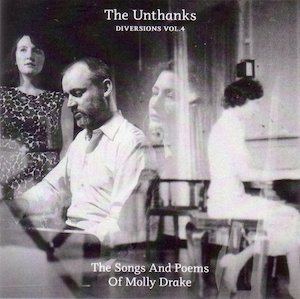
 The Unthanks – Diversions, Vol. 4: The Songs and Poems of Molly Drake
RabbleRouser Music – 26 May 2017
Molly Drake is perhaps best known as the mother of Nick Drake, the uniquely talented, famously fragile and ill-fated songwriter whose three albums attained a status that quickly grew from cult to classic after his death in 1974. But what is less well-known is that Molly was a prolific songwriter and poet in her own right, at a time when that sort of thing was considered a pastime rather than a valid vocation for women. She was born in Rangoon in 1915 and spent much of her life abroad – much of her life’s path was dictated by British colonial activity in South Asia. In 1944, four years before Nick was born, Molly gave birth to a girl, Gabrielle.
Flash forward to the present day. The Unthanks – one of our best and most critically acclaimed of contemporary folk groups – have released three successful albums under the ‘Diversions’ banner. These records represent labours of love, versions of songs by the favourite acts of various band members, and loosely conceptual collections (such as Songs From The Shipyards – a soundtrack to a film about shipbuilding). Now they have decided to have a go at the songs of Molly Drake. But this is no mere covers album. They have enlisted Gabrielle Drake – now in her seventies and with a long acting career behind her – to recite some of her mother’s poems.
Drake’s songs – simple, personal, but full of universal wisdom – prefigure those of Sibylle Baier or Connie Converse, and talk about womanhood and the creative drive in a way that can be compared to the novels and stories of Madeleine Bourdouxhe and Tove Jansson. She has a refreshing disregard for structural convention, and her songs twist around pure melodies which take very little from the popular song or even the folk music of the time. The piano-led What Can A Song Do For You, for example, begins as a set of clear, almost haiku-like observations before becoming a more profound celebration of creativity. It is all topped off by Gabrielle’s sure-footed recitation of the poem Lost Grief (one of many poems that sit beautifully within the arrangement of a different song, whilst a number of others are left to stand alone.
The north-east accents, natural harmonies and arranging skill of the Unthanks makes them one of the most distinctive sounding bands around. At barely two minutes Dream Your Dreams has the feel of a nursery rhyme or lullaby, but the stately piano and restrained singing imbue it with a layer of calm seriousness. How Wild The Wind Blows is full of mournful violin and clarinet overlaying the minimal, prettily sad piano. Lyrically there is a hint of eastern mysticism in the air – and remember of course that these songs were written long before these things became popular concerns in the English-speaking music world.
Pianist Adrian McNally – Rachel Unthank’s husband – plays perhaps a bigger part on this than on any other Unthanks album. His sombre chords underpin Little Weaver Bird, a song that bears all the lyrical hallmarks of an ancient parable. Bird In The Blue starts with a poem (Lost Blue) spoken over sparse keys and develops into another of those deceptively simple tunes on which Becky and Rachel’s unpolished but nonetheless perfect harmonies thrive. The Road To The Stars is a kind of dramatic centre point of the album, the melody developing and rolling out almost like a narrative song from an old musical. The way its poem – the gnomic Warning To Heroes – grows naturally out of the song gives it a conceptual, almost progressive feel.
Although there is no easily discernible linear narrative to the record, the whole thing hangs wonderfully well together, as if Drake’s lyrics and poems represent a single underlying preoccupation. This is backed up by songs like Set Me Free and its accompanying poem Escape Me Never, which taken together examine two sides of the same coin: freeing oneself from grief and being freed into grief. At the time these songs were written, anyone with a melancholic or depressive nature, particularly women, had no outlet for their feelings other than to produce something in a creative way. But, with cruel irony, creative women often weren’t taken as seriously as their male counterparts, and this would have fed further into any insecurities they may have had. Molly Drake appears fully aware of this vicious circle. Even on short, apparently bucolic songs like Woods In May, there is a sense of doubt alongside the appreciation of natural beauty, and this is something that the Unthanks are able to tease out with minor chords and haunting singing. The whole album has a melancholic feel, a knowledge that Spring will soon become Autumn.
Drake’s songs have a timelessness to them, and none more so than I Remember, a set of short narratives about shared experiences and different perceptions that could easily pass of a great lost track by Sandy Denny. The assuredness of Drake’s songwriting – given the historic period and the social milieu in which she would have found herself – is nothing short of astonishing. Never Pine For The Old Love is similar in its accomplishments, as well as reminding us of Drake’s eye for detail: a red checked tablecloth takes on a meaning that is both mysterious and visceral. Other tracks have a pleasing strangeness: Soft Shelled Crabs uses humour to examine vulnerability. Lyrically it could almost be a solo Syd Barrett track, musically the Unthanks go for a jazzy, Robert Wyatt vibe.
Of the unaccompanied poems – with Gabrielle taking centre stage – Martha is a meditation on mortality and ennui that showcases Molly’s easy way with a memorable phrase, while The Shell bears the mark of the Elizabethan metaphysical poets. But perhaps the album’s most successful moments are those when poetry and song are combined. A real standout is the final track, The First Day. It begins with a gentle splashing of water and a dusty piano melody before the song’s narrator extols the benefits of starting anew, living in the present. The assertiveness is quiet but admirable. Then, towards the end of the song’s seven minutes, Gabrielle recites a poem called A Prayer For Love. The final words outstay the hushing musical backdrop. It is, like much of the record, transcendent in its own unassuming way. Regardless of any societal constraints Molly Drake may have felt in her life, regardless of her unwillingness to publish her own material, she was a consummately gifted songwriter. And in The Unthanks, those songs have found their perfect outlet.
Diversions, Vol. 4: The Songs and Poems of Molly Drake is Out Now.
Order it here: http://www.the-unthanks.com/