
Best Foot Music is an on-going project which documents and promotes music made by people who have come to live in the UK from other places in the world. It started as a hobby in 2009 and in February 2010 I set up as a “not for profit” organisation, with a constitution and committee.
Most of the people we work with are originally from Eastern Europe. I have always been interested in music from the region, although originally didn’t know much about it. It also happens to be where the most visible and recent wave of migrants to the UK have come from. That is not to say we don’t work with people from other places; we do. I am open to anyone, wherever they are from.
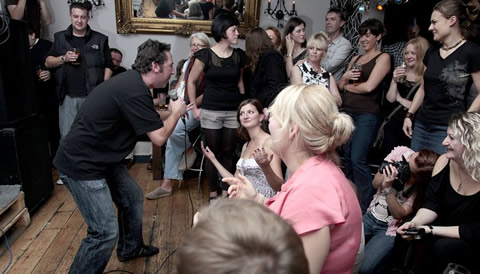
Crowd shot from Polish concert in Brighton – the guy singing was supporting Marysia Band – his name is Piotr, the lady he is looking at with her arms up is Edyta who set up the Polish language radio show in Brighton.
The idea is to facilitate recordings for musicians who would not normally have the opportunity to do so, it’s very much a grass roots project. The musicians record whatever they want. It is important to focus on their decisions not mine. Although there are some criteria; I don’t work with people who sing in English and there has to be a connection to the roots or culture of the countries the musicians originate from. For example we don’t work with rock or indie bands. That said one of the Roma (Gypsy) bands we work with do everything from old folk songs to the occasional house/dance track, but even these are re-workings of traditional songs. Some of the younger members of their community are quite keen on Hip Hop, but they rap in Romani and will include traditional instruments in the music, so there is still a distinct cultural identity to what they do.
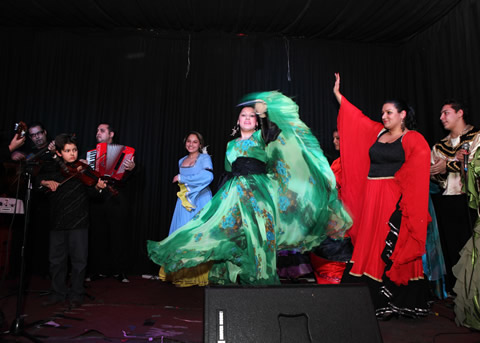
Gypsy Stars live in Brighton
The project was inspired by a couple of contrasting events. Firstly in 2007 I went to Istanbul for an English friend’s wedding. He married a Turkish American woman who lived there. I fell in love with the city and have visited several times. After every trip I always arrived back in the UK with a bag of CD’s. Not just Turkish music, but recordings from all over the Balkan region. Influenced by the music I was hearing, I began dreaming of travelling around Eastern Europe and making field recordings of folk musicians. It was never more than a dream. It wasn’t financially possible and I have a full time teaching job. Not to mention no connections in that part of the World. Besides there are hundreds of perfectly good recordings already in existence: what would be the point?
The other event that triggered the project was rather sad. In 2008, some of the British newspapers where regularly printing negative stories about migrants from Eastern Europe ranging from the usual ‘taking our jobs’ to the ridiculous ‘eating our swans’. I started thinking it would be good idea to do something positive, to counteract the negative stereotypes portrayed in the press. Then an article on the evening news, finally gave me the idea. Somewhere in Britain (I forget where) families of Romanians where being bused away from the area they’d settled in due to harassment from some sections of the local community. For a few seconds the camera cut to a guy getting on a bus. He was wearing a brown leather jacket and had black hair, that’s about all you could see. Apart from that, (most importantly) he was carrying an Accordion. That was it, I realised I didn’t need to travel to Eastern Europe to find musicians. They were, as certain papers where keen to remind us; coming here.
Marysia Band
A few nights after the Accordion guy had been on the news, I’d passed a Polish cafe, noticing a woman putting up a poster for a live music night, staring Marysia Band. We had a brief chat, and she said I should come along Friday. The gig only seemed to be publicised in the Polish shops and cafe, and there was nothing on the internet, so I had no idea what to expect.
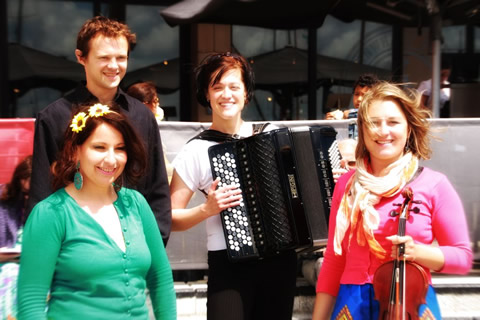
Marysia Band – Portsmouth street festival – Marysia (vocals/Guitar), Ol (Bass)i, Ema (Accordion) and Asia (Violin)
I live in Brighton, there are a lot of gigs here. I was beginning to wonder if I liked going to see live music anymore. Any night of the week you could see formulaic bands playing variations of the same music. The crowd would shuffle around; too busy looking cool or miserable to inspire any real excitement.
The following Friday night Marysia Band completely changed that for me. There were about 150 people there, all Polish, Czech or Slovak. It was akin to watching a lower league football crowd getting really behind their team whilst winning the FA cup at Wembley. Everyone sang and danced, no one was too self-conscious to show their support. The music was a mixture of Polish pop and folk songs. The band consisted of female vocals, acoustic guitar, violin, bass, flute and piano. The piano player has since left and been replace by accordion, giving them a more traditional folk sound. The climax of the evening was “Hej Sokoly” a traditional Polish/Ukrainian song, which was popularised by soldiers during the Polish Soviet war of 1919 – 21. It tells the story of a woman saying farewell to her lover for the final time as he leaves for battle. It’s a sad song, which starts slowly and builds to a crescendo, by which time the whole crowd were waving their arms and singing along. I’ve since made live recordings of this song, and you can barely hear the band, such is the enthusiasm of the crowd.
The Marysia Band concert opened my eyes to something new. On our doorsteps in Brighton was a vibrant live band (and fans) which was totally different to anything I’d seen before. Although the lyrics were in a language I couldn’t understand, it didn’t matter, the melodies where catchy. The songs are meant to be a shared experience, sang together with friends in moments of celebration.
We made our first recordings with Marysia Band in January 2009.
Gypsy Stars
There are a lot of East European Romani in London. My friend Dudek, who runs the Gypsy Stars estimates there are between 200 to 300 hundred Polish Roma families living in the capital.
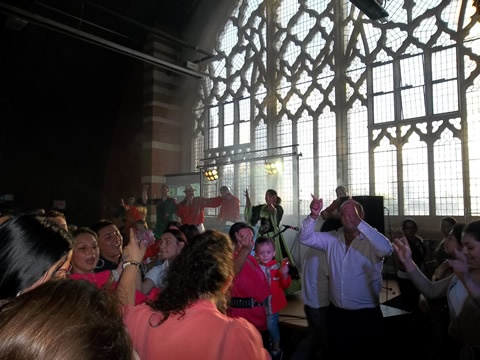
Crowd shot – Roma festival, London
There are Roma from several ex-Communist countries in the UK, but most of the people Dudek knows well come from Poland. Although when we’ve organised festivals there have been Roma from Poland, Hungary, Czech Republic, Slovakia, Russia and Romania. There are Roma communities from Eastern Europe in many UK towns and people have travelled from all over to some of the events we’ve held in London (from as far as Scotland and Northern Ireland). The incredible thing is, nearly all the promotion is word of mouth.
Dudek and his family have Polish passports, but don’t see themselves as Polish. Although they can speak Polish, their first language is Romani. There are many dialects, but the roots of their language are from northern India, where the Romani people originally came from.
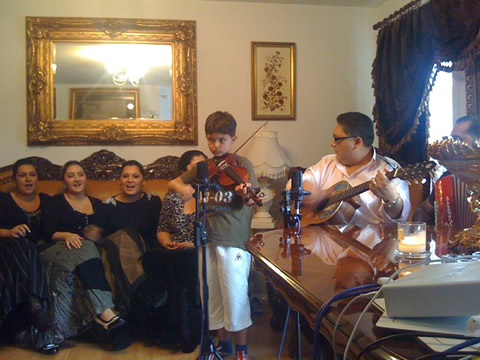
Recording with Gypsy Stars in Dudek and Beata’s flat – thats Blanko, their son on violin. Dudek on guitar
Before the war, Dudek’s family had lived in Hungary, Russia and Poland. They had been nomadic until the mid 60’s when the Polish government had forced all the Roma in Poland to settle. The Roma Dudek knows, started coming here in the early 90’s shortly after the collapse of Communism. Danny the guitarist in the band told me the men came here first to see how it was, but often found themselves in detention centers. They later started coming with their wives and children as this made it easier to claim asylum (there is unfortunately a lot of prejudice against them in many East European countries).
The current incarnation of the band was started by Dudeks grandad, and as older members have retired from playing, new younger members have joined, so the culture and music is passed down through the generations. Blanko (Dudek’s son) is 11 and already a talented violinist. He has been playing with the band for a few years. His mum and Dudek’s wife Beata is one of the main vocalists. One of the earliest recordings of the band, on our website is from a tape Dudek gave me of his Dad and uncle. They had paid someone to smuggle them out of Poland in 1982, and met a guy in West Germany with a four track tape machine who’d agreed to record them. They spent the next few years busking around Europe.
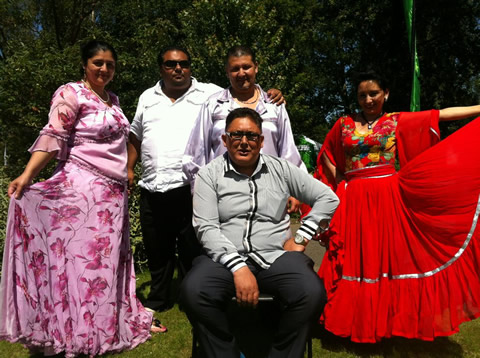
Some of Gypsy Stars at Crawley Mela 2012 Left to Right – Beata , Rafo, Dudek, Danny, Madyna
I first met Gypsy Stars when they were busking one evening in Brighton. They often travel around the UK to busk in summer. It was just the men; violins, accordions and guitars. The women usually sing and don’t go busking. I think there was maybe 8 to 10 of them walking around Brighton, stopping outside bars and cafes, playing a few tunes then going round with a hat. It was a real chance meeting; it was getting late and they would be soon on their way back to London, I was running late for a friend’s birthday. If I’d been a better timekeeper I would have been sat in a pub and missed them. As soon as I saw them I recognised they were Roma and knew one of the tunes they were playing, so I just went up to them to have a chat. Right from the beginning they were friendly and open with me; they have a reputation for being wary of outsiders (non Roma, or Gadjo as they call us in their language). I’ve never seen this and have always been made to feel welcome by the Roma people I’ve met. Often when we record at their houses in London, we’ll make stops to pick up musicians at family and friends houses on the way to wherever we are recording. Often these stops will be a mini social occasion, with food and coffee, they are always keen for me to try the food and share with them. The recording sessions themselves are always a pleasant occasion, people will come round for a chat, to join in the playing or just to sit and listen.
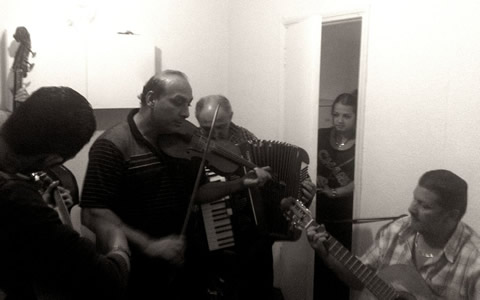
Recording with some of Gypsy Stars – this is from a session at one of their houses – I just put mics in the room and they played
The night I met the band, one of the guys gave me a can of beer, told me to go and sit on a nearby bench until they’d finished playing, then we could chat more. We swapped phone numbers, and a few days later, Dudek called me and I arranged for them to come down to the music college I work in, so we could do a day recording. It wasn’t long enough, as I don’t think they’d been in a studio before and at first it was a slow process. There was a bit of a language gap, as when I first met him his English wasn’t great, and I didn’t know any Romani or Polish. Somehow that’s never been a problem, and a couple of weeks later I went up to London with a portable recording equipment to record them in their flat. Over the last couple of years, I’ve learned a few bits of Romani and Polish, and Dudek has improved his English. One of the nice things about the whole project, is we have now become real friends and I feel privileged that a chance meeting led to becoming involved with so many talented and warm hearted people.
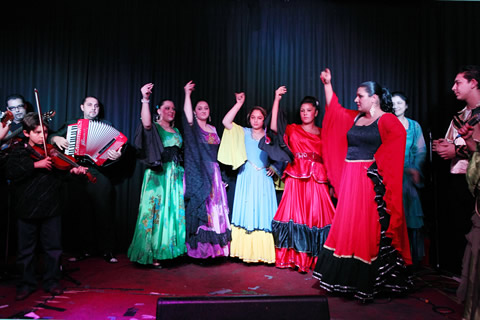
Gypsy Stars live in Brighton
Best Foot Music is an ongoing project which documents and promotes musicians who have come to the UK from other regions in the World.
Discover a whole new world of music here:
www.bestfootmusic.net
Facebook